
[Paper Review] Deductive Verification of Chain-of-Thought Reasoning
The paper introduces Natural Program, a natural-language deductive reasoning format, to enable step-by-step verification of each reasoning step in LLMs, and combines it with a Unanimity-Plurality Voting scheme to improve rigor, trustworthiness, and interpretability of chain-of-thought reasoning. Evaluations on arithmetic and commonsense datasets show higher verification accuracy with stepwise, premise-minimized verification, with on-par or better final answers in many cases, and occasional slight drops when applying full verification.
Large Language Models (LLMs) significantly benefit from Chain-of-Thought (CoT) prompting in performing various reasoning tasks. While CoT allows models to produce more comprehensive reasoning processes, its emphasis on intermediate reasoning steps can inadvertently introduce hallucinations and accumulated errors, thereby limiting models' ability to solve complex reasoning tasks. Inspired by how humans engage in careful and meticulous deductive logical reasoning processes to solve tasks, we seek to enable language models to perform explicit and rigorous deductive reasoning, and also ensure the trustworthiness of their reasoning process through self-verification. However, directly verifying the validity of an entire deductive reasoning process is challenging, even with advanced models like ChatGPT. In light of this, we propose to decompose a reasoning verification process into a series of step-by-step subprocesses, each only receiving their necessary context and premises. To facilitate this procedure, we propose Natural Program, a natural language-based deductive reasoning format. Our approach enables models to generate precise reasoning steps where subsequent steps are more rigorously grounded on prior steps. It also empowers language models to carry out reasoning self-verification in a step-by-step manner. By integrating this verification process into each deductive reasoning stage, we significantly enhance the rigor and trustfulness of generated reasoning steps. Along this process, we also improve the answer correctness on complex reasoning tasks. Code will be released at https://github.com/lz1oceani/verify_cot.
Motivation & Objective
- Motivate and enable rigorous deductive reasoning in LLMs to reduce hallucinations and errors in Chain-of-Thought (CoT).
- Propose a Natural Program format that explicitly lists minimal premises per reasoning step for verifiability.
- Develop stepwise verification by analyzing only necessary context, and integrate with voting to improve trust in final answers.
- Empirically validate the approach on diverse reasoning benchmarks using GPT-3.5-turbo, demonstrating improved rigor and interpretability.
Proposed method
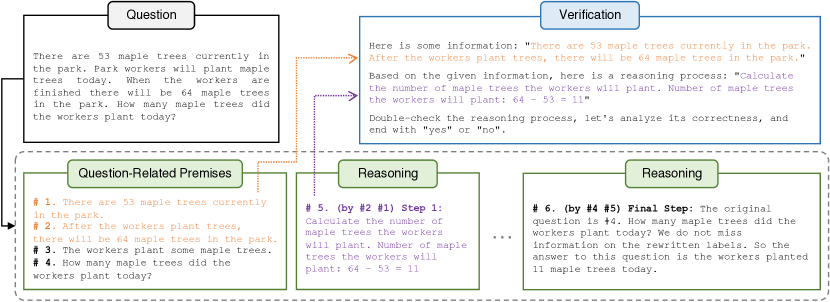
- Introduce Natural Program: a structured, natural-language format that lists question-related premises and stepwise reasoning with explicit premise usage.
- Decompose deductive verification into per-step validity V(s_i) using minimal required premises p_i, enabling local verification.
- Perform single-step validity checks with prompts that include premises, the step description, and a verification instruction; use one-shot prompts for reliability.
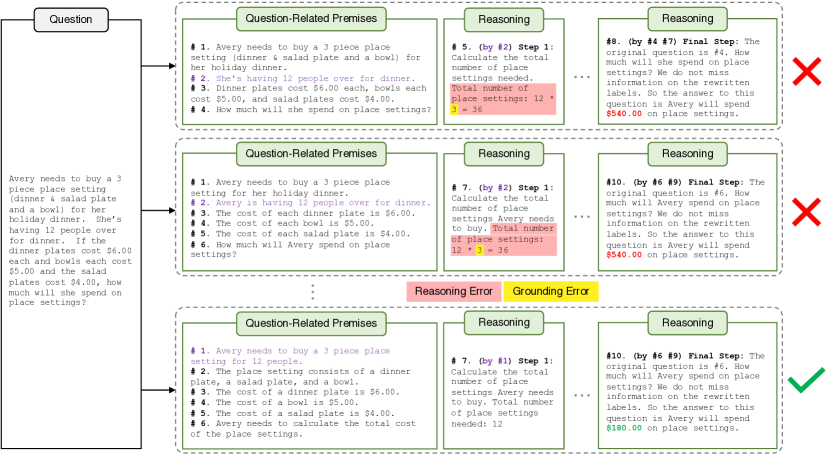
- Apply Unanimity-Plurality Voting (UPV): unanimity phase filters chains where all steps are valid, then plurality voting determines the final answer among verified chains.
- Evaluate two regimes: (i) Natural Program reasoning without full verification, (ii) NP reasoning with deductive verification and UPV; compare to CoT and Faithful CoT baselines on several datasets.
- Datasets include GSM8K, AQuA, MATH, AddSub, Date, and Last Letters.
Experimental results
Research questions
- RQ1Can LLMs verify the deductive validity of each reasoning step when reasoning in Natural Program format?
- RQ2Does stepwise, premise-minimized verification improve the rigor and trustworthiness of reasoning compared to end-to-end verification?
- RQ3How does integrating deductive verification with UPV affect final answer accuracy and robustness across tasks?
- RQ4What is the impact of using minimal premises versus full premises on verification accuracy?
Key findings
- Natural Program-based verification significantly improves stepwise reasoning verification accuracy across most datasets.
- Minimal premises per step markedly improve verification performance compared to using all premises, reducing distraction from irrelevant context.
- Increasing the number of votes in single-step validity (k') generally improves verification accuracy, at the cost of more computation.
- Prompting models in Natural Program format yields on-par or better final answer accuracy than baselines on many tasks, even before verification.
- Applying full deductive verification can slightly reduce final answer accuracy by filtering out chains that produce correct answers but with flawed reasoning, though it boosts reasoning rigor.
- Ablations show that premise minimization and UPV settings materially influence both verification accuracy and final outcomes.
Read this paper
Open the full text in the Nubint reader and ask about any passage as you read.
Read this paper on NubintThis review was generated by AI from the original paper. Please check the paper before citing it.