
[Paper Review] Deep Affordance Foresight: Planning Through What Can Be Done in the Future
This paper proposes Deep Affordance Foresight (DAF), a learning-to-plan framework that extends classical affordances to model future action feasibility, enabling long-horizon robotic manipulation. By learning a latent dynamics model and affordance predictor from pixel inputs, DAF plans multi-step tasks with high success rates, outperforming prior methods on complex tasks like pouring liquids and tool use.
Planning in realistic environments requires searching in large planning spaces. Affordances are a powerful concept to simplify this search, because they model what actions can be successful in a given situation. However, the classical notion of affordance is not suitable for long horizon planning because it only informs the robot about the immediate outcome of actions instead of what actions are best for achieving a long-term goal. In this paper, we introduce a new affordance representation that enables the robot to reason about the long-term effects of actions through modeling what actions are afforded in the future, thereby informing the robot the best actions to take next to achieve a task goal. Based on the new representation, we develop a learning-to-plan method, Deep Affordance Foresight (DAF), that learns partial environment models of affordances of parameterized motor skills through trial-and-error. We evaluate DAF on two challenging manipulation domains and show that it can effectively learn to carry out multi-step tasks, share learned affordance representations among different tasks, and learn to plan with high-dimensional image inputs. Additional material is available at https://sites.google.com/stanford.edu/daf
Motivation & Objective
- Address the challenge of long-horizon planning in high-dimensional robotic environments with combinatorial action spaces.
- Overcome the limitations of classical affordances, which only model immediate action feasibility and ignore long-term task goals.
- Develop a method that reasons about which actions are optimal not just now, but for future task achievement.
- Enable end-to-end training from raw RGB observations to model complex dynamics such as liquid pouring.
- Facilitate transfer learning by sharing task-agnostic affordance representations across different manipulation tasks.
Proposed method
- Introduce a relaxed affordance definition that models action feasibility without requiring immediate success, focusing instead on future feasibility after action execution.
- Learn a latent dynamics model to predict future latent states conditioned on executed skill plans.
- Train an affordance prediction model to evaluate the feasibility of actions at both current and future latent states.
- Combine the latent dynamics and affordance models to select multi-step plans that maximize the likelihood of achieving the task goal.
- Use a ResNet encoder with Spatial-Softmax and MLP for image observation encoding, enabling end-to-end training from pixels.
- Train the framework via trial-and-error using a reward-based curriculum, allowing incremental environment model building.
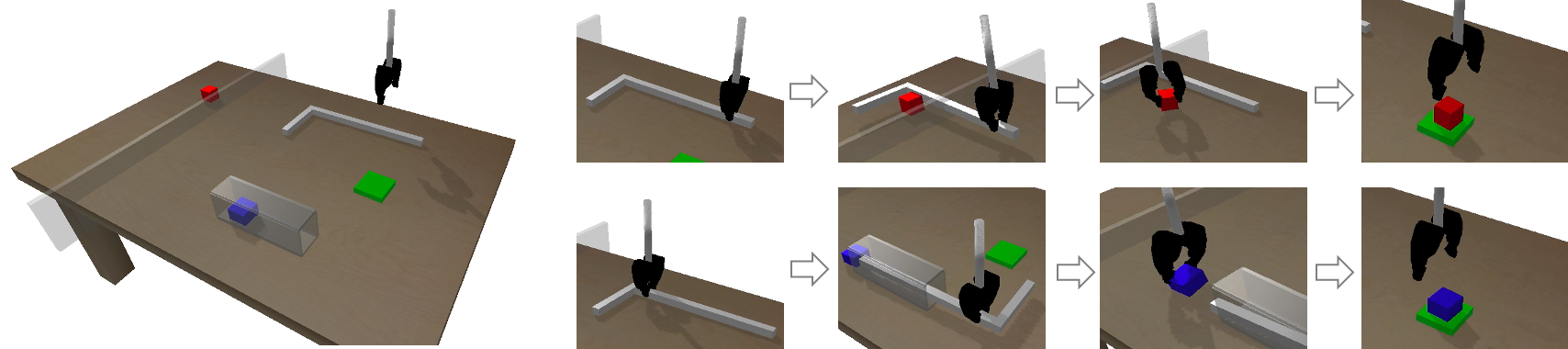
Experimental results
Research questions
- RQ1Can affordance representations be extended to model long-term action consequences, enabling better planning for multi-step tasks?
- RQ2How can a robot learn to select actions that are not only feasible now but also lead to future action feasibility toward a goal?
- RQ3Can a single, task-agnostic affordance representation be shared across multiple tasks to enable efficient transfer learning?
- RQ4To what extent can a model trained on raw image inputs learn complex dynamics such as liquid pouring for manipulation tasks?
- RQ5How does the proposed method compare to existing latent-space planning approaches in terms of sample efficiency and success rate on complex tasks?
Key findings
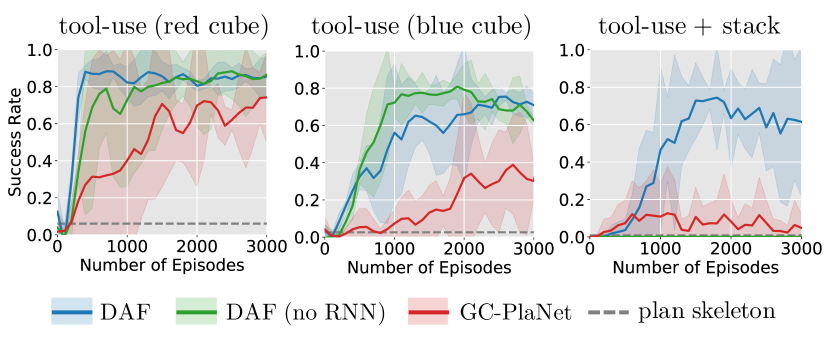
- DAF achieved a 0.6 success rate in learning the complex get-coffee task within 1500 episodes, significantly outperforming GC-PlaNet, which plateaued below 0.2.
- DAF demonstrated low performance variance, with high success rates on the simpler get-tea task, while GC-PlaNet showed higher instability.
- When finetuned from a pre-trained get-tea policy, DAF learned the get-coffee task in just 300 episodes, showing strong transferability.
- In contrast, GC-PlaNet showed no significant improvement when finetuned, indicating that DAF’s task-agnostic affordance representation enables effective knowledge transfer.
- DAF successfully learned to plan with high-dimensional image inputs and model complex dynamics such as liquid pouring, which are difficult to define manually.
- The method enabled joint learning of both get-tea and get-coffee tasks from raw visual observations, demonstrating robustness and generalization in challenging manipulation domains.
Read this paper
Open the full text in the Nubint reader and ask about any passage as you read.
Read this paper on NubintThis review was generated by AI from the original paper. Please check the paper before citing it.