
[Paper Review] Deep Convolutional Neural Networks with Zero-Padding: Feature Extraction and Learning
This paper demonstrates that deep convolutional neural networks with zero-padding (eDCNN) outperform fully connected networks (DFCNs) and non-padded convolutional networks (cDCNNs) in feature extraction by inherently encoding translation-equivalence and enabling universal approximation. Theoretical analysis and experiments confirm eDCNN's superior generalization and invariance properties, especially with pooling, across diverse datasets including WISDM and ECG data.
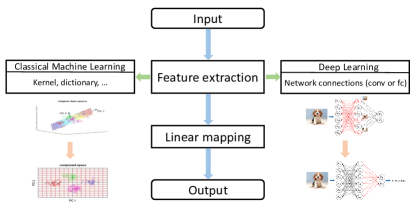
This paper studies the performance of deep convolutional neural networks (DCNNs) with zero-padding in feature extraction and learning. After verifying the roles of zero-padding in enabling translation-equivalence, and pooling in its translation-invariance driven nature, we show that with similar number of free parameters, any deep fully connected networks (DFCNs) can be represented by DCNNs with zero-padding. This demonstrates that DCNNs with zero-padding is essentially better than DFCNs in feature extraction. Consequently, we derive universal consistency of DCNNs with zero-padding and show its translation-invariance in the learning process. All our theoretical results are verified by numerical experiments including both toy simulations and real-data running.
Motivation & Objective
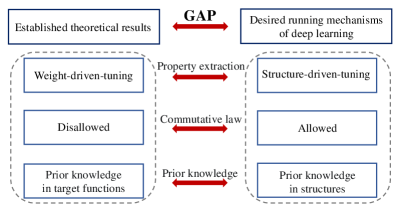
- To address the gap between theoretical analysis and practical design of deep neural networks by clarifying why structured networks like DCNNs with zero-padding outperform fully connected networks.
- To establish that zero-padding enables eDCNN to achieve universal approximation and translation-equivalence without relying on training, unlike DFCNs.
- To demonstrate that eDCNN overcomes the limitations of cDCNN (which contracts feature width and loses edge information) by maintaining feature universality through zero-padding.
- To provide theoretical consistency and empirical validation for eDCNN’s superior performance in learning tasks involving temporal and spatial invariance.
- To guide network design by identifying optimal configurations (zero-padding, pooling, depth) for specific learning tasks based on theoretical and experimental evidence.
Proposed method
- Proposes eDCNN (expanded DCNN with zero-padding) to counteract the contracting behavior of cDCNN, enabling feature width preservation and universal feature extraction.
- Theoretically proves that any DFCN with similar parameter count can be represented by eDCNN, showing eDCNN’s structural superiority in feature representation.
- Analyzes the roles of zero-padding (enabling translation-equivalence), pooling (inducing translation-invariance), and bias vectors in enhancing learning performance.
- Derives universal consistency of eDCNN, showing convergence in learning under appropriate network depth and structure.
- Employs numerical experiments on WISDM and ECG datasets using Adam optimizer, batch size 512, and varying depths (1–10) to compare eDCNN, cDCNN, DFCN, and hybrid models.
- Uses max pooling with kernel size 2 after convolutional layers in 'eDCNN+pl' configuration to enhance invariance and performance.
Experimental results
Research questions
- RQ1How does zero-padding in DCNNs affect feature extraction and translation-equivalence compared to fully connected networks?
- RQ2Can eDCNN with zero-padding universally approximate any function that DFCNs can, while preserving structural invariance?
- RQ3What is the role of pooling in inducing translation-invariance in eDCNN, and how does it affect learning performance?
- RQ4How does eDCNN compare to cDCNN and DFCN in extracting features from temporal data such as ECG and WISDM datasets?
- RQ5What network configurations (depth, pooling, zero-padding) yield optimal generalization and accuracy in real-world learning tasks?
Key findings
- eDCNN with zero-padding achieves universal approximation and can represent any DFCN with similar parameter count, proving its structural superiority in feature extraction.
- eDCNN maintains feature width across layers, unlike cDCNN, which contracts features and fails to extract edge-based features, limiting its universality.
- On the WISDM dataset, 'eDCNN+pl' achieved the highest test accuracy across all depths (1–10), outperforming DFCN and 'cDCNN+fc' by preserving temporal structure.
- On the MIT-BIH Arrhythmia dataset, 'eDCNN+pl' achieved the highest and most stable test accuracy, demonstrating robustness to depth and strong invariance learning.
- cDCNN and 'cDCNN+fc' underperformed due to information loss at feature edges without zero-padding, especially when bias was not used.
- The PTB ECG dataset showed that DFCN performed poorly, while eDCNN and its variants achieved high and consistent accuracy, indicating eDCNN’s suitability for complex signal learning.
Read this paper
Open the full text in the Nubint reader and ask about any passage as you read.
Read this paper on NubintThis review was generated by AI from the original paper. Please check the paper before citing it.