
[Paper Review] Deep Coupling Network For Multivariate Time Series Forecasting
This paper proposes DeepCN, a novel deep coupling network for multivariate time series forecasting that jointly models multi-order intra- and inter-series relationships using a coupling mechanism based on mutual information. By explicitly capturing hierarchical couplings across orders and integrating a coupled variable representation module with a one-step inference mechanism, DeepCN achieves state-of-the-art performance on seven real-world datasets, outperforming existing GNN- and Transformer-based models.
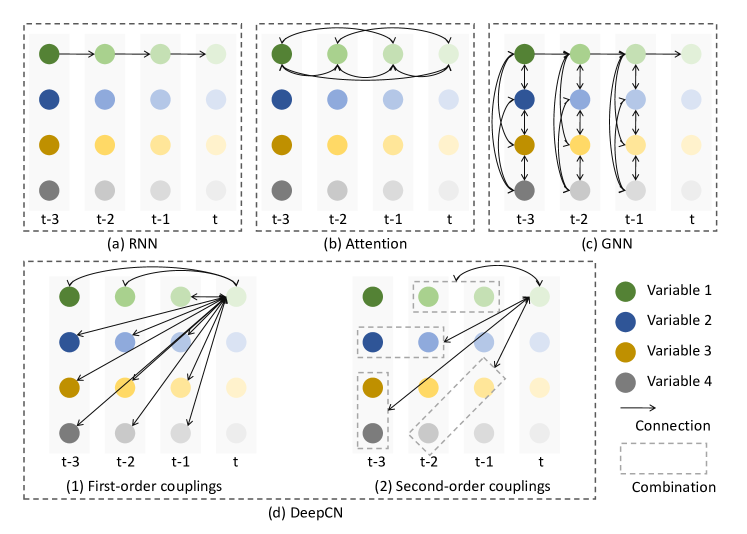
Multivariate time series (MTS) forecasting is crucial in many real-world applications. To achieve accurate MTS forecasting, it is essential to simultaneously consider both intra- and inter-series relationships among time series data. However, previous work has typically modeled intra- and inter-series relationships separately and has disregarded multi-order interactions present within and between time series data, which can seriously degrade forecasting accuracy. In this paper, we reexamine intra- and inter-series relationships from the perspective of mutual information and accordingly construct a comprehensive relationship learning mechanism tailored to simultaneously capture the intricate multi-order intra- and inter-series couplings. Based on the mechanism, we propose a novel deep coupling network for MTS forecasting, named DeepCN, which consists of a coupling mechanism dedicated to explicitly exploring the multi-order intra- and inter-series relationships among time series data concurrently, a coupled variable representation module aimed at encoding diverse variable patterns, and an inference module facilitating predictions through one forward step. Extensive experiments conducted on seven real-world datasets demonstrate that our proposed DeepCN achieves superior performance compared with the state-of-the-art baselines.
Motivation & Objective
- To address the limitation of existing models in jointly modeling intra- and inter-series relationships in multivariate time series (MTS) forecasting.
- To overcome the separate modeling of intra- and inter-series dependencies, which fails to capture unified, complex couplings in real-world data.
- To explicitly model multi-order interactions (first to fourth order) within and between time series, including time lag effects.
- To develop a unified framework that captures diverse, disentangled couplings for richer representation learning.
- To improve forecasting accuracy and stability through a one-forward-step inference mechanism that avoids error accumulation.
Proposed method
- Proposes a coupling mechanism based on mutual information to model multi-order intra- and inter-series relationships simultaneously.
- Introduces a coupled variable representation module to encode diverse variable patterns across different time series.
- Designs a one-forward-step inference module to enable efficient and stable multi-step forecasting without error accumulation.
- Leverages dense representations of couplings at different orders (ℓ = 1 to 4) and computes weight matrices via $ W_{\text{vis}}^{(\ell)} = \mathcal{X}^{(\ell)} \times (\mathcal{X}^{(\ell)})^T $ for visualization and analysis.
- Employs t-SNE and heatmap visualizations to demonstrate that different order couplings are disentangled and contribute uniquely to representation learning.
- Uses a graph-based coupling structure to model complex dependencies, explicitly accounting for time lags between variables.
Experimental results
Research questions
- RQ1How can multi-order intra- and inter-series relationships in multivariate time series be effectively modeled in a unified framework?
- RQ2What is the relative contribution of different order couplings (first to fourth) to forecasting performance across diverse datasets?
- RQ3Can a coupling mechanism based on mutual information improve representation learning beyond traditional RNNs, Transformers, or GNNs?
- RQ4How does explicit modeling of time-lagged interactions enhance forecasting accuracy compared to standard models?
- RQ5To what extent do disentangled multi-order couplings lead to more robust and generalizable representations in MTS forecasting?
Key findings
- DeepCN achieves state-of-the-art performance on seven real-world multivariate time series datasets, outperforming existing SOTA models including GNN- and Transformer-based baselines.
- Second- and third-order couplings contribute most significantly to capturing both intra- and inter-series relationships, explaining the strong performance of existing models relying on these orders.
- First- and fourth-order couplings are also indispensable, indicating that modeling all multi-order interactions enhances representation learning.
- t-SNE visualizations confirm that couplings of different orders are disentangled and distinct, supporting the model's ability to learn diverse relationship patterns.
- The one-forward-step inference mechanism improves stability and efficiency in multi-step forecasting by avoiding error accumulation.
- Visualization of coupling heatmaps reveals that the model learns meaningful, structured relationships across variables and time steps.

Read this paper
Open the full text in the Nubint reader and ask about any passage as you read.
Read this paper on NubintThis review was generated by AI from the original paper. Please check the paper before citing it.