
[Paper Review] Deep Generalized Green's Functions
This paper introduces Deep Generalized Green's Functions (DGGF), a neural network-based method that bypasses the Dirac delta singularity in traditional Green's functions to enable stable, mesh-free, and reusable solutions for linear PDEs. DGGF achieves state-of-the-art accuracy and 20,000× faster solution inference than PINNs, while maintaining reusability and low memory footprint across diverse PDE types and domains.
In this study, we address the challenge of obtaining a Green's function operator for linear partial differential equations (PDEs). The Green's function is well-sought after due to its ability to directly map inputs to solutions, bypassing the need for common numerical methods such as finite difference and finite elements methods. However, obtaining an explicit form of the Green's function kernel for most PDEs has been a challenge due to the Dirac delta function singularity present. To address this issue, we propose the Deep Generalized Green's Function (DGGF) as an alternative, which can be solved for in an efficient and accurate manner using neural network models. The DGGF provides a more efficient and precise approach to solving linear PDEs while inheriting the reusability of the Green's function, and possessing additional desirable properties such as mesh-free operation and a small memory footprint. The DGGF is compared against a variety of state-of-the-art (SOTA) PDE solvers, including direct methods, namely physics-informed neural networks (PINNs), Green's function approaches such as networks for Gaussian approximation of the Dirac delta functions (GADD), and numerical Green's functions (NGFs). The performance of all methods is compared on four representative PDE categories, each with different combinations of dimensionality and domain shape. The results confirm the advantages of DGGFs, and benefits of Generalized Greens Functions as an novel alternative approach to solve PDEs without suffering from singularities.
Motivation & Objective
- To overcome the singularity challenge in traditional Green's functions for linear PDEs, which limits analytical and numerical computation.
- To develop a mesh-free, reusable, and efficient alternative to conventional PDE solvers like FDM and FEM that require grid-based discretization.
- To enable stable and accurate neural network approximation of Green's functions without direct modeling of the Dirac delta function.
- To preserve the key advantages of Green's functions—reusability and convolution-based solution construction—while enabling practical deep learning implementation.
- To demonstrate superior performance and stability across diverse PDEs, including Poisson, Helmholtz, and advection-diffusion equations, in 2D and 3D domains with varying boundary conditions.
Proposed method
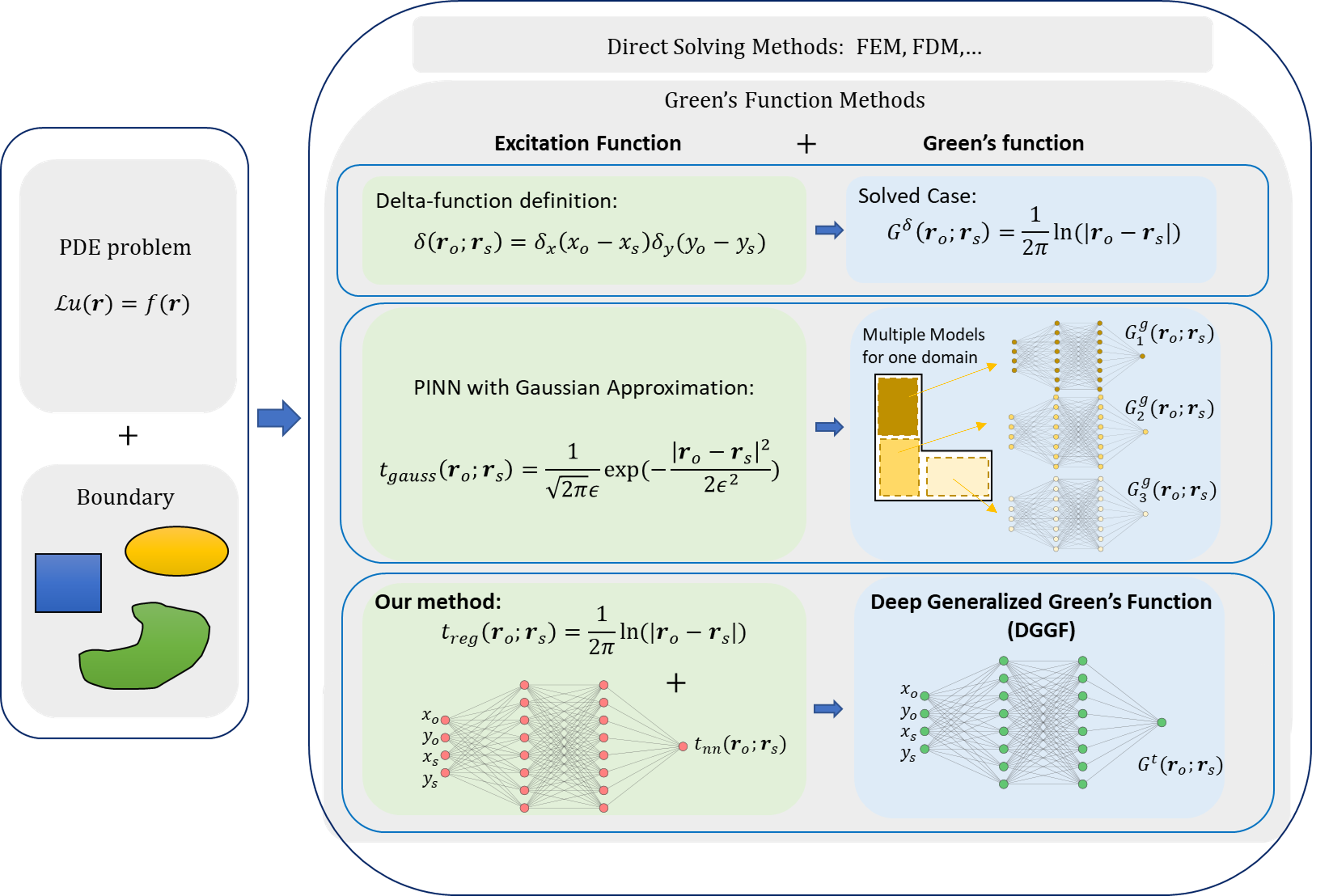
- Propose a generalized Green's function formulation that avoids direct singularity handling by redefining the kernel learning problem to be compatible with neural network optimization.
- Train a deep neural network to learn the generalized Green's function as a differentiable kernel, using residual and boundary loss terms to enforce PDE and boundary condition satisfaction.
- Decompose the training into two stages: first learning the time- or source-dependent component $ G^t $, then refining the full kernel via joint optimization.
- Use a standard 8-layer ReLU network with 100 neurons per layer, trained with ADAM optimizer and no weight decay, for fair comparison with PINNs and GaussNet.
- Implement a loss function combining residual loss $ \ abla^2 G^t = \delta(\mathbf{x}-\mathbf{x}_0) $ in weak form and boundary loss, avoiding explicit delta function evaluation.
- Compare against PINNs, GaussNet (with Gaussian approximations of delta), and numerical Green’s functions (NGF) using identical architectures and hyperparameters for fairness.
Experimental results
Research questions
- RQ1Can a deep neural network learn a generalized Green’s function that avoids the Dirac delta singularity while preserving the theoretical properties of standard Green’s functions?
- RQ2How does the DGGF method compare in accuracy and inference speed to state-of-the-art PDE solvers such as PINNs and GaussNet across diverse PDE types and domains?
- RQ3Does the DGGF method maintain stability across different random weight initializations, particularly in complex or irregular domains?
- RQ4To what extent does the DGGF enable reusable, mesh-free, and low-memory PDE solution construction for linear problems with varying inputs and boundary conditions?
- RQ5Can the DGGF approach achieve high accuracy with significantly reduced computational cost in the solution phase compared to training-intensive methods like PINNs?
Key findings
- DGGF achieves at least three orders of magnitude lower L2 error than GaussNet across all tested PDEs and domain configurations, demonstrating superior learning capability.
- DGGF matches the accuracy of PINNs but achieves solution inference in 0.08 seconds for 2D domains, compared to ~30 minutes of training time required by PINNs for a single problem.
- The method exhibits exceptional stability, with accuracy variance across 30 random initializations of order $ 10^{-11} $, indicating robustness and consistent performance.
- DGGF maintains reusability: once trained, the same generalized Green’s function kernel can be reused to solve multiple PDEs with different inputs and boundary conditions.
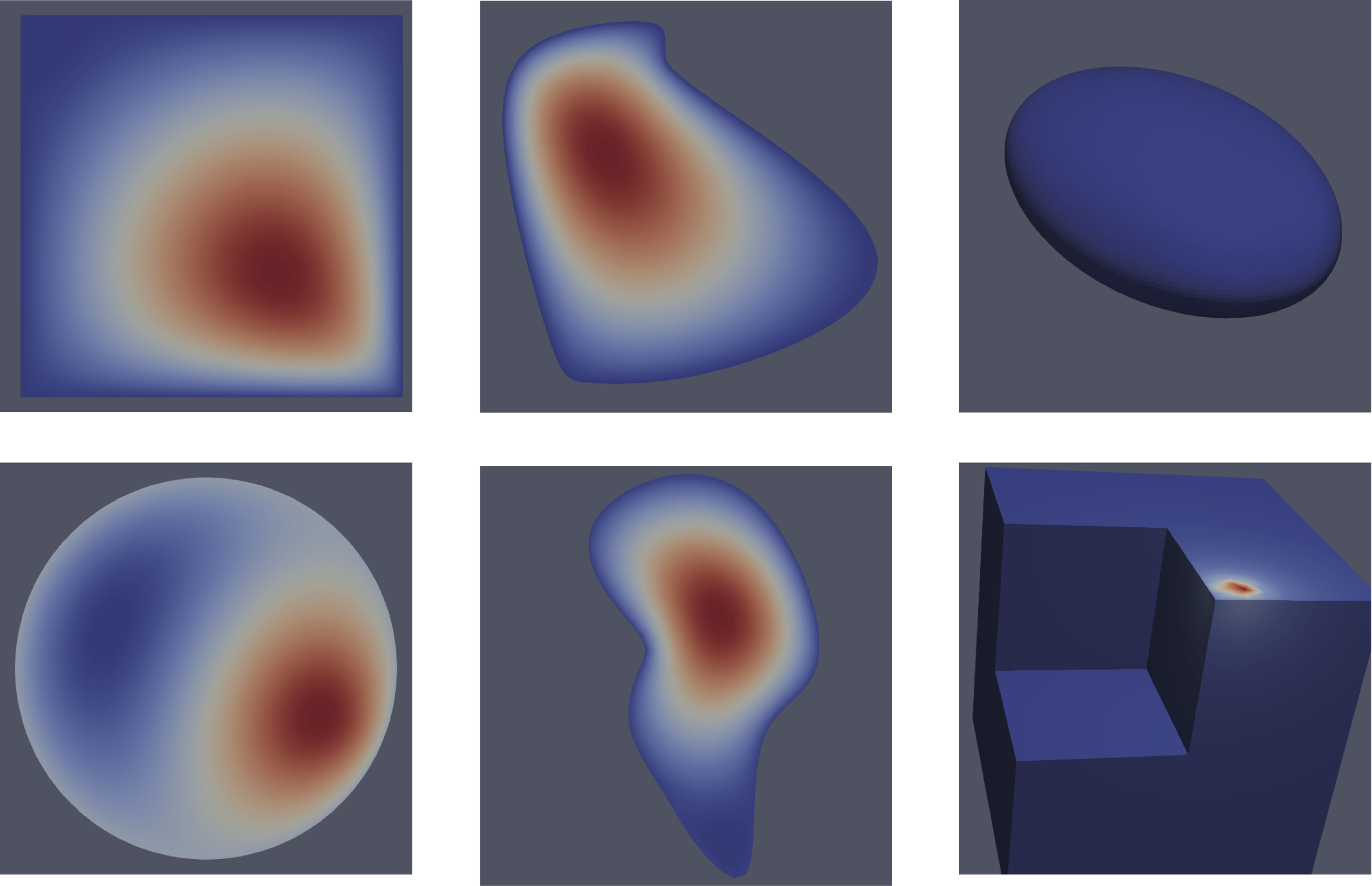
- The approach is scalable and effective across four PDE categories—Poisson, Helmholtz, advection-diffusion, and wave equations—across 2D and 3D domains with varying shapes and boundary conditions.
- The ablation study confirms that training only the $ G^t $ component yields stable and accurate results, validating the two-stage training strategy and the robustness of the generalized formulation.
Read this paper
Open the full text in the Nubint reader and ask about any passage as you read.
Read this paper on NubintThis review was generated by AI from the original paper. Please check the paper before citing it.