
[Paper Review] Deep Generalized Unfolding Networks for Image Restoration
This paper proposes Deep Generalized Unfolding Networks (DGUNet), a differentiable, interpretable deep learning framework that generalizes Proximal Gradient Descent (PGD) for image restoration by integrating a learnable gradient estimation module and inter-stage feature fusion. The method achieves state-of-the-art performance across diverse image restoration tasks, including denoising, deraining, and compressive sensing, while maintaining transparency and robustness to real-world, complex degradations without requiring predefined degradation models.
Deep neural networks (DNN) have achieved great success in image restoration. However, most DNN methods are designed as a black box, lacking transparency and interpretability. Although some methods are proposed to combine traditional optimization algorithms with DNN, they usually demand pre-defined degradation processes or handcrafted assumptions, making it difficult to deal with complex and real-world applications. In this paper, we propose a Deep Generalized Unfolding Network (DGUNet) for image restoration. Concretely, without loss of interpretability, we integrate a gradient estimation strategy into the gradient descent step of the Proximal Gradient Descent (PGD) algorithm, driving it to deal with complex and real-world image degradation. In addition, we design inter-stage information pathways across proximal mapping in different PGD iterations to rectify the intrinsic information loss in most deep unfolding networks (DUN) through a multi-scale and spatial-adaptive way. By integrating the flexible gradient descent and informative proximal mapping, we unfold the iterative PGD algorithm into a trainable DNN. Extensive experiments on various image restoration tasks demonstrate the superiority of our method in terms of state-of-the-art performance, interpretability, and generalizability. The source code is available at https://github.com/MC-E/Deep-Generalized-Unfolding-Networks-for-Image-Restoration.
Motivation & Objective
- To address the lack of interpretability and generalization in black-box deep neural networks for image restoration.
- To overcome the limitations of existing deep unfolding networks (DUNs) that require known or handcrafted degradation models.
- To mitigate intrinsic information loss in DUNs caused by reconstructing images at each stage, which distorts feature representations.
- To enable end-to-end training of a structured, optimization-based network that generalizes to complex, real-world image degradations.
- To combine the interpretability of model-based methods with the representational power and efficiency of deep learning.
Proposed method
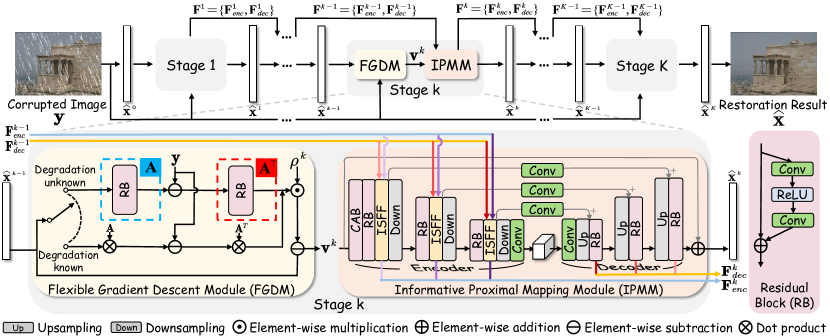
- The method formulates image restoration as an optimization problem using Proximal Gradient Descent (PGD), which is then unfolded into a deep neural network architecture.
- A Flexible Gradient Descent Module (FGDM) is introduced to estimate gradients in degradation-unknown scenarios, enabling the network to handle complex, real-world degradations without prior knowledge of the degradation matrix A.
- Inter-stage feature fusion pathways (ISFF) are designed to preserve and propagate multi-scale, spatial-adaptive features across PGD iterations, counteracting information loss from image reconstruction at each stage.
- The ISFF module uses spatial-adaptive normalization to dynamically weight features from different scales, improving feature representation fidelity.
- The entire network is trained end-to-end, allowing joint optimization of the unfolding process and the learned components, including the FGDM and ISFF modules.
- The framework is applied to multiple image restoration tasks—denoising, deblurring, deraining, compressive sensing—by adapting the data fidelity and regularization terms accordingly.
Experimental results
Research questions
- RQ1Can a deep unfolding network be made robust to complex, real-world image degradations without requiring explicit degradation modeling?
- RQ2How can information loss from reconstructing images at each stage in deep unfolding networks be effectively mitigated?
- RQ3To what extent does incorporating a learnable gradient estimation module improve performance and generalization in image restoration?
- RQ4Does inter-stage feature fusion with multi-scale and spatial-adaptive mechanisms enhance feature representation and model performance?
- RQ5Can a differentiable, optimization-based deep network achieve state-of-the-art performance while maintaining interpretability?
Key findings
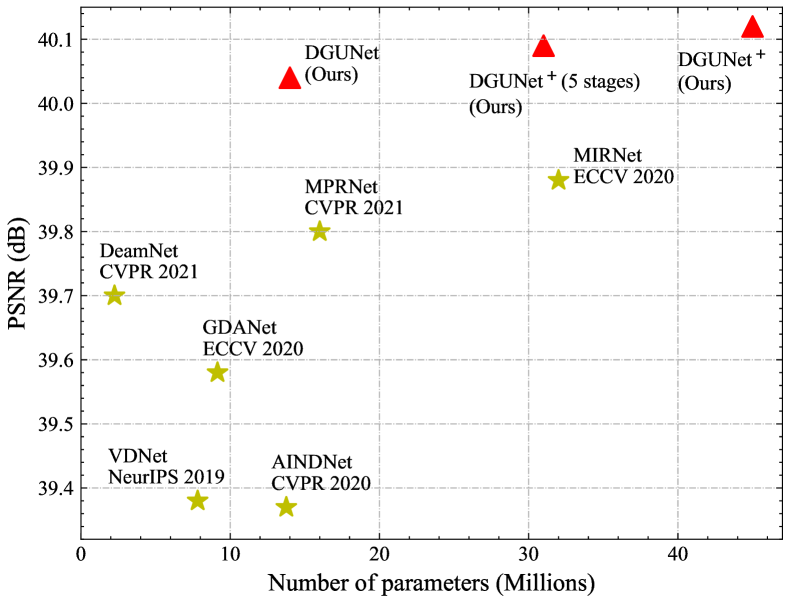
- DGUNet achieves state-of-the-art performance on the DND dataset, outperforming MPRNet by 0.32 dB in PSNR.
- On the SIDD dataset, DGUNet outperforms MPRNet by 0.20 dB in PSNR, demonstrating strong robustness to real-world noise.
- In compressive sensing at 1% sampling ratio, DGUNet achieves a 2 dB gain over OPINENet+, highlighting its effectiveness in low-sampling regimes.
- Abllation studies show that removing the ISFF module leads to performance degradation, confirming its critical role in preserving feature information across stages.
- The FGDM module contributes significantly to performance, as removing it causes a 0.55 dB drop in PSNR on Rain100H, proving its value beyond interpretability.
- The method generalizes well across diverse tasks, including synthetic and real-world benchmarks, with consistent gains in PSNR and SSIM.
Read this paper
Open the full text in the Nubint reader and ask about any passage as you read.
Read this paper on NubintThis review was generated by AI from the original paper. Please check the paper before citing it.