
[Paper Review] Deep Generative Symbolic Regression
This paper proposes Deep Generative Symbolic Regression (DGSR), a novel framework that leverages pre-trained deep generative models to learn invariant representations of mathematical equations, enabling scalable symbolic regression with improved generalization and efficiency. DGSR achieves state-of-the-art equation recovery rates on high-dimensional problems and reduces inference time compared to reinforcement learning baselines by encoding equation invariances such as commutativity and distributivity through invariant neural networks and end-to-end Bayesian-inspired training.
Symbolic regression (SR) aims to discover concise closed-form mathematical equations from data, a task fundamental to scientific discovery. However, the problem is highly challenging because closed-form equations lie in a complex combinatorial search space. Existing methods, ranging from heuristic search to reinforcement learning, fail to scale with the number of input variables. We make the observation that closed-form equations often have structural characteristics and invariances (e.g., the commutative law) that could be further exploited to build more effective symbolic regression solutions. Motivated by this observation, our key contribution is to leverage pre-trained deep generative models to capture the intrinsic regularities of equations, thereby providing a solid foundation for subsequent optimization steps. We show that our novel formalism unifies several prominent approaches of symbolic regression and offers a new perspective to justify and improve on the previous ad hoc designs, such as the usage of cross-entropy loss during pre-training. Specifically, we propose an instantiation of our framework, Deep Generative Symbolic Regression (DGSR). In our experiments, we show that DGSR achieves a higher recovery rate of true equations in the setting of a larger number of input variables, and it is more computationally efficient at inference time than state-of-the-art RL symbolic regression solutions.
Motivation & Objective
- To address the scalability and computational inefficiency of existing symbolic regression methods when handling a large number of input variables.
- To learn equation representations that encode structural invariances such as commutativity and distributivity, which are often ignored in prior approaches.
- To enable efficient inference and generalization to unseen input variables beyond those seen during pre-training.
- To unify and improve upon prior symbolic regression methods by grounding them in a principled deep generative framework with end-to-end training.
Proposed method
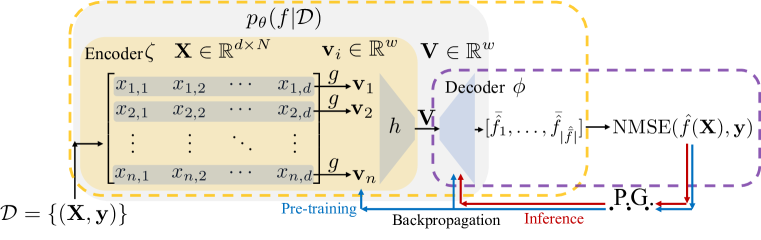
- DGSR employs a deep conditional generative model trained end-to-end using a Bayesian inference-inspired loss to learn invariant representations of equations.
- The model uses invariant neural networks that explicitly encode symmetries like commutativity and distributivity in equation structures.
- Equations are represented not as trees or sequences, but as structured latent representations that preserve equivalence under known algebraic transformations.
- The framework supports gradient-based refinement of the pre-trained model at inference time, enabling efficient optimization without retraining.
- Pre-training is performed on a large corpus of equations, learning intrinsic regularities and invariances, which are then fine-tuned using data-specific gradients.
- The method generalizes to unseen input variables by leveraging the inductive bias of the pre-trained generative model and its structured latent space.
Experimental results
Research questions
- RQ1Can deep generative models effectively capture and encode algebraic invariances such as commutativity and distributivity in symbolic regression?
- RQ2Does learning invariant equation representations lead to improved scalability and generalization in symbolic regression with increasing input variables?
- RQ3Can end-to-end training of a pre-trained generative model enable efficient inference and gradient-based refinement without full retraining?
- RQ4How does DGSR compare to reinforcement learning and heuristic-based symbolic regression methods in terms of equation recovery rate and computational cost?
- RQ5Can the proposed framework generalize to higher-dimensional input spaces than previously achievable with existing methods?
Key findings
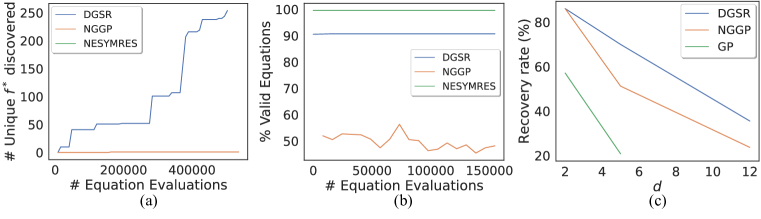
- DGSR achieves a higher recovery rate of the true underlying equation in settings with a larger number of input variables compared to state-of-the-art reinforcement learning and heuristic-based methods.
- The framework demonstrates significantly reduced inference-time computational cost compared to reinforcement learning baselines, enabling faster equation discovery.
- DGSR generalizes effectively to unseen input variables of higher dimension than those seen during pre-training, fulfilling the objective of scalability.
- The end-to-end training scheme with a Bayesian-inspired loss enables effective gradient refinement of the pre-trained model, improving data-specific performance without retraining.
- DGSR achieves state-of-the-art performance on the SRBench benchmark datasets, particularly in recovering complex equations with high symmetry and structure.
- The ablation study confirms that encoding invariances through invariant neural networks is critical for performance, especially in high-dimensional settings.
Read this paper
Open the full text in the Nubint reader and ask about any passage as you read.
Read this paper on NubintThis review was generated by AI from the original paper. Please check the paper before citing it.