
[Paper Review] Deep Learning based Full-reference and No-reference Quality Assessment Models for Compressed UGC Videos
This paper proposes a deep learning-based video quality assessment (VQA) framework for compressed user-generated content (UGC) videos, leveraging multi-level feature fusion from CNNs for both full-reference (FR) and no-reference (NR) settings. The model achieves state-of-the-art performance on the Compressed UGC VQA database and strong results on in-the-wild UGC benchmarks by combining structural/textural similarity (FR) and hierarchical feature statistics (NR) with subjectively inspired temporal pooling.
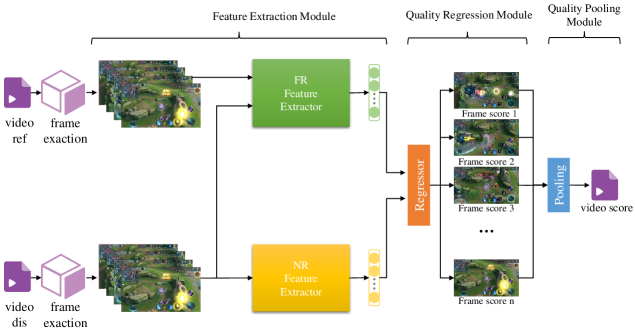
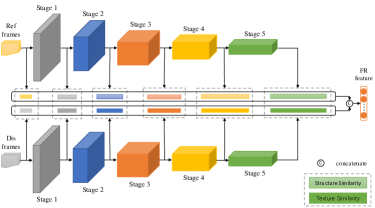
In this paper, we propose a deep learning based video quality assessment (VQA) framework to evaluate the quality of the compressed user's generated content (UGC) videos. The proposed VQA framework consists of three modules, the feature extraction module, the quality regression module, and the quality pooling module. For the feature extraction module, we fuse the features from intermediate layers of the convolutional neural network (CNN) network into final quality-aware feature representation, which enables the model to make full use of visual information from low-level to high-level. Specifically, the structure and texture similarities of feature maps extracted from all intermediate layers are calculated as the feature representation for the full reference (FR) VQA model, and the global mean and standard deviation of the final feature maps fused by intermediate feature maps are calculated as the feature representation for the no reference (NR) VQA model. For the quality regression module, we use the fully connected (FC) layer to regress the quality-aware features into frame-level scores. Finally, a subjectively-inspired temporal pooling strategy is adopted to pool frame-level scores into the video-level score. The proposed model achieves the best performance among the state-of-the-art FR and NR VQA models on the Compressed UGC VQA database and also achieves pretty good performance on the in-the-wild UGC VQA databases.
Motivation & Objective
- Address the challenge of accurately assessing the quality of compressed user-generated content (UGC) videos, which often suffer from diverse distortions beyond standard compression artifacts.
- Overcome the limitations of existing VQA models that focus primarily on professional-grade content or ignore the interplay between low-level visual features and high-level semantics in UGC.
- Develop a unified deep learning framework that performs effectively in both full-reference (FR) and no-reference (NR) settings for real-world UGC video quality assessment.
- Integrate temporal dynamics into quality assessment by using a subjectively inspired pooling strategy that reflects human perception of video quality over time.
Proposed method
- Fuses features from intermediate layers of a pre-trained CNN backbone to create quality-aware representations, enhancing sensitivity to both low-level textures and high-level semantics.
- For FR VQA, computes structure and texture similarities across feature maps from multiple layers as the input representation.
- For NR VQA, applies a staircase-style hierarchical fusion of intermediate features, then computes global mean and standard deviation of the final fused feature map as the representation.
- Uses a fully connected (FC) layer to regress the quality-aware features into frame-level quality scores.
- Applies a subjectively inspired temporal pooling strategy to aggregate frame-level scores into a single video-level quality score.
- Trains the model using Adam optimizer with a low initial learning rate (0.00001) and a batch size of 6 on a V100 GPU, with data augmentation via random cropping during training.
Experimental results
Research questions
- RQ1Can a unified deep learning framework effectively assess the quality of compressed UGC videos in both full-reference and no-reference settings?
- RQ2How does multi-level feature fusion from intermediate CNN layers improve quality assessment performance compared to single-level or end-layer features?
- RQ3To what extent do structural and texture similarities in feature maps (FR) and global statistics of fused features (NR) correlate with subjective video quality perception?
- RQ4Does a subjectively inspired temporal pooling strategy outperform standard pooling methods in predicting human-rated video quality scores?
- RQ5How does the proposed model generalize to in-the-wild UGC datasets with diverse shooting conditions and complex distortions?
Key findings
- The proposed FR VQA model achieves the best performance among state-of-the-art models on the Compressed UGC VQA database, with a SROCC of 0.9215 and RMSE of 0.2483.
- On the KoNViD-1k dataset, the NR VQA model achieves SROCC of 0.8134, KROCC of 0.6201, PLCC of 0.8143, and RMSE of 0.3695, outperforming all compared NR models.
- On the LIVE-VQC dataset, the NR model achieves SROCC of 0.7466 and PLCC of 0.7815, ranking second-best among compared models despite not explicitly modeling motion.
- The model's performance is significantly better than BRISQUE, V-BLIINDS, TLVQM, and VIDEVAL on both KoNViD-1k and LIVE-VQC, demonstrating robustness to diverse UGC distortions.
- The ablation study confirms that multi-level feature fusion and the hierarchical fusion strategy in the NR branch are critical for performance, especially in handling complex UGC artifacts.
- The subjectively inspired temporal pooling strategy contributes to improved correlation with subjective quality scores, particularly in videos with dynamic content.
Read this paper
Open the full text in the Nubint reader and ask about any passage as you read.
Read this paper on NubintThis review was generated by AI from the original paper. Please check the paper before citing it.