
[Paper Review] Deep Learning-Enabled Semantic Communication Systems with Task-Unaware Transmitter and Dynamic Data
This paper proposes a deep learning-based semantic communication system for image transmission where the transmitter is unaware of the receiver's pragmatic task and the observed data distribution differs from the training data. By combining receiver-leading training with domain adaptation, the system maintains high performance in both data recovery and task execution under dynamic conditions, achieving near-ideal performance with minimal retraining.
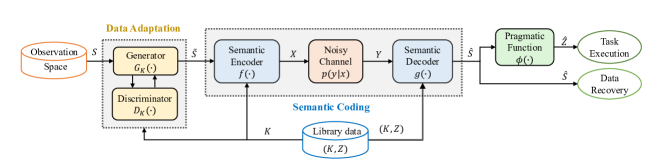
Existing deep learning-enabled semantic communication systems often rely on shared background knowledge between the transmitter and receiver that includes empirical data and their associated semantic information. In practice, the semantic information is defined by the pragmatic task of the receiver and cannot be known to the transmitter. The actual observable data at the transmitter can also have non-identical distribution with the empirical data in the shared background knowledge library. To address these practical issues, this paper proposes a new neural network-based semantic communication system for image transmission, where the task is unaware at the transmitter and the data environment is dynamic. The system consists of two main parts, namely the semantic coding (SC) network and the data adaptation (DA) network. The SC network learns how to extract and transmit the semantic information using a receiver-leading training process. By using the domain adaptation technique from transfer learning, the DA network learns how to convert the data observed into a similar form of the empirical data that the SC network can process without retraining. Numerical experiments show that the proposed method can be adaptive to observable datasets while keeping high performance in terms of both data recovery and task execution.
Motivation & Objective
- Address the practical challenge of task-unaware transmitters in semantic communication, where the receiver's pragmatic task is unknown to the transmitter.
- Overcome performance degradation when observed data distribution differs from the empirical knowledge base used during training.
- Enable efficient adaptation to dynamic data environments without retraining the semantic coding network.
- Minimize communication and computational overhead by avoiding direct transmission of receiver task information to the transmitter.
- Develop a scalable semantic communication framework applicable to real-world scenarios such as IoT and UAVs with varying data sources.
Proposed method
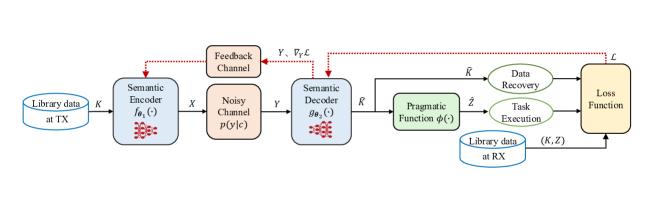
- Introduce a two-stage training process: preparation stage (offline) and working stage (online), where the transmitter is trained without knowledge of the receiver’s task.
- Design a receiver-leading training framework that enables joint optimization of the encoder and decoder using only receiver-side semantic feedback, preserving task privacy.
- Propose a semantic-oriented loss function that adapts to different pragmatic tasks by selecting appropriate distortion metrics.
- Implement a data adaptation (DA) network based on domain adaptation techniques from transfer learning to map observed data into a form compatible with the pre-trained semantic coding network.
- Train the DA network with only a few labeled samples from the observed data distribution, enabling fast convergence and low communication cost.
- Use a pre-trained semantic coding (SC) network trained on a library dataset (e.g., MNIST) to extract and transmit semantic features, while the DA network transforms incoming data into a similar distribution for compatibility.
Experimental results
Research questions
- RQ1How can a semantic communication system maintain high performance when the transmitter is unaware of the receiver’s pragmatic task?
- RQ2To what extent can a domain adaptation-based method reduce the need for retraining when the observed data distribution differs from the training data?
- RQ3Can a receiver-leading training process effectively train the semantic encoder and decoder without leaking task-specific information to the transmitter?
- RQ4How does the system perform in terms of both data recovery and task execution under low compression rates and noisy channels?
- RQ5What is the performance gain of the proposed method compared to baseline schemes without data adaptation under dynamic data environments?
Key findings
- The proposed system achieves classification accuracy within 5% of retraining-based schemes after only 80 training epochs, even with a compression rate of 0.1 and SNR of 3 dB.
- The data adaptation network converges rapidly, requiring only a few epochs and dozens of samples, especially when the observed and library datasets are similar (e.g., USPS and MNIST).
- The system maintains high semantic fidelity: visual results show that after data adaptation, reconstructed images preserve object outlines and are recognizable by classifiers despite blurriness.
- On the CIFAR-10/STL-10 benchmark, the proposed method achieves 59.3% higher classification accuracy than the non-DA baseline under the same compression rate.
- The performance gap between the proposed method and the ideal retraining case is minimal across all compression rates from 0.1 to 0.9, indicating strong robustness.
- The domain adaptation performance correlates with dataset similarity: PAD (Pairwise Adaptation Distance) of 0.5 between MNIST and USPS yields better results than 1.48 between MNIST and SVHN, confirming the method’s adaptability to distribution shifts.
Read this paper
Open the full text in the Nubint reader and ask about any passage as you read.
Read this paper on NubintThis review was generated by AI from the original paper. Please check the paper before citing it.