
[Paper Review] Deep Learning for Cross-Domain Few-Shot Visual Recognition: A Survey
This survey formalizes cross-domain few-shot learning (CDFSL), provides a comprehensive taxonomy and dataset benchmarks, and analyzes four approach categories with discussions on TSERM challenges and future directions.
While deep learning excels in computer vision tasks with abundant labeled data, its performance diminishes significantly in scenarios with limited labeled samples. To address this, Few-shot learning (FSL) enables models to perform the target tasks with very few labeled examples by leveraging prior knowledge from related tasks. However, traditional FSL assumes that both the related and target tasks come from the same domain, which is a restrictive assumption in many real-world scenarios where domain differences are common. To overcome this limitation, Cross-domain few-shot learning (CDFSL) has gained attention, as it allows source and target data to come from different domains and label spaces. This paper presents the first comprehensive review of Cross-domain Few-shot Learning (CDFSL), a field that has received less attention compared to traditional FSL due to its unique challenges. We aim to provide both a position paper and a tutorial for researchers, covering key problems, existing methods, and future research directions. The review begins with a formal definition of CDFSL, outlining its core challenges, followed by a systematic analysis of current approaches, organized under a clear taxonomy. Finally, we discuss promising future directions in terms of problem setups, applications, and theoretical advancements.
Motivation & Objective
- Define and formalize the CDFSL problem and its relation to FSL and transfer learning.
- Identify the unique challenges posed by domain gaps and limited target supervision.
- Provide a unified taxonomy of CDFSL approaches and summarize key datasets and benchmarks.
- Lay out future research directions in problem setups, applications, and theory.
Proposed method
- Review and formalize CDFSL definitions and problem statements.
- Propose a four-category taxonomy: instance-guided, parameter-based, feature post-processing, and hybrid approaches.
- Analyze two-stage empirical risk minimization (TSERM) as the core challenge in CDFSL.
- Survey validated CDFSL methods, datasets, and benchmarks.
- Discuss practical guidance and future directions for CDFSL research.

Experimental results
Research questions
- RQ1What is the formal definition of cross-domain few-shot learning and how does it differ from related problems like FSL, DA, and DG?
- RQ2What are the core challenges unique to CDFSL, especially regarding domain gaps and limited target data?
- RQ3How can knowledge be transferred effectively across domains, and which taxonomy best organizes existing approaches?
- RQ4What datasets and benchmarks suitably evaluate CDFSL progress, and what are the open directions for future work?
Key findings
- CDFSL is defined to leverage prior knowledge from a labeled source domain to learn with limited labeled data in a distinct target domain and task.
- A unique two-stage empirical risk minimization (TSERM) framework underpins CDFSL by learning a shared feature representation and a target-specific hypothesis.
- Existing work in CDFSL is best organized into four categories: instance-guided, parameter-based, feature post-processing, and hybrid approaches.
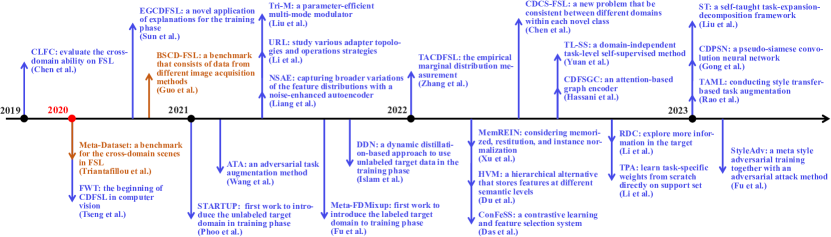
- The survey compiles and explains relevant datasets and benchmarks (e.g., Meta-Dataset and BSCD-FSL) and analyzes their implications for method evaluation.
- The paper outlines promising future directions across problem setups, applications, and theoretical foundations.
Read this paper
Open the full text in the Nubint reader and ask about any passage as you read.
Read this paper on NubintThis review was generated by AI from the original paper. Please check the paper before citing it.