
[Paper Review] Deep Metric Learning for Unsupervised Remote Sensing Change Detection
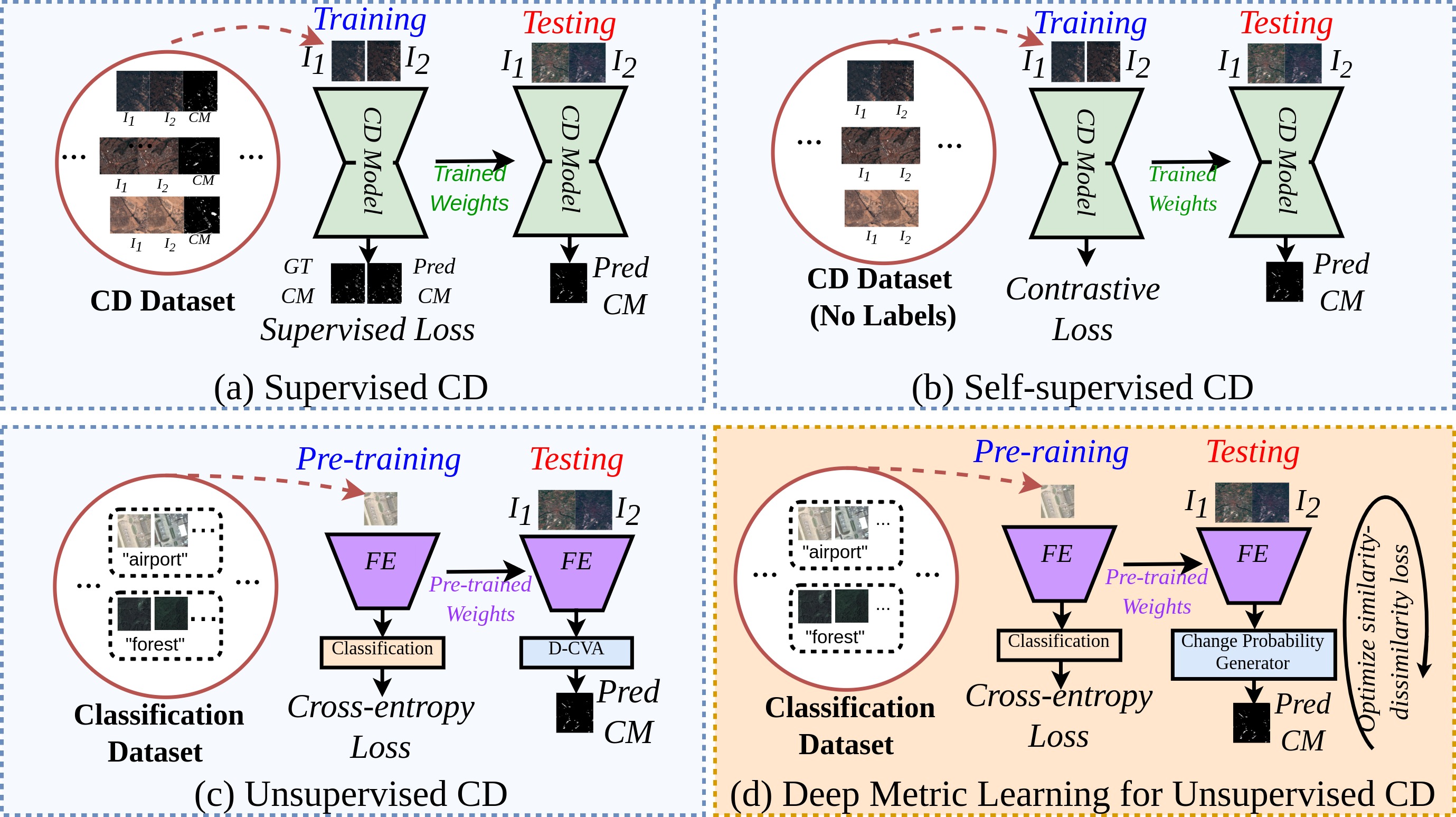
This paper proposes an unsupervised remote sensing change detection method using deep metric learning that jointly optimizes a Deep-Change Probability Generator (D-CPG) and a Deep-Feature Extractor (D-FE) via an unsupervised similarity-dissimilarity loss. The approach achieves state-of-the-art performance on three benchmark datasets without requiring labeled training data, significantly outperforming existing supervised and unsupervised methods.
Remote Sensing Change Detection (RS-CD) aims to detect relevant changes from Multi-Temporal Remote Sensing Images (MT-RSIs), which aids in various RS applications such as land cover, land use, human development analysis, and disaster response. The performance of existing RS-CD methods is attributed to training on large annotated datasets. Furthermore, most of these models are less transferable in the sense that the trained model often performs very poorly when there is a domain gap between training and test datasets. This paper proposes an unsupervised CD method based on deep metric learning that can deal with both of these issues. Given an MT-RSI, the proposed method generates corresponding change probability map by iteratively optimizing an unsupervised CD loss without training it on a large dataset. Our unsupervised CD method consists of two interconnected deep networks, namely Deep-Change Probability Generator (D-CPG) and Deep-Feature Extractor (D-FE). The D-CPG is designed to predict change and no change probability maps for a given MT-RSI, while D-FE is used to extract deep features of MT-RSI that will be further used in the proposed unsupervised CD loss. We use transfer learning capability to initialize the parameters of D-FE. We iteratively optimize the parameters of D-CPG and D-FE for a given MT-RSI by minimizing the proposed unsupervised ``similarity-dissimilarity loss''. This loss is motivated by the principle of metric learning where we simultaneously maximize the distance between change pair-wise pixels while minimizing the distance between no-change pair-wise pixels in bi-temporal image domain and their deep feature domain. The experiments conducted on three CD datasets show that our unsupervised CD method achieves significant improvements over the state-of-the-art supervised and unsupervised CD methods. Code available at https://github.com/wgcban/Metric-CD
Motivation & Objective
- Address the challenge of limited availability of large-scale annotated datasets for remote sensing change detection.
- Overcome domain shift issues in supervised models by developing a fully unsupervised method that generalizes across domains.
- Improve robustness to seasonal and color variations in multi-temporal remote sensing images.
- Enable transferable and adaptive change detection without fine-tuning on new datasets.
- Develop a self-supervised training paradigm that leverages metric learning principles to distinguish change from no-change pixels.
Proposed method
- The method uses two deep neural networks: a Deep-Change Probability Generator (D-CPG) for predicting change/no-change probability maps and a Deep-Feature Extractor (D-FE) for extracting hierarchical deep features from bi-temporal images.
- The D-FE is initialized via transfer learning from a pre-trained ImageNet model to improve feature quality and convergence.
- An unsupervised similarity-dissimilarity loss is proposed, which maximizes inter-class (change) distances and minimizes intra-class (no-change) distances in both image and deep feature spaces.
- The loss function combines three components: image-level similarity-dissimilarity loss ($\mathcal{L}_{\text{img}}$), feature-level loss ($\mathcal{L}_{\text{feat}}$), and context-consistency loss ($\mathcal{L}_{\text{ctx}}$) to enforce spatial consistency.
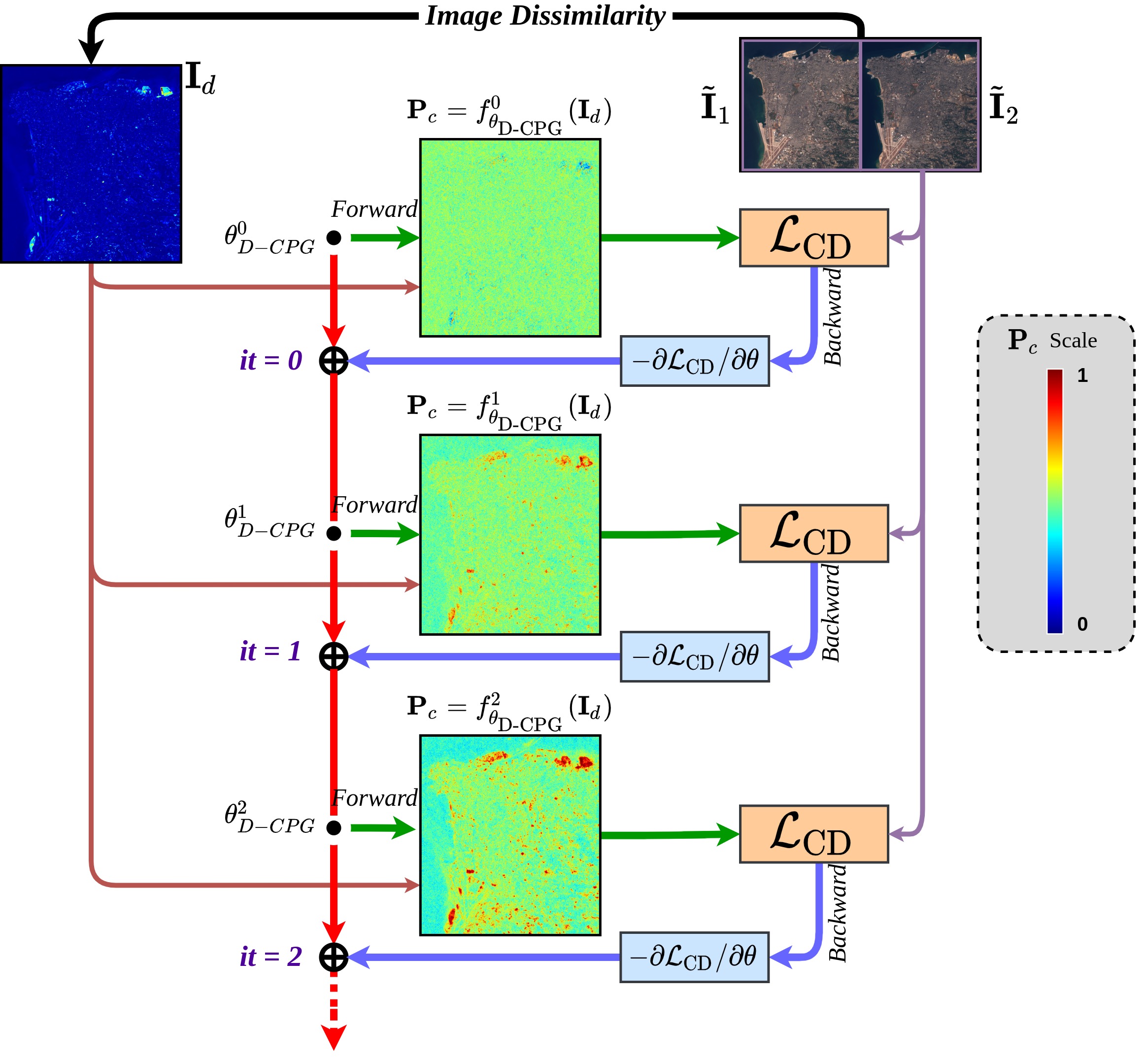
- The D-CPG and D-FE are jointly and iteratively optimized using backpropagation to refine change probability maps and feature representations.
- The method leverages multi-scale features from VGG-16 (scales $l=1$ and $l=2$) for optimal performance, with ablation showing degradation when using deeper layers.
Experimental results
Research questions
- RQ1Can deep metric learning be effectively applied to unsupervised remote sensing change detection without requiring annotated training data?
- RQ2How does joint optimization of a change probability generator and feature extractor improve detection robustness to color and seasonal variations?
- RQ3What is the relative contribution of image-level, feature-level, and context-consistency losses in enhancing change detection performance?
- RQ4How does the choice of network architecture and feature scale affect the final detection accuracy?
- RQ5Can a self-supervised metric learning approach outperform existing supervised and unsupervised SOTA methods on standard benchmarks?
Key findings
- The proposed method achieves an AUC of 0.937 on the OSCD dataset, significantly outperforming previous state-of-the-art unsupervised and supervised methods.
- Using a ResNet with 32 residual blocks in the D-CPG yields the highest AUC (0.937), outperforming U-Net, Hourglass, and shallower ResNets.
- The combination of image-level, feature-level, and context-consistency losses ($\mathcal{L}_{\text{img}}$, $\mathcal{L}_{\text{feat}}$, $\mathcal{L}_{\text{ctx}}$) achieves the best F1 score of 0.325 and OA of 0.958 on OSCD.
- Utilizing deep features from the first two scales of VGG-16 ($l=1,2$) yields optimal performance, while deeper layers degrade results.
- The feature-level similarity-dissimilarity loss ($\mathcal{L}_{\text{feat}}$) contributes more to performance improvement than the image-level loss ($\mathcal{L}_{\text{img}}$), with AUC increasing from 0.821 to 0.879.
- The method converges stably to an optimal change probability map, as demonstrated by convergence curves on the Beirut image pair in the OSCD dataset.
Read this paper
Open the full text in the Nubint reader and ask about any passage as you read.
Read this paper on NubintThis review was generated by AI from the original paper. Please check the paper before citing it.