
[Paper Review] Deep Multimodal Learning with Missing Modality: A Survey
This survey presents the first comprehensive overview of deep multimodal learning with missing modality (MLMM), categorizing methodologies across modality augmentation, feature space engineering, architecture design, and model selection. It synthesizes recent advances, applications, and datasets, identifying key challenges and future directions for robust multimodal AI in real-world scenarios with incomplete data.
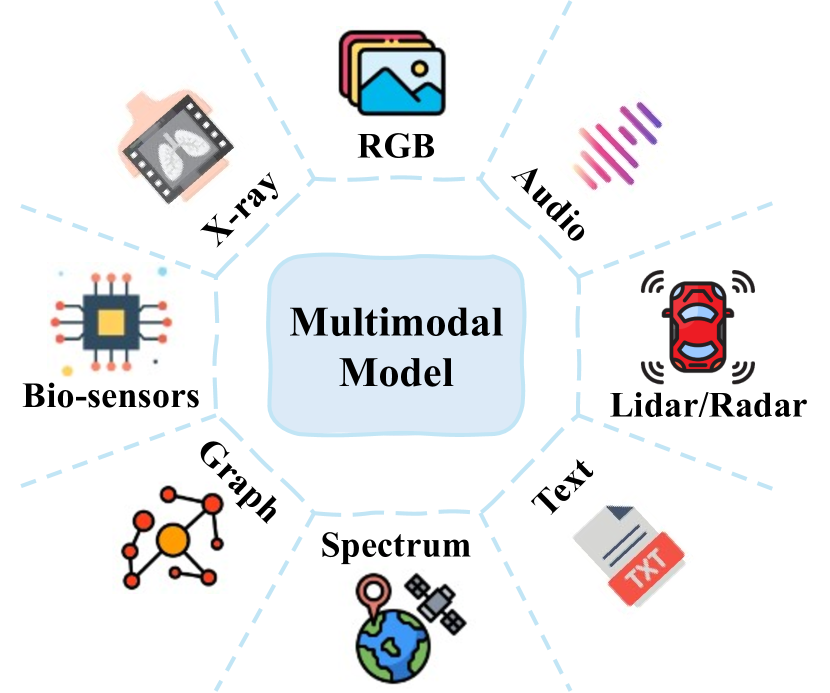
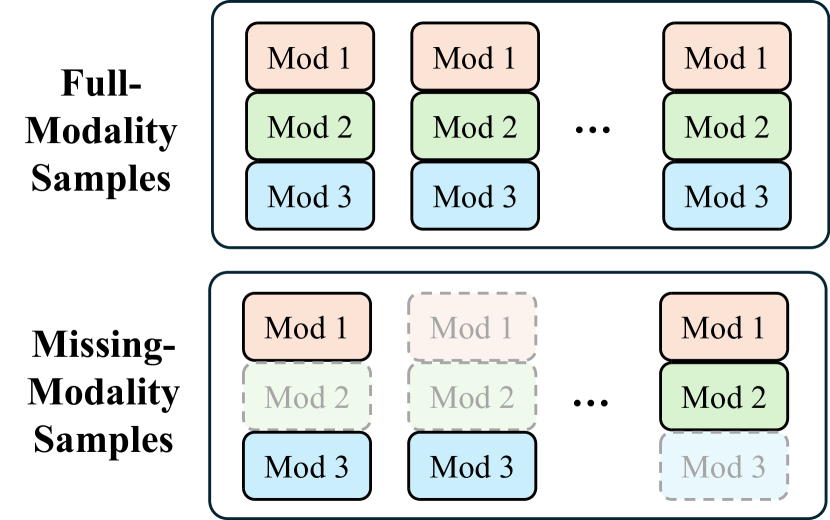
During multimodal model training and testing, certain data modalities may be absent due to sensor limitations, cost constraints, privacy concerns, or data loss, negatively affecting performance. Multimodal learning techniques designed to handle missing modalities can mitigate this by ensuring model robustness even when some modalities are unavailable. This survey reviews recent progress in Multimodal Learning with Missing Modality (MLMM), focusing on deep learning methods. It provides the first comprehensive survey that covers the motivation and distinctions between MLMM and standard multimodal learning setups, followed by a detailed analysis of current methods, applications, and datasets, concluding with challenges and future directions.
Motivation & Objective
- To provide a systematic and comprehensive review of recent advances in deep multimodal learning with missing modality (MLMM), addressing a critical gap in existing surveys.
- To distinguish MLMM from standard multimodal learning (MLFM) by clarifying the unique challenges of handling incomplete data during training and inference.
- To compile and analyze a wide range of applications, datasets, and real-world use cases across domains such as medical AI, robotics, affective computing, and natural sciences.
- To identify key open challenges, including lack of benchmarks for multimodal large language models and limited research in streaming data and reinforcement learning.
- To guide future research by outlining promising directions, especially in scientific AI and resource-constrained environments.
Proposed method
- Proposes a novel, fine-grained taxonomy of MLMM methods across four dimensions: modality augmentation, feature space engineering, architecture engineering, and model selection.
- Classifies existing techniques into strategies for handling missing modalities, including data-level augmentation, representation learning in shared or modality-specific spaces, and architectural designs that dynamically adapt to available modalities.
- Reviews methods that use attention mechanisms, contrastive learning, and generative modeling to mitigate performance degradation from missing data.
- Analyzes models that leverage pre-trained components, including multimodal large language models (MLLMs), for improved generalization under incomplete input conditions.
- Introduces a framework for evaluating MLMM models based on modality availability patterns and robustness across varying degrees of missingness.
- Highlights architectural innovations such as modality-specific encoders with dynamic fusion heads and early/late fusion strategies tailored for partial input.
Experimental results
Research questions
- RQ1How do current deep learning methods in MLMM differ from traditional multimodal learning frameworks that assume full modality availability?
- RQ2What are the dominant methodological approaches to handling missing modalities, and how do they compare in terms of performance and generalization?
- RQ3In which real-world applications is MLMM most critical, and what specific challenges do these domains pose for model robustness?
- RQ4What are the key limitations in current MLMM research, particularly regarding benchmarking and evaluation standards?
- RQ5How can MLMM be extended to emerging paradigms such as multimodal streaming data, reinforcement learning, and scientific AI?
Key findings
- MLMM is increasingly critical in real-world AI applications due to frequent data incompleteness from sensor failure, privacy constraints, and environmental interference.
- The survey identifies a significant research gap in multimodal reinforcement learning and streaming data, with only limited work addressing missing modalities in these settings.
- Applications in medical AI, space exploration (e.g., Mars rover navigation), and affective computing demonstrate that missing modalities are not anomalies but systemic challenges requiring robust solutions.
- Despite the rise of multimodal large language models (MLLMs), there is currently no unified benchmark to evaluate their performance under missing modality conditions.
- The field lacks standardized datasets and evaluation protocols, especially for scientific domains like materials science and drug discovery where multimodal data integration is essential but often incomplete.
- The survey concludes that future progress hinges on developing unified benchmarks, especially for MLLMs, and expanding research into underexplored areas such as long-sequence multimodal data and real-time decision-making systems.
Read this paper
Open the full text in the Nubint reader and ask about any passage as you read.
Read this paper on NubintThis review was generated by AI from the original paper. Please check the paper before citing it.