
[Paper Review] Deep neural operator for learning transient response of interpenetrating phase composites subject to dynamic loading
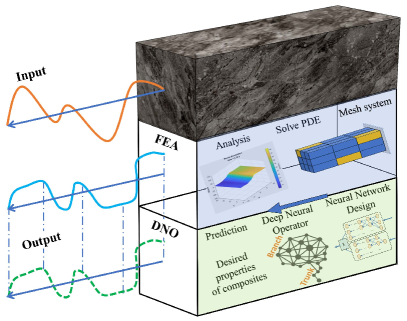
This paper proposes a deep neural operator (DNO) to surrogate finite element analysis (FEA) for predicting the transient mechanical response of interpenetrating phase composites (IPCs) under dynamic loading. Trained on 5,000 random strain loadings via incremental sequence-to-sequence learning in JAX, the DNO achieves 98% accuracy in predicting reaction forces and stress distributions in under one second—100× faster than standard DeepONet models—enabling rapid, accurate, and robust design exploration of 3D-printed IPCs.
Additive manufacturing has been recognized as an industrial technological revolution for manufacturing, which allows fabrication of materials with complex three-dimensional (3D) structures directly from computer-aided design models. The mechanical properties of interpenetrating phase composites (IPCs), especially response to dynamic loading, highly depend on their 3D structures. In general, for each specified structural design, it could take hours or days to perform either finite element analysis (FEA) or experiments to test the mechanical response of IPCs to a given dynamic load. To accelerate the physics-based prediction of mechanical properties of IPCs for various structural designs, we employ a deep neural operator (DNO) to learn the transient response of IPCs under dynamic loading as surrogate of physics-based FEA models. We consider a 3D IPC beam formed by two metals with a ratio of Young's modulus of 2.7, wherein random blocks of constituent materials are used to demonstrate the generality and robustness of the DNO model. To obtain FEA results of IPC properties, 5,000 random time-dependent strain loads generated by a Gaussian process kennel are applied to the 3D IPC beam, and the reaction forces and stress fields inside the IPC beam under various loading are collected. Subsequently, the DNO model is trained using an incremental learning method with sequence-to-sequence training implemented in JAX, leading to a 100X speedup compared to widely used vanilla deep operator network models. After an offline training, the DNO model can act as surrogate of physics-based FEA to predict the transient mechanical response in terms of reaction force and stress distribution of the IPCs to various strain loads in one second at an accuracy of 98%. Also, the learned operator is able to provide extended prediction of the IPC beam subject to longer random strain loads at a reasonably well accuracy.
Motivation & Objective
- To accelerate the prediction of transient mechanical responses in interpenetrating phase composites (IPCs) under dynamic loading, which currently requires hours or days per simulation via FEA or experiments.
- To develop a data-driven surrogate model that generalizes across diverse 3D microstructures and dynamic strain loadings, enabling rapid design iteration for additive-manufactured IPCs.
- To overcome the computational bottleneck of repeated FEA by training a single deep neural operator (DNO) that instantaneously predicts responses to arbitrary dynamic load inputs.
- To evaluate the robustness and generalization of the DNO model under noisy data and extended loading durations beyond the training window.
- To demonstrate that incremental learning and sequence-to-sequence training in JAX significantly accelerate DNO training compared to standard DeepONet implementations.
Proposed method
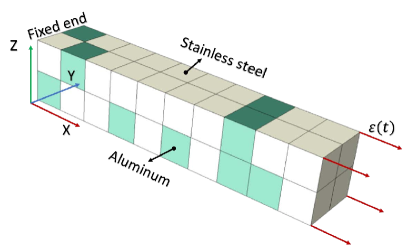
- The DNO is trained on 5,000 time-dependent strain loadings generated by a Gaussian process kernel, simulating dynamic loading conditions on a 3D IPC beam with two metals (Young’s modulus ratio 2.7).
- Finite element analysis (FEA) is used to compute ground-truth reaction forces and stress fields for each loading case, forming the training dataset.
- An incremental learning strategy is applied during DNO training, where adjacent elements with high similarity are trained in sequence to improve convergence and accuracy.
- Sequence-to-sequence training is implemented in JAX to model the time-dependent evolution of mechanical responses, enabling end-to-end learning of input-output dynamics.
- The DNO is evaluated on unseen loading types, including longer-duration random processes, sinusoidal inputs, and piecewise linear sequences, to test generalization.
- Robustness is tested by injecting Gaussian white noise (β = 0.05 to 0.2) into the output data during training, assessing prediction accuracy under contamination.
Experimental results
Research questions
- RQ1Can a deep neural operator (DNO) be trained to accurately and rapidly predict the transient mechanical response of 3D interpenetrating phase composites (IPCs) under arbitrary dynamic strain loading?
- RQ2How does incremental learning based on element similarity improve the training efficiency and prediction accuracy of the DNO model?
- RQ3To what extent can the DNO generalize to unseen loading types, such as sinusoidal or piecewise linear strain inputs, beyond the training data distribution?
- RQ4How robust is the DNO model to noisy output data, and what level of noise can it tolerate while maintaining high prediction accuracy?
- RQ5Can the DNO model extrapolate beyond the training duration (e.g., predict 2 seconds of response from a 1-second training window) with acceptable accuracy?
Key findings
- The DNO model achieves 98% prediction accuracy for reaction forces and stress distributions in less than one second, enabling real-time design exploration of IPCs.
- The DNO model trained with incremental learning in JAX is approximately 100 times faster to train than a standard DeepONet model implemented in TensorFlow.
- The model generalizes well to unseen loading types, including sinusoidal and piecewise linear strain inputs, maintaining high accuracy across diverse input patterns.
- For noisy data, the DNO maintains over 90% accuracy when noise levels are below β = 0.15, with 86.48% accuracy at β = 0.2, demonstrating strong robustness.
- The DNO successfully extrapolates to longer loading durations (up to 2 seconds), showing promise for extended-time prediction without retraining.
- The model’s performance is enhanced when training follows element similarity, indicating that structural coherence in the input domain improves learning efficiency and accuracy.
Better researchstarts right now
From reading papers to final review, dramatically reduce your research time.
No credit card · Free plan available
This review was created by AI and reviewed by human editors.