
[Paper Review] Deep Reinforcement Learning for Autonomous Spacecraft Inspection using Illumination
This paper proposes a deep reinforcement learning (PPO) controller for a free-flying deputy spacecraft to autonomously inspect a chief spacecraft while maximizing illumination for optical sensing. Using a physics-based ray-tracing illumination model, the agent achieves 98.82% interquartile mean inspection of all surface points across 10 random seeds, demonstrating robust, low-thrust, illumination-aware autonomous inspection in simulation.
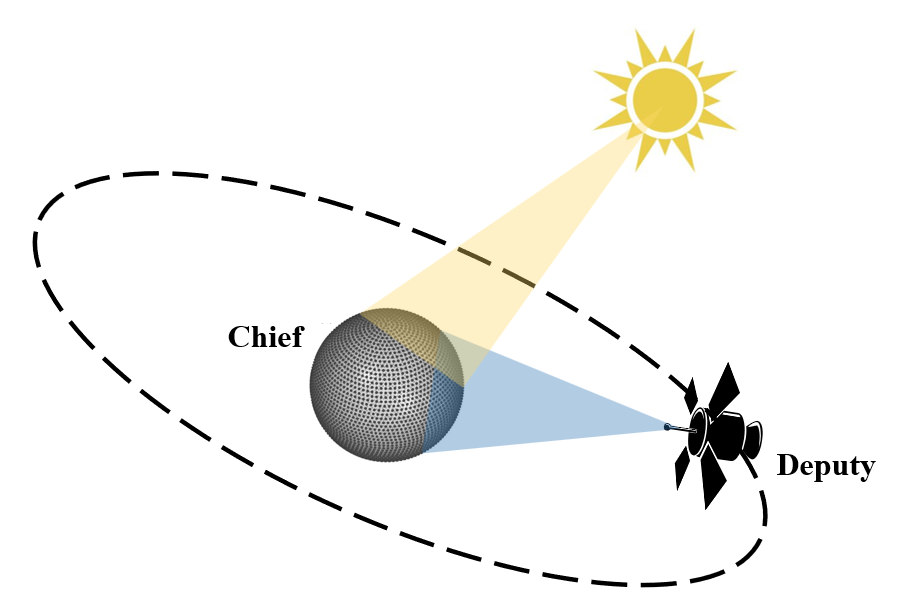
This paper investigates the problem of on-orbit spacecraft inspection using a single free-flying deputy spacecraft, equipped with an optical sensor, whose controller is a neural network control system trained with Reinforcement Learning (RL). This work considers the illumination of the inspected spacecraft (chief) by the Sun in order to incentivize acquisition of well-illuminated optical data. The agent's performance is evaluated through statistically efficient metrics. Results demonstrate that the RL agent is able to inspect all points on the chief successfully, while maximizing illumination on inspected points in a simulated environment, using only low-level actions. Due to the stochastic nature of RL, 10 policies were trained using 10 random seeds to obtain a more holistic measure of agent performance. Over these 10 seeds, the interquartile mean (IQM) percentage of inspected points for the finalized model was 98.82%.
Motivation & Objective
- Address the challenge of autonomous, comprehensive inspection of a chief spacecraft using a single free-flying deputy satellite.
- Integrate realistic solar illumination modeling into the inspection task to ensure high-quality optical data acquisition.
- Develop a sample-efficient, low-level control policy using deep reinforcement learning that maximizes both coverage and illumination.
- Evaluate policy robustness across multiple random seeds to ensure statistical reliability in a simulated environment.
- Demonstrate that illumination-aware RL can outperform fixed-logic illumination strategies in autonomous inspection tasks.
Proposed method
- Employ Proximal Policy Optimization (PPO) as the deep reinforcement learning algorithm to train a neural network policy for 3-DOF spacecraft dynamics governed by the Clohessy-Wiltshire equations.
- Design a custom illumination reward signal based on ray-tracing to compute direct and indirect solar illumination on the chief spacecraft’s surface at each timestep.
- Use a spectral illumination model (Blinn-Phong) to simulate realistic lighting conditions, including surface reflectance and angular dependence of illumination.
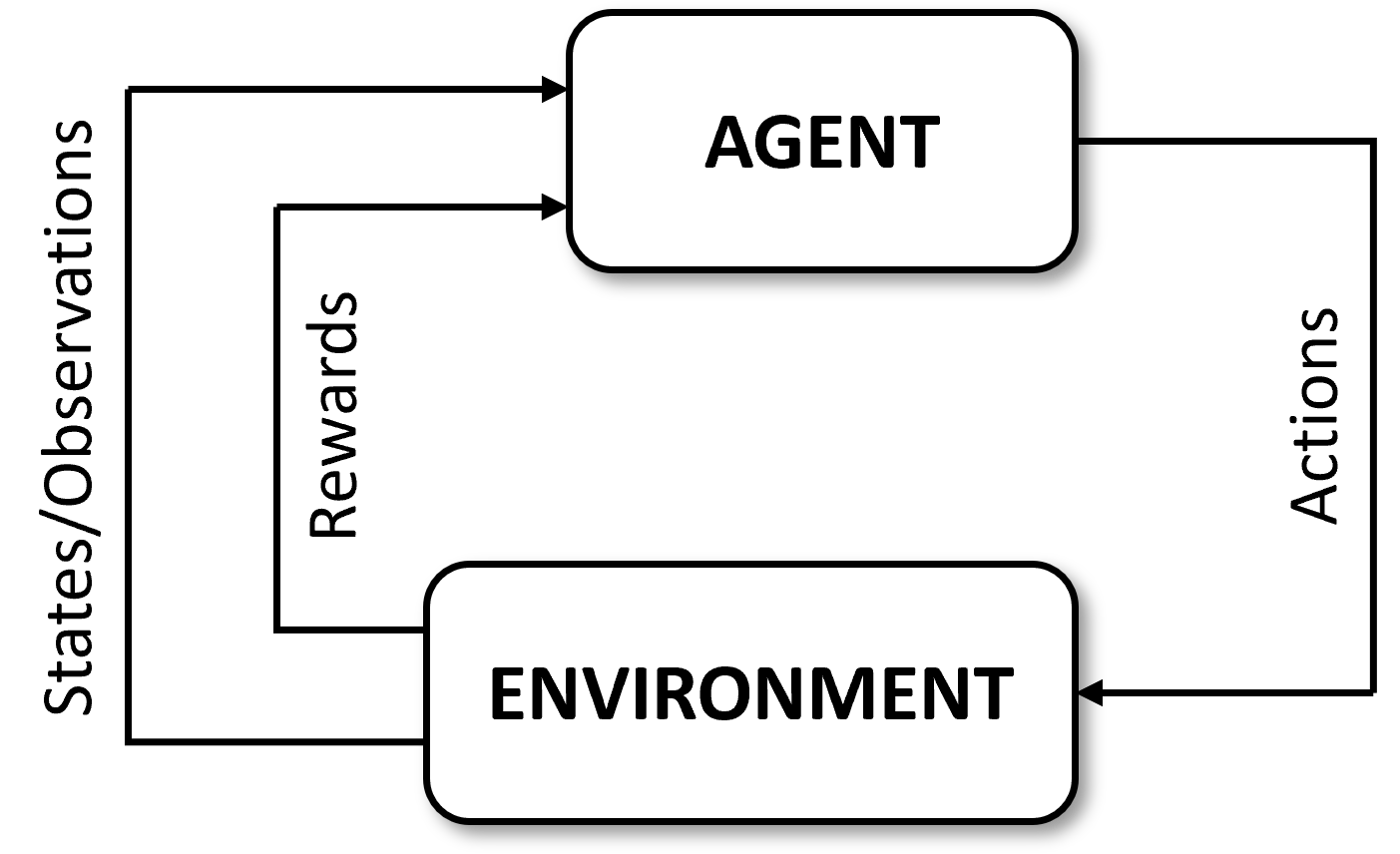
- Define observations as relative position, velocity, and illumination state, with actions as thruster commands in three principal axes.
- Train 10 independent policies with different random seeds to assess robustness and compute interquartile mean (IQM) performance metrics.
- Implement a simulation environment with dynamic Sun rotation to model changing illumination conditions over time.
Experimental results
Research questions
- RQ1Can a deep reinforcement learning agent learn to inspect all points on a chief spacecraft while maximizing illumination using only low-level thruster commands?
- RQ2How does the inclusion of a physics-based illumination model affect the performance and robustness of the RL-based inspection policy?
- RQ3To what extent does the agent balance inspection coverage and fuel efficiency (ΔV) in a dynamic illumination environment?
- RQ4How does policy performance vary across multiple random seeds, and what is the statistical robustness of the learned behavior?
- RQ5Does the agent adapt its trajectory to exploit natural orbital motion and Sun rotation to minimize control usage while maximizing illuminated inspection?
Key findings
- The RL agent successfully inspected 98.82% of all surface points on the chief spacecraft, as measured by the interquartile mean (IQM) across 100 trials and 10 random seeds.
- The agent achieved high inspection performance with low ΔV consumption, averaging 16.25 m/s across trials, indicating fuel-efficient maneuvering.
- The spectral illumination model (Blinn-Phong) produced slightly worse inspection performance than the simplified model, as expected due to stricter illumination thresholds.
- Despite the increased complexity of the spectral model, the agent maintained strong performance, with a 95% confidence interval for inspected points of [98.45, 99.13]%
- The agent demonstrated adaptive behavior by leveraging natural orbital motion and Sun rotation, using thrusters sparsely and gradually inspecting new points as illumination improved.
- Animations and visualizations confirmed that the agent’s trajectory systematically explored the chief spacecraft while aligning with optimal illumination angles over time.
Read this paper
Open the full text in the Nubint reader and ask about any passage as you read.
Read this paper on NubintThis review was generated by AI from the original paper. Please check the paper before citing it.