
[Paper Review] Deep Reinforcement Learning for Traffic Light Control in Intelligent Transportation Systems
The paper studies DRL-based traffic light control in single intersections and grid networks, showing DQN yields optimal control at a single intersection while DDPG induces emergent greenwave behavior in grids, demonstrating scalability and policy optimality under specified models.
Smart traffic lights in intelligent transportation systems (ITSs) are envisioned to greatly increase traffic efficiency and reduce congestion. Deep reinforcement learning (DRL) is a promising approach to adaptively control traffic lights based on the real-time traffic situation in a road network. However, conventional methods may suffer from poor scalability. In this paper, we investigate deep reinforcement learning to control traffic lights, and both theoretical analysis and numerical experiments show that the intelligent behavior ``greenwave" (i.e., a vehicle will see a progressive cascade of green lights, and not have to brake at any intersection) emerges naturally a grid road network, which is proved to be the optimal policy in an avenue with multiple cross streets. As a first step, we use two DRL algorithms for the traffic light control problems in two scenarios. In a single road intersection, we verify that the deep Q-network (DQN) algorithm delivers a thresholding policy; and in a grid road network, we adopt the deep deterministic policy gradient (DDPG) algorithm. Secondly, numerical experiments show that the DQN algorithm delivers the optimal control, and the DDPG algorithm with passive observations has the capability to produce on its own a high-level intelligent behavior in a grid road network, namely, the ``greenwave" policy emerges. We also verify the ``greenwave" patterns in a $5 imes 10$ grid road network. Thirdly, the ``greenwave" patterns demonstrate that DRL algorithms produce favorable solutions since the ``greenwave" policy shown in experiment results is proved to be optimal in a specified traffic model (an avenue with multiple cross streets). The delivered policies both in a single road intersection and a grid road network demonstrate the scalability of DRL algorithms.
Motivation & Objective
- Motivate the use of DRL for adaptive traffic light control in ITS to improve efficiency and reduce congestion.
- Evaluate DRL methods on two scenarios: a single intersection and a grid road network.
- Demonstrate scalability of DRL approaches to larger networks.
- Show that greenwave-like intelligent behavior arises from DRL in grid networks under a specified model.
Proposed method
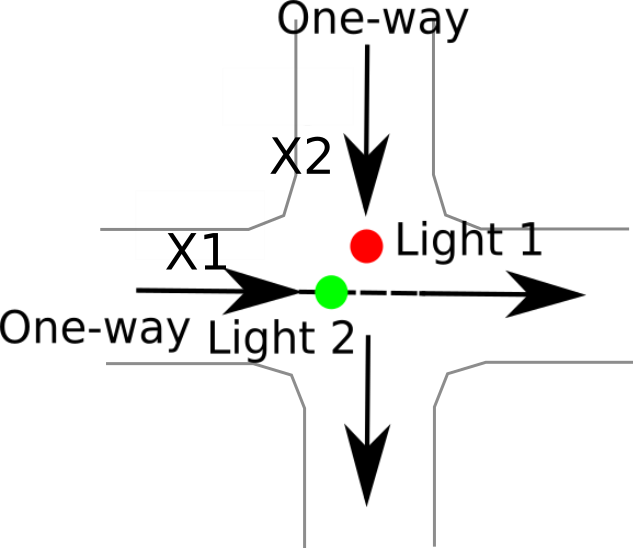
- Model traffic light control as an MDP with queue dynamics and discrete time steps.
- Apply DQN to a single intersection and demonstrate thresholding control that matches optimal conventional MDP results.
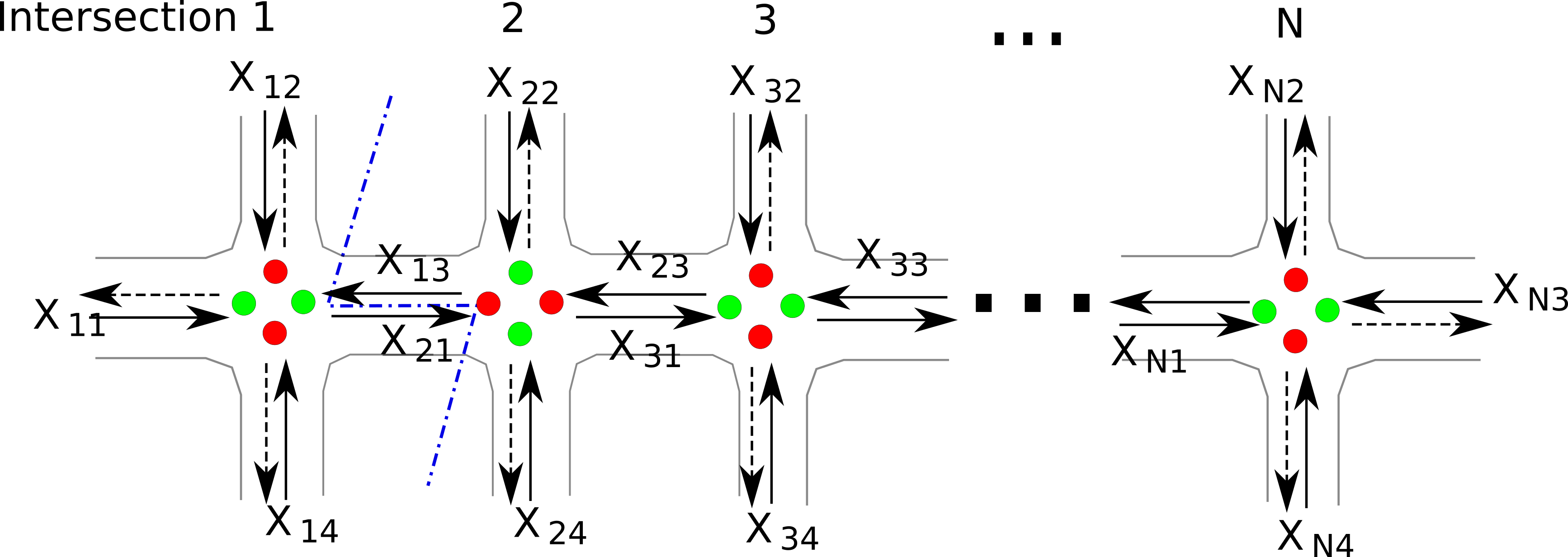
- Apply DDPG to a grid network to handle continuous-like control and discretize outputs for traffic signals.
- Use an episodic long-term congestion cost Z(X) and discounting to optimize policy.
- Introduce a discretized DDPG variant with a modified sigmoid activation to produce discrete actions.
- Demonstrate that greenwave patterns emerge as an optimal policy in the grid setting under the specified model.
Experimental results
Research questions
- RQ1Can DRL (DQN) achieve optimal or near-optimal signal control at a single intersection compared to conventional MDP methods?
- RQ2Can DRL (DDPG) produce high-level intelligent behaviors, such as greenwave, in a grid road network?
- RQ3How do DRL approaches scale from a single intersection to a grid network in terms of policy quality and computational feasibility?
- RQ4Is the greenwave policy optimal under the study’s traffic model for an avenue with multiple cross streets?
Key findings
- DQN delivers the optimal control for a single road intersection and results align with conventional MDP optimal policies.
- DDPG on a grid road network yields the emergent greenwave pattern, demonstrating high-level intelligent behavior without explicit programming.
- Greenwave patterns emerge in a 5×10 grid, indicating DRL can produce scalable, favorable solutions in larger networks.
- The greenwave policy is shown to be optimal within the specified traffic model of an avenue with multiple cross streets.
- The study demonstrates scalability of DRL algorithms from single intersections to grid networks while achieving favorable traffic outcomes.
Read this paper
Open the full text in the Nubint reader and ask about any passage as you read.
Read this paper on NubintThis review was generated by AI from the original paper. Please check the paper before citing it.