
[Paper Review] Deep Temporal Linear Encoding Networks
This paper proposes Temporal Linear Encoding (TLE), a novel end-to-end deep learning layer that aggregates spatio-temporal features from entire videos into a compact, robust representation by encoding sparse video segments. TLE enhances 2D and 3D CNNs for action recognition, achieving state-of-the-art performance on HMDB51 (71.1%) and UCF101 (95.6%) with improved efficiency and discriminative feature learning.
The CNN-encoding of features from entire videos for the representation of human actions has rarely been addressed. Instead, CNN work has focused on approaches to fuse spatial and temporal networks, but these were typically limited to processing shorter sequences. We present a new video representation, called temporal linear encoding (TLE) and embedded inside of CNNs as a new layer, which captures the appearance and motion throughout entire videos. It encodes this aggregated information into a robust video feature representation, via end-to-end learning. Advantages of TLEs are: (a) they encode the entire video into a compact feature representation, learning the semantics and a discriminative feature space; (b) they are applicable to all kinds of networks like 2D and 3D CNNs for video classification; and (c) they model feature interactions in a more expressive way and without loss of information. We conduct experiments on two challenging human action datasets: HMDB51 and UCF101. The experiments show that TLE outperforms current state-of-the-art methods on both datasets.
Motivation & Objective
- Address the limitation of existing CNNs in modeling long-range temporal dependencies across entire videos.
- Overcome the computational inefficiency and information loss in traditional two-stream and 3D CNNs that rely on dense temporal sampling or fixed-length clips.
- Develop a general-purpose, lightweight encoding layer that enhances feature representation without increasing model parameters.
- Enable end-to-end learning of global video-level features that capture both appearance and motion dynamics across long sequences.
- Demonstrate the method's effectiveness and flexibility across diverse architectures and datasets, including HMDB51 and UCF101.
Proposed method
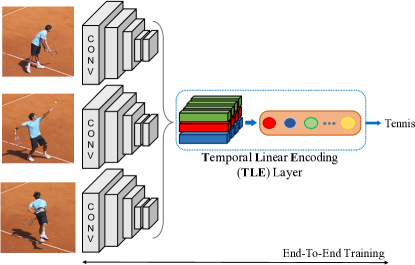
- TLE processes a fixed number of sparse video segments (frames or clips) sampled across the entire video duration.
- Each segment is processed by a shared-weight ConvNet (2D or 3D) to extract spatial and temporal features.
- Features from all segments are aggregated using a learnable linear projection layer, forming a compact global video embedding.
- The method uses bilinear or max-pooling-based fusion to model cross-segment feature interactions in a low-dimensional space.
- TLE is integrated as a differentiable layer within existing CNN architectures, enabling end-to-end training with backpropagation.
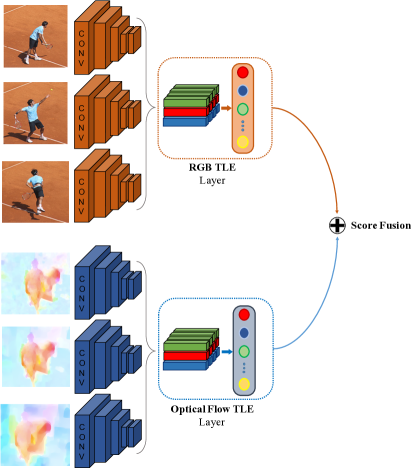
- The framework supports fusion with additional data streams, such as scene context from Places365, by adding a pre-trained spatial stream.
Experimental results
Research questions
- RQ1Can a learnable, compact temporal encoding layer improve global video representation learning in end-to-end CNNs?
- RQ2How does TLE compare to hand-crafted features (e.g., iDT+FV) and state-of-the-art deep learning methods on standard action recognition benchmarks?
- RQ3To what extent can TLE enhance performance across different network architectures, including two-stream and C3D networks?
- RQ4Can TLE effectively integrate auxiliary information, such as scene context, to further improve action recognition accuracy?
- RQ5Does TLE maintain discriminative power while reducing model complexity and avoiding information loss from pooling or truncation?
Key findings
- TLE achieves state-of-the-art accuracy of 95.6% on UCF101 and 71.1% on HMDB51, outperforming prior methods including iDT+FV and two-stream networks.
- TLE:Bilinear improves C3D ConvNet performance to 86.3% on UCF101 and 60.3% on HMDB51, surpassing the original C3D and two-stream baselines.
- The addition of scene context via Places365 pre-trained features boosts performance to 83.8% on UCF101 and 63.6% on HMDB51, demonstrating complementary feature learning.
- TLE reduces model parameters significantly compared to fully connected layers while preserving expressive feature interactions.
- TLE is computationally efficient and robust, enabling effective long-range temporal modeling without dense frame processing.
- The method generalizes well across architectures, including 2D and 3D CNNs, and can be extended to other sequential data streams.
Read this paper
Open the full text in the Nubint reader and ask about any passage as you read.
Read this paper on NubintThis review was generated by AI from the original paper. Please check the paper before citing it.