
[Paper Review] Deep-underground dark matter search with a COSINUS detector prototype
This paper presents the first deep-underground operation of a NaI cryogenic scintillating calorimeter using the remoTES readout scheme, achieving a 441 eV nuclear recoil energy resolution. With 11.6 g·d exposure, it sets a 90% confidence level upper limit on spin-independent dark matter-nucleon scattering cross-section at the pb level, demonstrating a factor of up to 100 improvement in sensitivity over single-channel detectors due to event-by-event particle discrimination.
Parallel Talk presented at the XX International Workshop on Neutrino Telescopes - Venice 23-27 October 2023
Motivation & Objective
- To validate the performance of a NaI-based cryogenic scintillating calorimeter in a deep-underground environment using the novel remoTES readout scheme.
- To measure the energy resolution and particle discrimination capability of the dual-channel phonon and light readout for nuclear recoils and electron/gamma events.
- To determine the quenching factors for sodium and iodine in NaI crystals at low energies (10 keV) using experimental data.
- To set a competitive limit on the spin-independent dark matter-nucleon elastic scattering cross-section using only 11.6 g·d of exposure.
- To demonstrate the feasibility of scaling up the prototype to the final COSINUS detector configuration with improved sensitivity and lower thresholds.
Proposed method
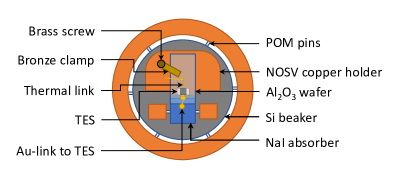
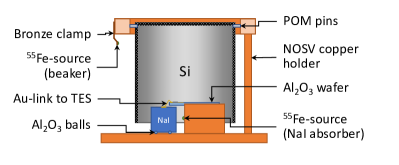
- The detector uses a 3.67 g NaI crystal with a silicon-based light detector and transition edge sensors (TESs) for phonon readout via the remoTES scheme.
- The dual-channel readout enables event-by-event discrimination between electron/gamma events and nuclear recoils based on the ratio of light to phonon signals.
- Energy resolution was measured for nuclear recoils, achieving a baseline resolution of 441 eV (σ) in the phonon channel.
- Theoretical modeling of the expected signal rate used the standard halo model with Helm form factors for sodium and iodine nuclei.
- Yellin’s optimum interval method was applied to compute 90% confidence level upper limits on the spin-independent scattering cross-section.
- Background data from the region of interest (ROI) and acceptance region were analyzed separately to assess the impact of discrimination performance on sensitivity.
Experimental results
Research questions
- RQ1Can a NaI-based cryogenic scintillating calorimeter with remoTES readout achieve sub-keV energy resolution in a deep-underground environment?
- RQ2To what extent does event-by-event particle discrimination improve sensitivity to dark matter compared to single-channel detectors?
- RQ3What are the experimentally measured quenching factors for sodium and iodine at 10 keV in NaI crystals?
- RQ4What sensitivity limit can be achieved on the spin-independent dark matter-nucleon scattering cross-section with only 11.6 g·d of exposure?
- RQ5How do leakage events from electron/gamma backgrounds affect the sensitivity, and what improvements are expected in the final low-background COSINUS setup?
Key findings
- A nuclear recoil energy resolution of 441 eV (σ) was achieved in the phonon channel, representing a five-fold improvement over previous baselines.
- The measured quenching factors were QF_Na(10 keV) = 0.2002 ± 0.0093 and QF_I(10 keV) = 0.0825 ± 0.0034, consistent with theoretical expectations.
- The 90% confidence level upper limit on the spin-independent dark matter-nucleon scattering cross-section reached the pb scale with only 11.6 g·d of exposure.
- The limit based on events in the acceptance region (solid line in Fig. 5) was up to two orders of magnitude stricter than the limit from all ROI events, demonstrating the power of event-by-event discrimination.
- The sensitivity of this prototype with 11.6 g·d exposure is only three orders of magnitude less stringent than COSINE-100’s limit from 6303.9 kg·d exposure, highlighting the efficiency of the dual-channel approach.
- Leakage from electron/gamma bands—primarily from the 55Fe calibration source and refrigerator background—was identified as the main limitation, with expected improvement in the final low-background COSINUS setup.
Read this paper
Open the full text in the Nubint reader and ask about any passage as you read.
Read this paper on NubintThis review was generated by AI from the original paper. Please check the paper before citing it.