
[Paper Review] DeepBF: Malicious URL detection using Learned Bloom Filter and Evolutionary Deep Learning
This paper proposes deepBF, a two-stage malicious URL detection system combining a self-adjusted 2D Bloom Filter with an evolutionary convolutional neural network (evoCNN). It uses a modified Murmur2 hash function in a 2D Bloom Filter to reduce false positives and accelerate filtering, while evoCNN classifies previously unseen URLs; the system achieves high accuracy with reduced computational load by offloading common URLs to the fast filter layer.
Malicious URL detection is an emerging research area due to continuous modernization of various systems, for instance, Edge Computing. In this article, we present a novel malicious URL detection technique, called deepBF (deep learning and Bloom Filter). deepBF is presented in two-fold. Firstly, we propose a learned Bloom Filter using 2-dimensional Bloom Filter. We experimentally decide the best non-cryptography string hash function. Then, we derive a modified non-cryptography string hash function from the selected hash function for deepBF by introducing biases in the hashing method and compared among the string hash functions. The modified string hash function is compared to other variants of diverse non-cryptography string hash functions. It is also compared with various filters, particularly, counting Bloom Filter, Kirsch extit{et al.}, and Cuckoo Filter using various use cases. The use cases unearth weakness and strength of the filters. Secondly, we propose a malicious URL detection mechanism using deepBF. We apply the evolutionary convolutional neural network to identify the malicious URLs. The evolutionary convolutional neural network is trained and tested with malicious URL datasets. The output is tested in deepBF for accuracy. We have achieved many conclusions from our experimental evaluation and results and are able to reach various conclusive decisions which are presented in the article.
Motivation & Objective
- To address the growing challenge of detecting malicious URLs in modern systems like Edge Computing and IoT.
- To reduce the computational burden on deep learning models by pre-filtering known URLs using an optimized Bloom Filter.
- To improve Bloom Filter accuracy and efficiency through a self-adjusted 2D structure and a bias-enhanced, non-cryptographic hash function.
- To evaluate the performance of deepBF against established filters (e.g., Cuckoo, counting Bloom, Kirsch) and demonstrate its superiority in false positive rate and memory efficiency.
- To validate the end-to-end system using real malicious URL datasets and show that the hybrid approach maintains high detection accuracy while minimizing model inference load.
Proposed method
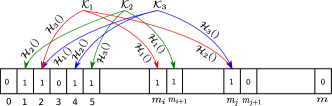
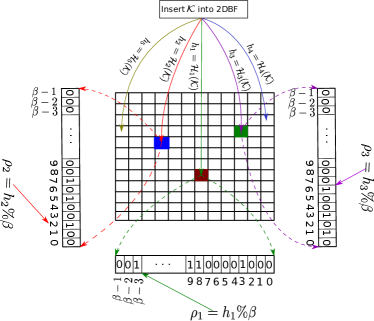
- Design a 2D Bloom Filter using prime-numbered dimensions (m ≠ n) to improve hash distribution and reduce collisions.
- Select and modify the Murmur2 hash function as the optimal non-cryptographic string hash function after experimental comparison with alternatives including MMurmur and SHA512.
- Introduce intentional biases and redundancies into the hash function to enhance performance without increasing false positive probability (FPP), as validated experimentally.
- Implement a two-layer filtering mechanism: first query malignant (μBF) and benign (βBF) 2D Bloom Filters; if both return false, forward the URL to the evoCNN for classification.
- Train and test an evolutionary convolutional neural network (evoCNN) on a public malicious URL dataset (Mamun dataset) to classify new URLs.
- Integrate the evoCNN output into the system: insert confirmed malicious URLs into μBF and benign ones into βBF, enabling the system to learn and adapt over time.
Experimental results
Research questions
- RQ1Can a self-adjusted 2D Bloom Filter with a modified non-cryptographic hash function outperform traditional and advanced Bloom Filter variants in terms of false positive probability and memory efficiency?
- RQ2Does introducing intentional biases and redundancies into the hash function degrade the false positive rate of the Bloom Filter, despite reducing cryptographic strength?
- RQ3How effective is the two-layer filtering architecture (Bloom Filters + evoCNN) in reducing the load on the deep learning model while maintaining high detection accuracy?
- RQ4What is the comparative performance of deepBF against established filters like Cuckoo Filter, counting Bloom Filter, and Kirsch et al. in diverse real-world test cases?
- RQ5To what extent can the learned behavior of the Bloom Filter (via repeated insertions) improve long-term detection accuracy without retraining the evoCNN?
Key findings
- The modified Murmur2 hash function outperformed other non-cryptographic hash functions, including MMurmur and SHA512, in terms of FPP and speed, despite introducing higher biases and redundancies.
- Cryptography-based hash functions like SHA512 were found to be unnecessary for Bloom Filters due to their high computational cost and no significant improvement in FPP, contradicting common assumptions.
- deepBF achieved lower false positive probability than Cuckoo Filter (CF), which exhibited unpredictable FPP and memory bloat, especially with large key sizes or repeated runs.
- The counting Bloom Filter (CBF) had higher memory footprint and worse FPP than conventional Bloom Filters under the same memory constraints, despite supporting deletion operations.
- The two-layer architecture significantly reduced the load on the evoCNN: only new, unseen URLs were passed to the deep learning model, improving system efficiency.
- deepBF demonstrated stable performance across multiple runs, unlike CF, which showed inconsistent behavior and potential crash under repeated execution due to poor hash seeding and design flaws.
Read this paper
Open the full text in the Nubint reader and ask about any passage as you read.
Read this paper on NubintThis review was generated by AI from the original paper. Please check the paper before citing it.