
[Paper Review] DeepCache: Accelerating Diffusion Models for Free
DeepCache accelerates diffusion models at inference time by caching high-level features across sequential denoising steps in U-Net architectures, reusing them to reduce redundant computation. It achieves 2.3× speedup for Stable Diffusion v1.5 with only a 0.05 drop in CLIP Score and 4.1× speedup for LDM-4-G with a 0.22 FID increase, all without retraining or model fine-tuning.
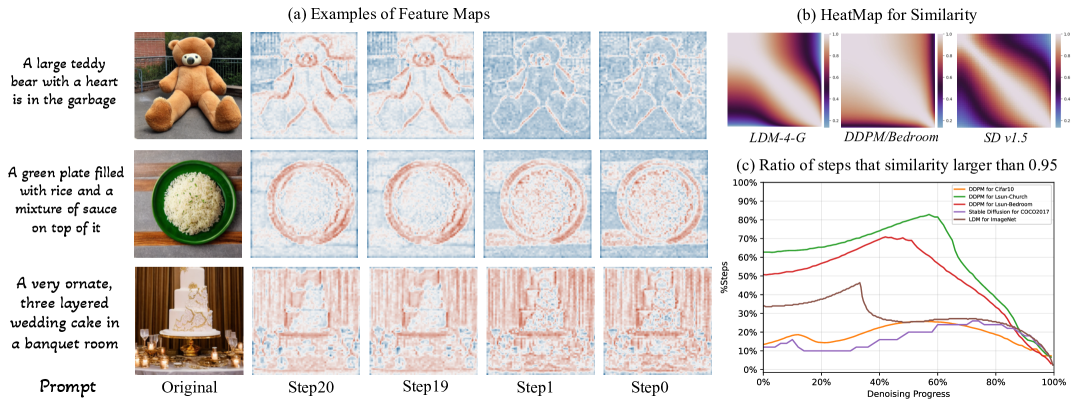
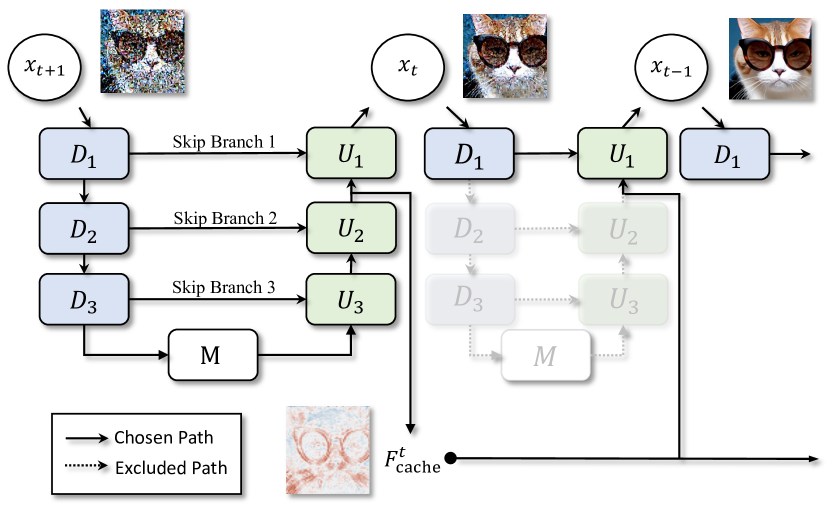
Diffusion models have recently gained unprecedented attention in the field of image synthesis due to their remarkable generative capabilities. Notwithstanding their prowess, these models often incur substantial computational costs, primarily attributed to the sequential denoising process and cumbersome model size. Traditional methods for compressing diffusion models typically involve extensive retraining, presenting cost and feasibility challenges. In this paper, we introduce DeepCache, a novel training-free paradigm that accelerates diffusion models from the perspective of model architecture. DeepCache capitalizes on the inherent temporal redundancy observed in the sequential denoising steps of diffusion models, which caches and retrieves features across adjacent denoising stages, thereby curtailing redundant computations. Utilizing the property of the U-Net, we reuse the high-level features while updating the low-level features in a very cheap way. This innovative strategy, in turn, enables a speedup factor of 2.3$ imes$ for Stable Diffusion v1.5 with only a 0.05 decline in CLIP Score, and 4.1$ imes$ for LDM-4-G with a slight decrease of 0.22 in FID on ImageNet. Our experiments also demonstrate DeepCache's superiority over existing pruning and distillation methods that necessitate retraining and its compatibility with current sampling techniques. Furthermore, we find that under the same throughput, DeepCache effectively achieves comparable or even marginally improved results with DDIM or PLMS. The code is available at https://github.com/horseee/DeepCache
Motivation & Objective
- Address the high computational cost of diffusion model inference, particularly due to sequential denoising and large model sizes.
- Overcome the limitations of existing compression methods that require retraining, such as pruning and knowledge distillation.
- Enable training-free acceleration by exploiting inherent temporal redundancy in high-level features across denoising steps.
- Achieve significant speedups while maintaining or slightly improving generation quality compared to fast samplers like DDIM and PLMS.
Proposed method
- Cache high-level features from previous denoising steps in the U-Net architecture to avoid recomputing them in subsequent steps.
- Leverage the U-Net’s skip connections to update only low-level features at each step, while reusing high-level features from the cache.
- Introduce a non-uniform 1:N caching strategy that allows longer intervals between full model inference steps, optimizing for efficiency.
- Apply the caching mechanism dynamically during inference without modifying the pre-trained model weights or requiring fine-tuning.
- Use a shallow U-Net head to perform lightweight inference on cached features, minimizing additional computation.
- Integrate seamlessly with existing sampling methods like DDIM and PLMS, acting as a complementary acceleration layer.
Experimental results
Research questions
- RQ1Can temporal redundancy in high-level features across denoising steps be exploited to accelerate diffusion model inference without retraining?
- RQ2How effective is feature caching in reducing computational overhead while preserving generation quality in diffusion models?
- RQ3What is the optimal caching interval (N) that balances speedup and image quality degradation?
- RQ4How does DeepCache compare to retraining-based compression methods like pruning and distillation in terms of speed and quality?
- RQ5Can DeepCache be effectively combined with fast samplers like DDIM and PLMS to further improve throughput and quality?
Key findings
- DeepCache achieves a 2.3× speedup for Stable Diffusion v1.5 with only a 0.05 decrease in CLIP Score, demonstrating minimal quality loss.
- For LDM-4-G on ImageNet, DeepCache delivers a 4.1× speedup with a 0.22 FID increase, outperforming retraining-based compression methods.
- The method maintains or slightly improves generation quality compared to DDIM and PLMS under the same throughput, as shown in FID and sFID metrics.
- Ablation studies confirm that cached features are critical—removing them reduces performance significantly, with FID increasing from 4.35 to 192.98 on Cifar10.
- Shallow network inference on cached features improves performance over baseline DDIM, reducing FID by 2.98 for 10-step inference.
- Performance degrades with large caching intervals (e.g., N=20), indicating an upper bound on achievable speedup due to feature drift.
Read this paper
Open the full text in the Nubint reader and ask about any passage as you read.
Read this paper on NubintThis review was generated by AI from the original paper. Please check the paper before citing it.