
[Paper Review] DeepFilterNet: Perceptually Motivated Real-Time Speech Enhancement
DeepFilterNet delivers real-time single-channel speech enhancement by combining coarse envelope enhancement with multi-frame complex filtering, achieving a real-time factor of 0.19 on a notebook CPU while matching state-of-the-art benchmarks.
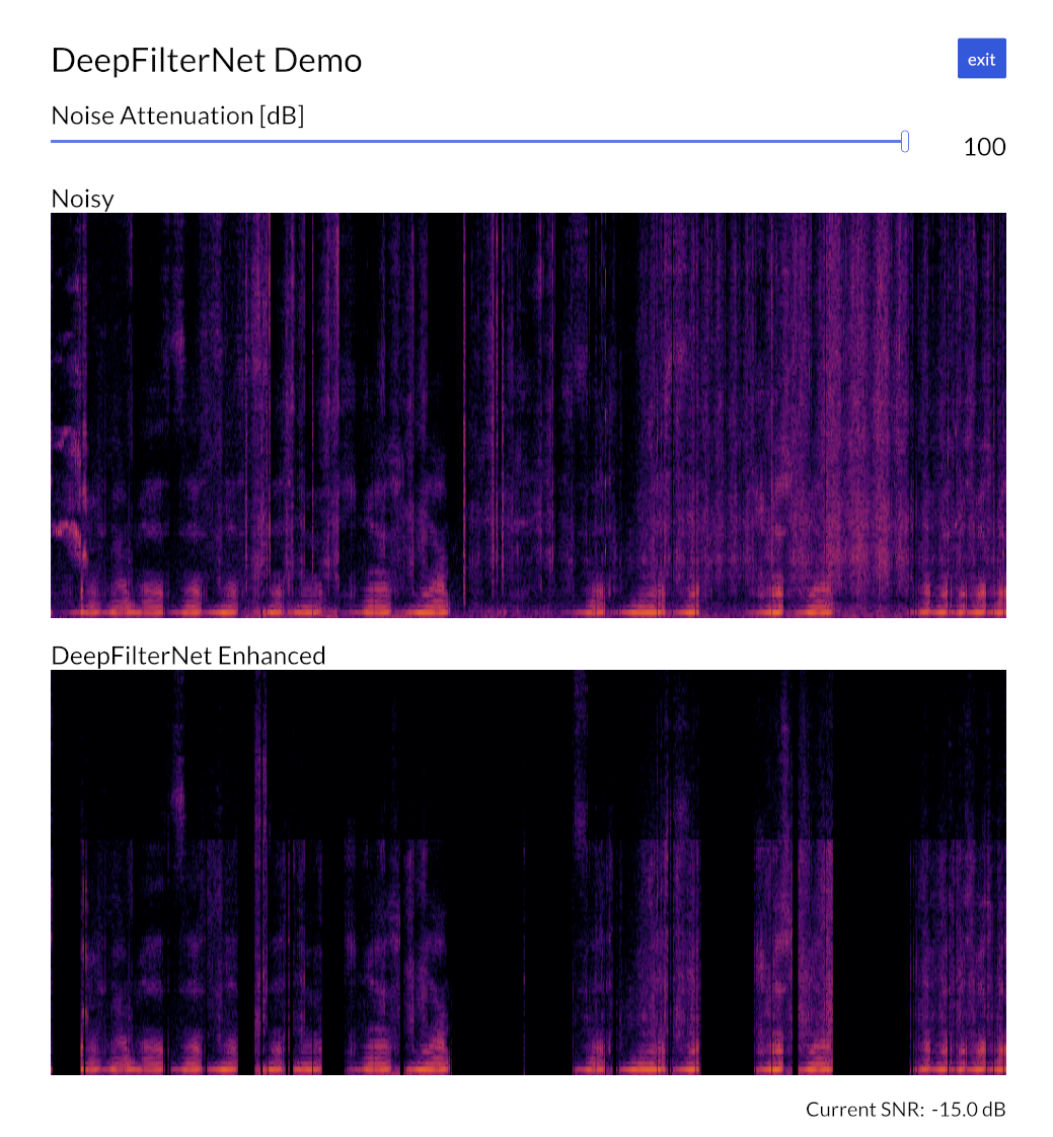
Multi-frame algorithms for single-channel speech enhancement are able to take advantage from short-time correlations within the speech signal. Deep Filtering (DF) was proposed to directly estimate a complex filter in frequency domain to take advantage of these correlations. In this work, we present a real-time speech enhancement demo using DeepFilterNet. DeepFilterNet's efficiency is enabled by exploiting domain knowledge of speech production and psychoacoustic perception. Our model is able to match state-of-the-art speech enhancement benchmarks while achieving a real-time-factor of 0.19 on a single threaded notebook CPU. The framework as well as pretrained weights have been published under an open source license.
Motivation & Objective
- Leverage psychoacoustic and speech production knowledge to guide real-time speech enhancement.
- Improve efficiency to enable real-time deployment on consumer CPUs.
- Combine envelope-based enhancement with deep filtering to preserve both speech envelope and periodicity.
Proposed method
- Two-stage speech enhancement framework operating at 48 kHz with 20 ms windows and 10 ms hop.
- First stage predicts 32 ERB-scaled gains to enhance the speech envelope in real frequency bands.
- Second stage predicts a 5-tap complex frequency-domain filter applied to the lowest 96 frequency bins (up to ~5 kHz).
- Use look-ahead of 2 frames yielding 40 ms total latency.
- Directly estimate a complex DF filter in frequency domain to exploit short-time correlations.
- Local SNR is inferred to adaptively disable stages under certain noise conditions.

Experimental results
Research questions
- RQ1Can a two-stage approach (ERB-domain envelope enhancement and multi-frame complex filtering) match state-of-the-art speech enhancement while maintaining real-time performance?
- RQ2How does exploiting psychoacoustic cues (ERB, logarithmic loudness/frequency) impact perceptual gains and computational efficiency?
- RQ3What are the real-time performance and objective metric outcomes on standard benchmarks for DeepFilterNet?
- RQ4Is adaptive gating (disabling stages based on estimated SNR) effective in preserving quality and saving compute?
Key findings
- Achieves competitive objective metrics on the Voicebank+Demand test set, with DeepFilterNet3 yielding PESQ 3.17, CSIG 4.34, CBAK 3.61, COVL 3.77, STOI 0.944.
- Outperforms earlier variants (DeepFilterNet and DeepFilterNet2) on several metrics, e.g., PESQ improving from 2.81 to 3.17 and STOI from 0.942 to 0.944.
- Demonstrates real-time capability with a single-threaded RT-factor of 0.19 on an i5-8250U CPU.
- Provides a live demo and potential integration as a Linux LADSPA plugin for real-time noise reduction during video calls.
Read this paper
Open the full text in the Nubint reader and ask about any passage as you read.
Read this paper on NubintThis review was generated by AI from the original paper. Please check the paper before citing it.