
[Paper Review] DeepMatcher: A Deep Transformer-based Network for Robust and Accurate Local Feature Matching
DeepMatcher proposes a deep Transformer-based network with a novel Slimming Transformer (SlimFormer) architecture to enable robust and accurate local feature matching under extreme viewpoint changes. By integrating relative position encoding, a layer-scale strategy, Feature Transition Module, and a Fine Matches Module for joint confidence and offset prediction, it achieves state-of-the-art performance with lower FLOPs than prior methods.
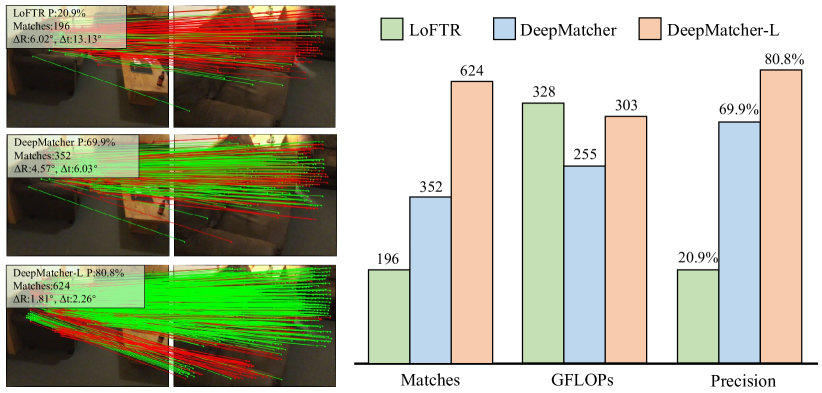
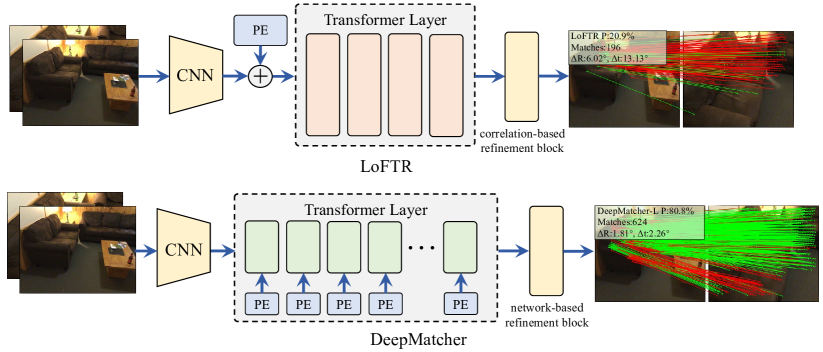
Local feature matching between images remains a challenging task, especially in the presence of significant appearance variations, e.g., extreme viewpoint changes. In this work, we propose DeepMatcher, a deep Transformer-based network built upon our investigation of local feature matching in detector-free methods. The key insight is that local feature matcher with deep layers can capture more human-intuitive and simpler-to-match features. Based on this, we propose a Slimming Transformer (SlimFormer) dedicated for DeepMatcher, which leverages vector-based attention to model relevance among all keypoints and achieves long-range context aggregation in an efficient and effective manner. A relative position encoding is applied to each SlimFormer so as to explicitly disclose relative distance information, further improving the representation of keypoints. A layer-scale strategy is also employed in each SlimFormer to enable the network to assimilate message exchange from the residual block adaptively, thus allowing it to simulate the human behaviour that humans can acquire different matching cues each time they scan an image pair. To facilitate a better adaption of the SlimFormer, we introduce a Feature Transition Module (FTM) to ensure a smooth transition in feature scopes with different receptive fields. By interleaving the self- and cross-SlimFormer multiple times, DeepMatcher can easily establish pixel-wise dense matches at coarse level. Finally, we perceive the match refinement as a combination of classification and regression problems and design Fine Matches Module to predict confidence and offset concurrently, thereby generating robust and accurate matches. Experimentally, we show that DeepMatcher significantly outperforms the state-of-the-art methods on several benchmarks, demonstrating the superior matching capability of DeepMatcher.
Motivation & Objective
- Address the challenge of local feature matching under extreme viewpoint changes where detector-based methods fail due to lack of repeatable keypoints.
- Overcome limitations in deep Transformer-based matching networks, such as poor long-range context aggregation and loss of positional information in deeper layers.
- Improve matching accuracy and robustness by simulating human-like scanning behavior through deep, layered feature interaction and adaptive message passing.
- Reduce computational cost while enhancing performance by designing a compact yet deep architecture with efficient attention mechanisms and structured feature transitions.
Proposed method
- Proposes a Slimming Transformer (SlimFormer) that uses vector-based attention to model global relevance among all keypoints, enabling efficient long-range context aggregation.
- Introduces relative position encoding in each SlimFormer layer to explicitly encode relative spatial relationships between keypoints, improving discrimination in symmetric or repetitive scenes.
- Employs a learnable layer-scale strategy to adaptively control message propagation from residual blocks, simulating human visual scanning behavior across multiple image pair inspections.
- Designs a Feature Transition Module (FTM) to ensure smooth feature transition between the CNN-based feature extractor and the SlimFormer, aligning receptive fields across different levels.
- Interleaves self- and cross-SlimFormer layers multiple times to build coarse-level dense matches through iterative inter-image and intra-image feature refinement.
- Develops a Fine Matches Module that jointly predicts confidence scores and spatial offsets for coarse matches, treating refinement as a combined classification and regression task for higher accuracy.
Experimental results
Research questions
- RQ1Can a deep Transformer-based architecture significantly improve local feature matching robustness under extreme viewpoint variations compared to existing state-of-the-art methods?
- RQ2How does relative position encoding compare to absolute position encoding in enhancing feature representation for matching in ambiguous or symmetric scenes?
- RQ3To what extent does a layer-scale strategy that mimics human visual scanning improve matching performance in deep networks?
- RQ4What is the contribution of the Feature Transition Module in maintaining consistent context range across feature extraction and attention stages?
- RQ5Does joint prediction of confidence and offset in a fine matching module lead to more accurate and reliable matches than traditional coarse-to-fine refinement?
Key findings
- DeepMatcher achieves a pose estimation AUC of 25.38% on the Scannet dataset, outperforming the next best method by 1.64% in AUC and 2.12% in @5° accuracy.
- Removing the relative position encoding leads to a 1.36% drop in AUC, demonstrating its critical role in distinguishing similar features under large viewpoint changes.
- The Fine Matches Module improves AUC by 8.34% compared to removing it, confirming the effectiveness of joint confidence and offset prediction for refinement.
- The Feature Transition Module contributes significantly, with a 0.66% accuracy gain when included, showing its importance in maintaining consistent feature context across stages.
- The layer-scale strategy improves performance by 0.88% in AUC, validating its role in enabling adaptive message exchange across deeper layers.
- Relative position encoding outperforms absolute position encoding by 0.86% in AUC, confirming its superiority in modeling spatial relationships for matching.
Read this paper
Open the full text in the Nubint reader and ask about any passage as you read.
Read this paper on NubintThis review was generated by AI from the original paper. Please check the paper before citing it.