
[Paper Review] DeepSRGM -- Sequence Classification and Ranking in Indian Classical Music with Deep Learning
DeepSRGM uses LSTM with attention to perform Raga recognition as sequence classification and introduces sequence ranking for Raga-based content retrieval, achieving state-of-the-art results on the Comp Music Carnatic Dataset.
A vital aspect of Indian Classical Music (ICM) is Raga, which serves as a melodic framework for compositions and improvisations alike. Raga Recognition is an important music information retrieval task in ICM as it can aid numerous downstream applications ranging from music recommendations to organizing huge music collections. In this work, we propose a deep learning based approach to Raga recognition. Our approach employs efficient pre possessing and learns temporal sequences in music data using Long Short Term Memory based Recurrent Neural Networks (LSTM-RNN). We train and test the network on smaller sequences sampled from the original audio while the final inference is performed on the audio as a whole. Our method achieves an accuracy of 88.1% and 97 % during inference on the Comp Music Carnatic dataset and its 10 Raga subset respectively making it the state-of-the-art for the Raga recognition task. Our approach also enables sequence ranking which aids us in retrieving melodic patterns from a given music data base that are closely related to the presented query sequence.
Motivation & Objective
- Address automatic Raga recognition in Indian Classical Music (ICM) to support organization and recommendation of large music collections.
- Reformulate Raga recognition as a sequence classification problem using LSTM-RNN with attention.
- Introduce sequence ranking to retrieve sequences closely related to a query sequence for content-based retrieval.
Proposed method
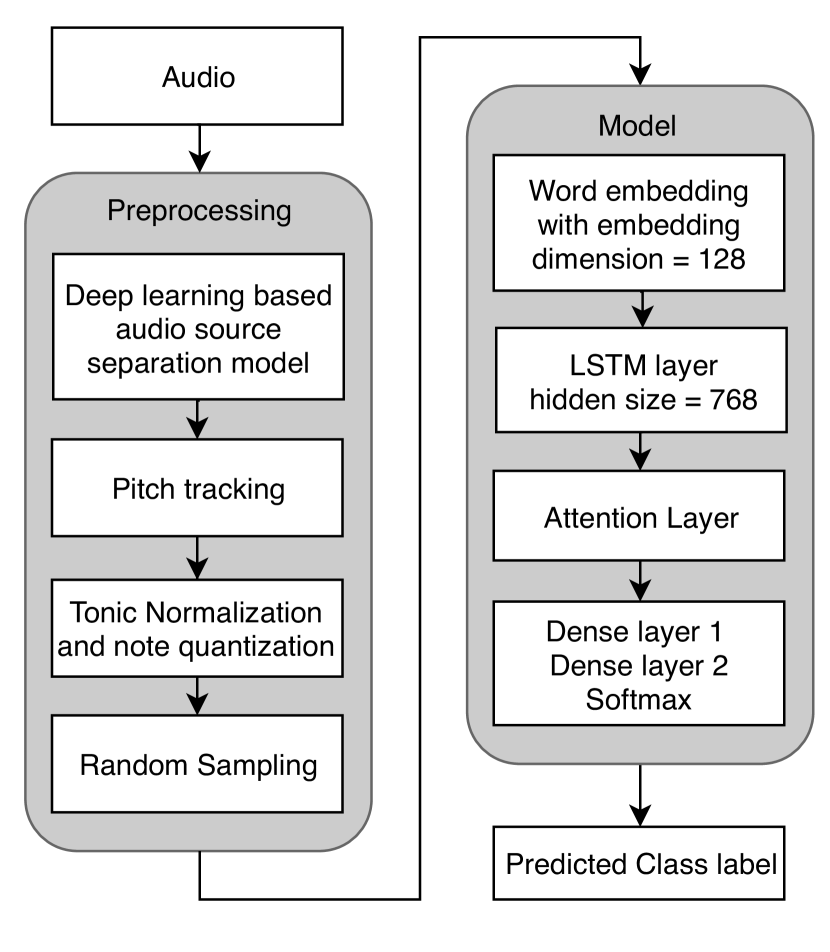
- Preprocess audio with vocal source separation and pitch tracking.
- Tonally normalize using a tonic-based centering in cents.
- Train an LSTM-RNN with 768 hidden units and 128-dim note embeddings, followed by attention and dense layers.
- Use categorical cross-entropy loss and Adam optimizer with distributed asynchronous SGD for training.
Experimental results
Research questions
- RQ1Can Raga recognition be effectively modeled as a sequence classification problem using LSTM with attention on pitch-quantized sequences?
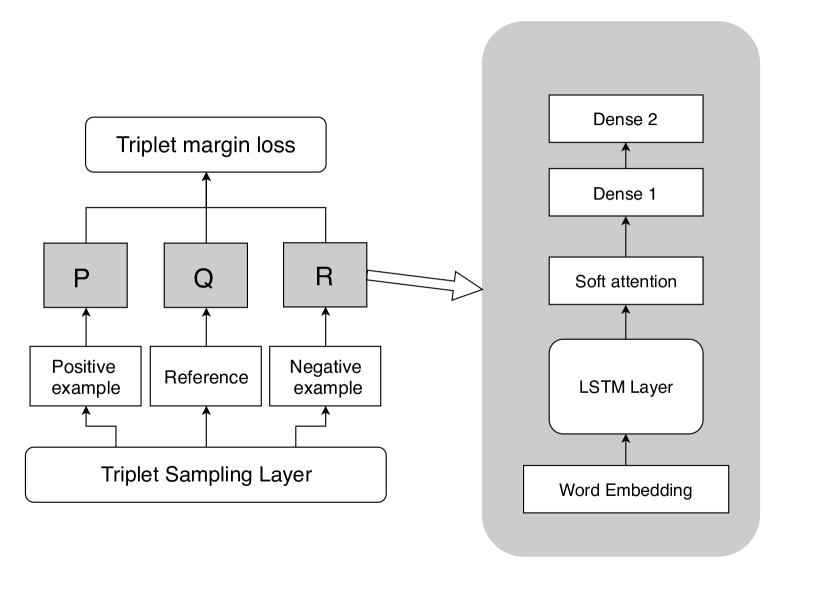
- RQ2Does a fine-tuned model using triplet loss enable reliable sequence ranking for Raga-based retrieval?
- RQ3How do subsequence length and sampling affect recognition and ranking performance on CMD?
- RQ4What are the state-of-the-art performance levels on CMD-10 and CMD-40 using SRGM1 and its ensemble?
- RQ5Can the model generalize for content-based retrieval within large ICM datasets?
Key findings
- SRGM1 achieves 95.6% accuracy on CMD-10 Ragascales and 84.6% on CMD-40 Ragascales.
- SRGM1 Ensemble improves to 97.1% (CMD-10) and 88.1% (CMD-40).
- SRGM2 (sequence ranking) yields top-30 precision of 81.83% and top-10 precision of 81.68%.
- The model outperforms prior TDMS, VSM, and PCD-based methods on CMD and CMD-10 subsets.
- Longer subsequences (e.g., 6000 steps) converge faster and yield better stability than shorter subsequences.
- Training with randomized subsequences and attention-based LSTM improves Raga recognition performance.
Read this paper
Open the full text in the Nubint reader and ask about any passage as you read.
Read this paper on NubintThis review was generated by AI from the original paper. Please check the paper before citing it.