
[Paper Review] Defending Multimodal Fusion Models against Single-Source Adversaries
This paper proposes a robust fusion strategy that detects and filters adversarial perturbations in a single modality by leveraging multimodal consistency through odd-one-out learning, significantly improving single-source adversarial robustness across action recognition, object detection, and sentiment analysis without degrading clean data performance.
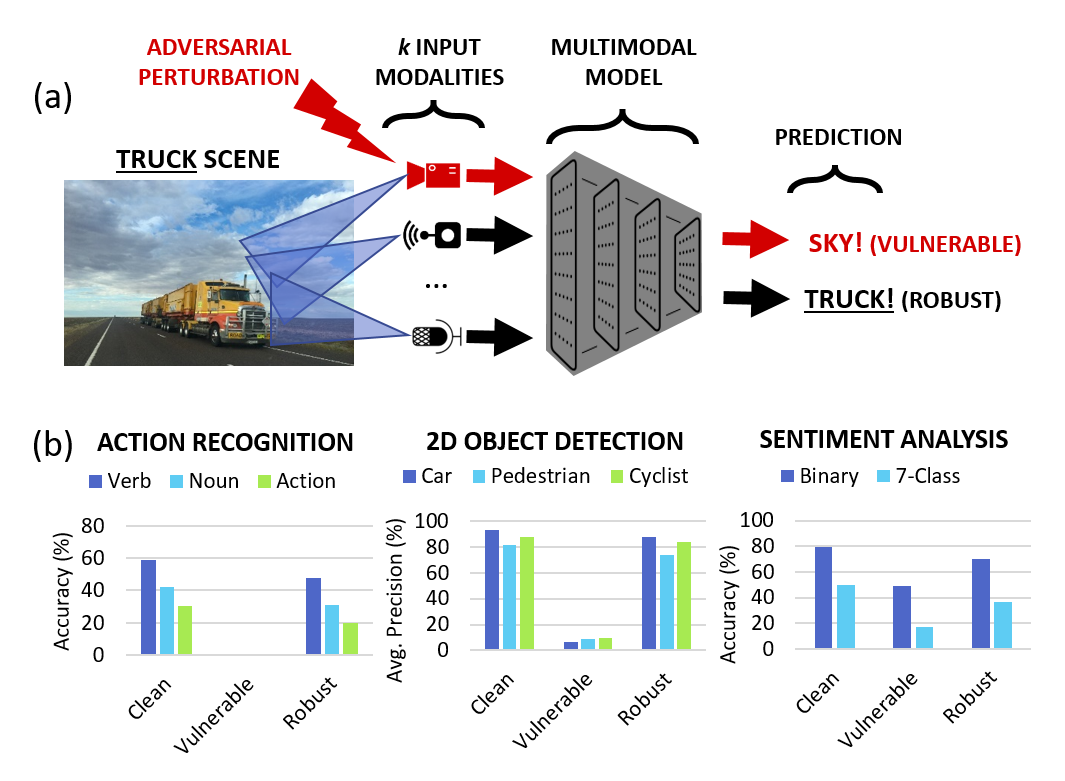
Beyond achieving high performance across many vision tasks, multimodal models are expected to be robust to single-source faults due to the availability of redundant information between modalities. In this paper, we investigate the robustness of multimodal neural networks against worst-case (i.e., adversarial) perturbations on a single modality. We first show that standard multimodal fusion models are vulnerable to single-source adversaries: an attack on any single modality can overcome the correct information from multiple unperturbed modalities and cause the model to fail. This surprising vulnerability holds across diverse multimodal tasks and necessitates a solution. Motivated by this finding, we propose an adversarially robust fusion strategy that trains the model to compare information coming from all the input sources, detect inconsistencies in the perturbed modality compared to the other modalities, and only allow information from the unperturbed modalities to pass through. Our approach significantly improves on state-of-the-art methods in single-source robustness, achieving gains of 7.8-25.2% on action recognition, 19.7-48.2% on object detection, and 1.6-6.7% on sentiment analysis, without degrading performance on unperturbed (i.e., clean) data.
Motivation & Objective
- To investigate the vulnerability of standard multimodal fusion models to single-source adversarial perturbations across diverse tasks.
- To address the lack of empirical studies on single-source adversarial robustness in multimodal systems.
- To develop a defense strategy that enhances robustness without degrading performance on clean data.
- To enable practical robustness in real-world multimodal systems by avoiding resource-intensive end-to-end adversarial training.
Proposed method
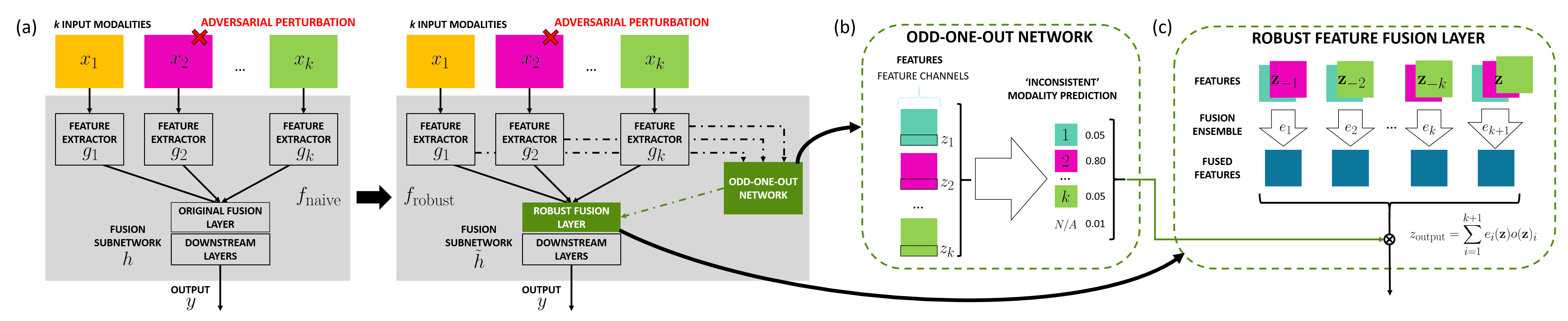
- Introduces an odd-one-out network that identifies the inconsistent modality among three inputs by comparing features across modalities.
- Trains the odd-one-out network using odd-one-out learning, where the model learns to detect which modality deviates from the other two.
- Employs a robust fusion network that suppresses features from the detected perturbed modality and fuses only consistent features from the remaining modalities.
- Uses unaligned features from pretrained modality-specific feature extractors as input to the odd-one-out network, preserving contextual information for detection.
- Applies a two-stage training process: first, the odd-one-out network is trained to detect adversarial inputs; second, the fusion network is trained using the detected consistent features.
- Limits adversarial training to only the fusion and odd-one-out network parameters, reducing computational cost compared to full model adversarial training.
Experimental results
Research questions
- RQ1Are standard multimodal fusion models vulnerable to single-source adversarial perturbations, even when multiple unperturbed modalities are available?
- RQ2Can multimodal consistency be leveraged to detect and filter adversarial inputs from a single modality?
- RQ3Can a robust fusion strategy improve adversarial robustness without degrading performance on clean, unperturbed data?
- RQ4How does the performance of the odd-one-out detection mechanism vary across different levels of modality redundancy?
- RQ5Can the proposed method defend against adaptive, white-box attacks that have access to the defense mechanism?
Key findings
- Standard multimodal fusion models are highly vulnerable to single-source adversarial attacks, with performance dropping below that of unimodal models under the same attack.
- The proposed odd-one-out learning approach achieves 7.8–25.2% improvement in single-source robustness on action recognition (EPIC-Kitchens).
- On 2D object detection (KITTI), the method achieves 19.7–48.2% gains in robustness, demonstrating strong effectiveness in high-redundancy settings.
- For sentiment analysis (CMU-MOSI), the approach improves robustness by 1.6–6.7%, showing applicability across diverse tasks.
- The method maintains clean performance comparable to standard fusion models, with no significant degradation on unperturbed data.
- Only 3.3% of model parameters (on KITTI) need to be retrained for robustness, significantly reducing resource costs compared to end-to-end adversarial training.
Read this paper
Open the full text in the Nubint reader and ask about any passage as you read.
Read this paper on NubintThis review was generated by AI from the original paper. Please check the paper before citing it.