
[Paper Review] Defending Your Voice: Adversarial Attack on Voice Conversion
This paper presents the first adversarial attack on voice conversion systems to defend personal speaker identity. By injecting human-imperceptible noise into a speaker's utterances, the method disrupts zero-shot voice conversion models so that converted outputs no longer sound like the defended speaker, while the adversarial inputs remain indistinguishable from authentic speech in both objective and subjective evaluations across white-box and black-box settings.
Substantial improvements have been achieved in recent years in voice conversion, which converts the speaker characteristics of an utterance into those of another speaker without changing the linguistic content of the utterance. Nonetheless, the improved conversion technologies also led to concerns about privacy and authentication. It thus becomes highly desired to be able to prevent one's voice from being improperly utilized with such voice conversion technologies. This is why we report in this paper the first known attempt to perform adversarial attack on voice conversion. We introduce human imperceptible noise into the utterances of a speaker whose voice is to be defended. Given these adversarial examples, voice conversion models cannot convert other utterances so as to sound like being produced by the defended speaker. Preliminary experiments were conducted on two currently state-of-the-art zero-shot voice conversion models. Objective and subjective evaluation results in both white-box and black-box scenarios are reported. It was shown that the speaker characteristics of the converted utterances were made obviously different from those of the defended speaker, while the adversarial examples of the defended speaker are not distinguishable from the authentic utterances.
Motivation & Objective
- To address growing privacy concerns from advanced voice conversion technologies that can impersonate individuals.
- To develop a defense mechanism that prevents unauthorized voice conversion by making a speaker's voice resistant to conversion attacks.
- To explore adversarial attacks on generative models, specifically voice conversion, which remains under-investigated compared to discriminative models.
- To evaluate effectiveness through both objective speaker verification and subjective listening tests in realistic (black-box) scenarios.
Proposed method
- Inject human-imperceptible adversarial noise into the speaker's utterances before they are processed by a voice conversion model.
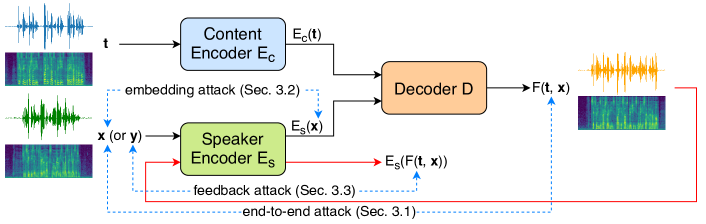
- Propose three attack strategies: end-to-end attack, embedding attack, and feedback attack, targeting different components of the voice conversion pipeline.
- Use a standard encoder-decoder architecture with separate content and speaker encoders, and perturb inputs to the speaker encoder to alter speaker representation.
- Optimize the perturbation using a loss function that maximizes the difference between the defended speaker and the converted output in speaker embedding space.
- Apply the attack in both white-box (full model access) and black-box (proxy model) settings to simulate real-world deployment.
- Validate the attack using objective metrics (e.g., speaker verification accuracy) and subjective listening tests with human raters.
Experimental results
Research questions
- RQ1Can adversarial noise be used to disrupt zero-shot voice conversion models without degrading the perceptual quality of the original utterance?
- RQ2How effective is the adversarial attack in making converted speech sound different from the defended speaker in both objective and subjective evaluations?
- RQ3Does the attack remain effective in a black-box scenario where the attacker has limited knowledge of the target model?
- RQ4To what extent do human listeners perceive the adversarial outputs as different from the defended speaker compared to the original?
- RQ5Can the attack be applied to state-of-the-art voice conversion models like Chou’s and AutoVC with consistent results?
Key findings
- In white-box scenarios, the speaker verification accuracy for adversarial outputs dropped to 1.5% for Chou’s model and 2.5% for AutoVC, indicating a significant deviation from the defended speaker.
- Subjective evaluations showed that over 58% of listeners judged adversarial outputs as coming from a different speaker (category I), while over 70% perceived adversarial inputs as identical to the original speaker.
- The black-box attack remained effective, with 12.0% and 19.5% of speaker verification scores indicating the converted speech was from a different speaker for Chou’s and AutoVC models, respectively.
- For AutoVC, only 27% of listeners perceived the original output as the same speaker, suggesting a mismatch between objective metrics and human perception.
- The proposed attack preserved audio quality, as adversarial inputs were not distinguishable from authentic utterances in both objective and subjective tests.
- The method demonstrated robustness across different models and settings, with consistent performance in both white-box and black-box evaluations.
Read this paper
Open the full text in the Nubint reader and ask about any passage as you read.
Read this paper on NubintThis review was generated by AI from the original paper. Please check the paper before citing it.