
[Paper Review] Defining the Middle Corona
This paper establishes a consensus definition for the middle corona as the region extending from approximately 1.5 to 6 solar radii (R⊙), based on physical transitions in magnetic field topology, plasma beta, and flow dynamics. The definition unifies observational and modeling perspectives to clarify a critical but historically ill-defined zone for solar wind acceleration and coronal heating research.
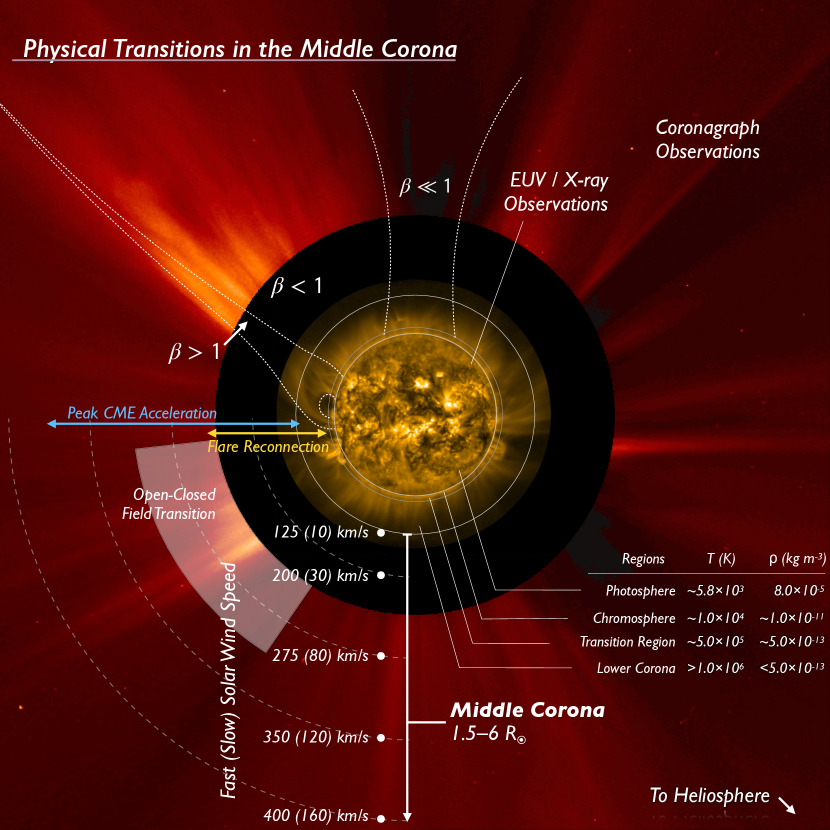
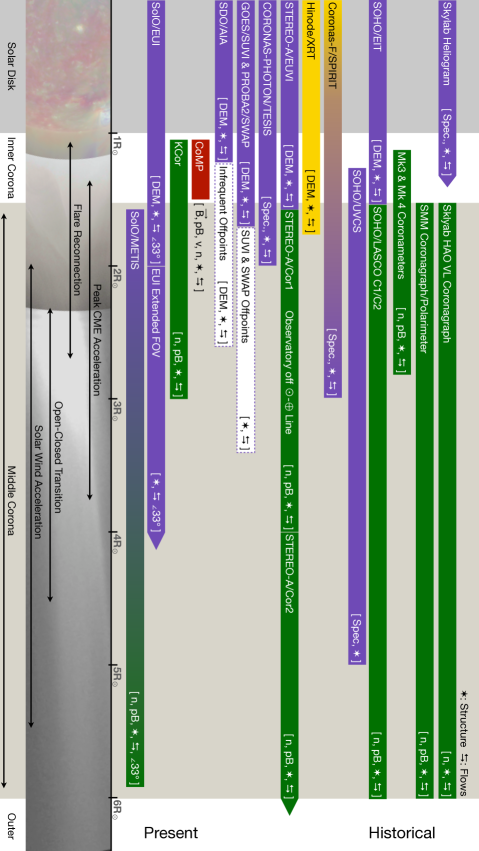
The middle corona, the region roughly spanning heliocentric altitudes from $1.5$ to $6\,R_\odot$, encompasses almost all of the influential physical transitions and processes that govern the behavior of coronal outflow into the heliosphere. Eruptions that could disrupt the near-Earth environment propagate through it. Importantly, it modulates inflow from above that can drive dynamic changes at lower heights in the inner corona. Consequently, this region is essential for comprehensively connecting the corona to the heliosphere and for developing corresponding global models. Nonetheless, because it is challenging to observe, the middle corona has been poorly studied by major solar remote sensing missions and instruments, extending back to the Solar and Heliospheric Observatory (SoHO) era. Thanks to recent advances in instrumentation, observational processing techniques, and a realization of the importance of the region, interest in the middle corona has increased. Although the region cannot be intrinsically separated from other regions of the solar atmosphere, there has emerged a need to define the region in terms of its location and extension in the solar atmosphere, its composition, the physical transitions it covers, and the underlying physics believed to be encapsulated by the region. This paper aims to define the middle corona and give an overview of the processes that occur there.
Motivation & Objective
- To resolve long-standing ambiguity in the boundaries of the middle corona, a region critical for solar wind acceleration and coronal heating.
- To establish a community-consensus definition of the middle corona based on physical transitions and historical observational context.
- To support future research by clarifying the region’s role in the Sun-Heliosphere system, particularly in relation to open/closed magnetic fields and plasma beta changes.
- To facilitate coordinated multi-instrument and multi-wavelength studies by defining a shared observational and modeling framework.
- To promote interdisciplinary collaboration through a standardized region definition, enabling focused study of complex coronal dynamics.
Proposed method
- Synthesized input from 50+ researchers across solar physics, spectroscopy, radio astronomy, and modeling through community-led workshops and online discussions.
- Evaluated observational evidence from coronal imaging, spectroscopy, radio bursts, and in-situ measurements to identify key physical transitions.
- Defined the inner boundary (~1.5 R⊙) as the height where closed magnetic field structures dominate and hydrostatic scale heights apply.
- Defined the outer boundary (~6 R⊙) as the region where plasma flow becomes fully radial and coronal structures transition to open-field outflow regimes.
- Used source surface models (e.g., PFSS) and observations of Sheeley Blobs to anchor the outer boundary at 3–6 R⊙.
- Integrated data from multiple missions (e.g., Ulysses, SOHO, STEREO, Parker Solar Probe) and instruments (e.g., SECCHI, SDO, Solar Orbiter) to validate the region boundaries.
Experimental results
Research questions
- RQ1What physical transitions define the middle corona, and how do they distinguish it from the inner and outer corona?
- RQ2Where exactly does the solar wind acceleration region begin, and how does this relate to magnetic field topology and plasma beta?
- RQ3How do observational constraints from radio, EUV, and spectroscopic data inform the boundaries of the middle corona?
- RQ4What role do magnetic reconnection and density inhomogeneities (e.g., Sheeley Blobs) play in defining the outer edge of the middle corona?
- RQ5How can a standardized definition of the middle corona improve modeling, observation, and collaboration across the solar physics community?
Key findings
- The middle corona is defined as the region extending from approximately 1.5 to 6 solar radii (R⊙), measured from the solar disk center.
- The inner boundary (~1.5 R⊙) corresponds to the height where closed magnetic field structures dominate and hydrostatic equilibrium begins to break down.
- The outer boundary (~6 R⊙) aligns with the transition to fully radial outflow and the disappearance of super-radial expansion in coronal structures.
- Observational evidence from coronal holes, streamers, and Sheeley Blobs supports the 3–6 R⊙ range as the outer limit of the middle corona.
- The region encapsulates key transitions, including the shift from closed to open magnetic fields and the rise in plasma beta in quiet-Sun regions.
- The consensus definition is grounded in both physical mechanisms and historical observational practices, enabling a unified framework for future research.
Read this paper
Open the full text in the Nubint reader and ask about any passage as you read.
Read this paper on NubintThis review was generated by AI from the original paper. Please check the paper before citing it.