
[Paper Review] DehazeNeRF: Multiple Image Haze Removal and 3D Shape Reconstruction using Neural Radiance Fields
DehazeNeRF proposes a physics-informed neural radiance field framework that jointly reconstructs 3D scene geometry and dehazes multi-view hazy images by extending NeRF's volume rendering with a physically based atmospheric scattering model. It achieves state-of-the-art performance in novel view synthesis and 3D reconstruction under hazy conditions without requiring paired clear-hazy datasets, outperforming existing methods in both synthetic and real-world data.
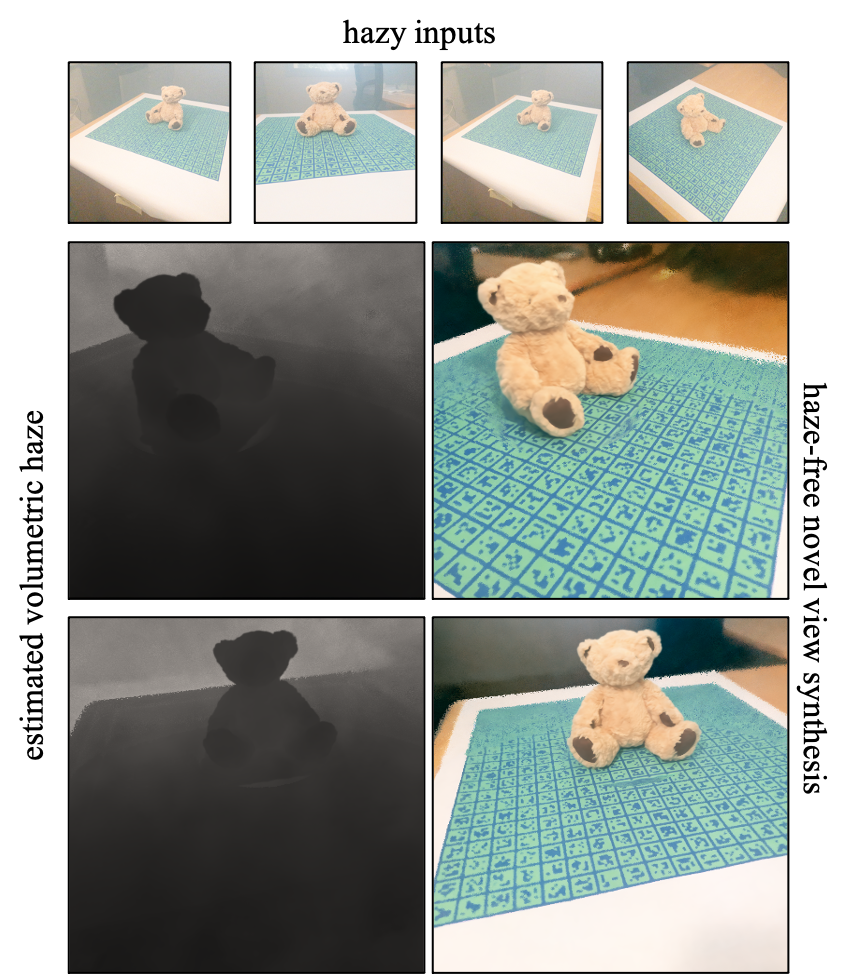
Neural radiance fields (NeRFs) have demonstrated state-of-the-art performance for 3D computer vision tasks, including novel view synthesis and 3D shape reconstruction. However, these methods fail in adverse weather conditions. To address this challenge, we introduce DehazeNeRF as a framework that robustly operates in hazy conditions. DehazeNeRF extends the volume rendering equation by adding physically realistic terms that model atmospheric scattering. By parameterizing these terms using suitable networks that match the physical properties, we introduce effective inductive biases, which, together with the proposed regularizations, allow DehazeNeRF to demonstrate successful multi-view haze removal, novel view synthesis, and 3D shape reconstruction where existing approaches fail.
Motivation & Objective
- To address the failure of standard NeRF in hazy conditions due to ambiguity between surface reflections and atmospheric scattering.
- To overcome the limitations of data-driven dehazing methods that generalize poorly to real-world data.
- To enable joint 3D shape reconstruction and haze-free novel view synthesis from multiple hazy images without paired clear-hazy supervision.
- To integrate physical scattering models directly into NeRF's rendering pipeline as inductive biases for improved disambiguation of haze and scene geometry.
Proposed method
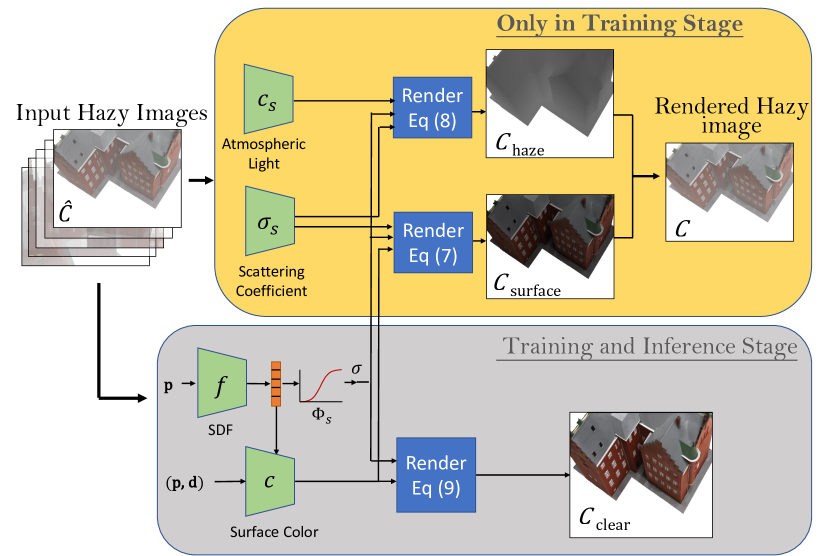
- Extends NeRF's volume rendering equation with a physically based 3D haze image formation model that accounts for atmospheric scattering.
- Introduces a scattering-aware rendering formulation that models in-scattering and extinction effects using a spatially varying scattering coefficient.
- Employs a surface-like density field parameterization (from NeuS) to encourage solid geometry and disambiguate surfaces from volumetric haze.
- Applies multiple regularization strategies, including a 2D photometric loss aligned with the Koschmieder law and a mask-free optimization scheme.
- Uses an MLP to predict spatially varying scattering coefficients, enabling heterogeneous haze modeling beyond constant atmospheric parameters.
- Optimizes for scene geometry, appearance, haze-free radiance, airlight, and scattering coefficients jointly from multiple posed hazy views.
Experimental results
Research questions
- RQ1Can a NeRF-based framework jointly reconstruct 3D scene geometry and dehaze images under hazy conditions using only unpaired hazy inputs?
- RQ2How can physical scattering models be integrated into NeRF's volume rendering to improve robustness in adverse weather?
- RQ3To what extent do physics-inspired inductive biases and regularization improve generalization compared to purely data-driven dehazing methods?
- RQ4Can the proposed method achieve better 3D reconstruction and novel view synthesis than baseline NeRF and pre-processing dehazing pipelines in real-world hazy scenes?
Key findings
- On synthetic data (Scene24), DehazeNeRF achieves a PSNR of 22.78, SSIM of 0.82, and LPIPS of 0.09, outperforming all baselines.
- On real-world captured data ('Elephant' scene), DehazeNeRF achieves a PSNR of 17.87, SSIM of 0.73, and LPIPS of 0.15, demonstrating superior visual quality and structure preservation.
- The method significantly reduces residual haze and color distortion compared to pre-processing with COLMAP or learning-based dehazing, as shown in qualitative comparisons.
- Ablation studies confirm that the full model with spatially varying scattering coefficients outperforms scalar-based and Koschmieder-law-reduced variants.
- The method generalizes well to real-world data, avoiding the sim2real gap common in data-driven dehazing approaches.
- The integration of physics-based inductive biases enables accurate disambiguation of haze and surface components, leading to more consistent and plausible novel view synthesis.
Read this paper
Open the full text in the Nubint reader and ask about any passage as you read.
Read this paper on NubintThis review was generated by AI from the original paper. Please check the paper before citing it.