
[Paper Review] DeMamba: AI-Generated Video Detection on Million-Scale GenVideo Benchmark
This paper introduces GenVideo, the first million-scale dataset for AI-generated video detection, and proposes DeMamba, a plug-and-play module that enhances detection by modeling spatial-temporal inconsistencies using a structured state space model. DeMamba achieves state-of-the-art generalization and robustness, improving XCLIP accuracy by 10.22% and AP by 12.02% on the benchmark.
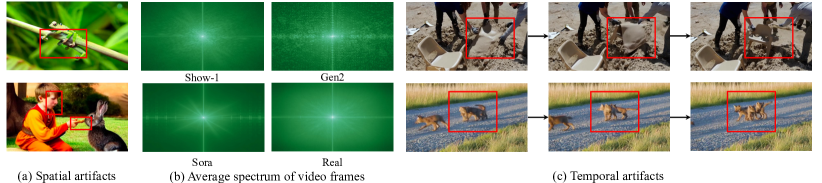
Recently, video generation techniques have advanced rapidly. Given the popularity of video content on social media platforms, these models intensify concerns about the spread of fake information. Therefore, there is a growing demand for detectors capable of distinguishing between fake AI-generated videos and mitigating the potential harm caused by fake information. However, the lack of large-scale datasets from the most advanced video generators poses a barrier to the development of such detectors. To address this gap, we introduce the first AI-generated video detection dataset, GenVideo. It features the following characteristics: (1) a large volume of videos, including over one million AI-generated and real videos collected; (2) a rich diversity of generated content and methodologies, covering a broad spectrum of video categories and generation techniques. We conducted extensive studies of the dataset and proposed two evaluation methods tailored for real-world-like scenarios to assess the detectors' performance: the cross-generator video classification task assesses the generalizability of trained detectors on generators; the degraded video classification task evaluates the robustness of detectors to handle videos that have degraded in quality during dissemination. Moreover, we introduced a plug-and-play module, named Detail Mamba (DeMamba), designed to enhance the detectors by identifying AI-generated videos through the analysis of inconsistencies in temporal and spatial dimensions. Our extensive experiments demonstrate DeMamba's superior generalizability and robustness on GenVideo compared to existing detectors. We believe that the GenVideo dataset and the DeMamba module will significantly advance the field of AI-generated video detection. Our code and dataset will be aviliable at \url{https://github.com/chenhaoxing/DeMamba}.
Motivation & Objective
- To address the lack of large-scale, diverse datasets for training and evaluating AI-generated video detectors.
- To develop detection methods that generalize across unseen video generators and remain robust under real-world video degradation.
- To design a detection module capable of identifying subtle spatial-temporal inconsistencies in AI-generated videos.
- To establish benchmark tasks that simulate real-world detection challenges: cross-generator generalization and degraded video classification.
Proposed method
- The authors constructed GenVideo, a dataset containing 1,078,838 AI-generated videos and 1,223,511 real videos from diverse sources and generation models.
- They introduced two evaluation tasks: cross-generator video classification to test generalization across unseen generators, and degraded video classification to assess robustness under quality degradation.
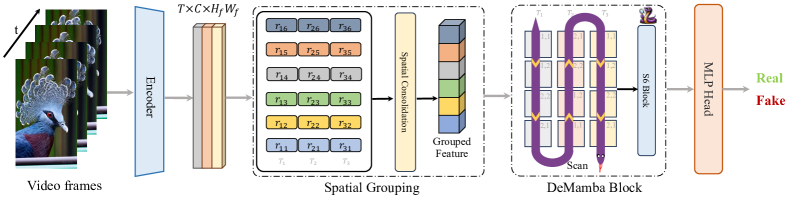
- DeMamba is a plug-and-play module based on a structured state space model that analyzes local spatial-temporal inconsistencies in video frames.
- The module divides video clips into spatial zones and processes them in a sequential scan to detect anomalies across time and space.
- DeMamba is integrated with existing feature extractors (e.g., XCLIP) and fine-tuned end-to-end to enhance detection performance.
- The method uses zone-based feature aggregation and continuous scanning to improve modeling of local inconsistencies.
Experimental results
Research questions
- RQ1Can a large-scale, diverse dataset like GenVideo enable more robust and generalizable AI-generated video detection?
- RQ2How well can detectors generalize to unseen video generators when trained on a diverse set of generation models?
- RQ3To what extent can a detection model maintain performance when faced with real-world video degradation such as compression or blur?
- RQ4Can a plug-and-play module that models spatial-temporal inconsistencies significantly improve detection accuracy and robustness?
Key findings
- DeMamba-XCLIP-FT achieved an average accuracy of 94.42% and average AP of 97.10% on the GenVideo benchmark, representing a 10.22% increase in accuracy and 12.02% increase in AP over the original XCLIP model.
- The model demonstrated superior generalization in both many-to-many and one-to-many cross-generator classification tasks, indicating strong adaptability to unseen generators.
- In degraded video classification, DeMamba-XCLIP-FT outperformed all baselines across eight types of perturbations, including H.264 compression, JPEG compression, Gaussian noise, and image watermarks.
- Ablation studies confirmed that DeMamba significantly improves detection performance, with optimal results when using fused features and a zone size of 2.
- The continuous scanning order in DeMamba outperformed traditional scanning, highlighting the importance of sequential processing for inconsistency modeling.
- The study identifies training inefficiency as a key limitation of DeMamba, particularly due to the inherent computational cost of Mamba-based architectures.
Read this paper
Open the full text in the Nubint reader and ask about any passage as you read.
Read this paper on NubintThis review was generated by AI from the original paper. Please check the paper before citing it.