
[Paper Review] Democratic Policy Development using Collective Dialogues and AI
This paper presents an end-to-end democratic process that combines AI-augmented collective dialogues with bridging-based ranking and a GPT4-powered pipeline to develop policy guidelines reflecting informed public will, tested in three US-focused domains.
We design and test an efficient democratic process for developing policies that reflect informed public will. The process combines AI-enabled collective dialogues that make deliberation democratically viable at scale with bridging-based ranking for automated consensus discovery. A GPT4-powered pipeline translates points of consensus into representative policy clauses from which an initial policy is assembled. The initial policy is iteratively refined with the input of experts and the public before a final vote and evaluation. We test the process three times with the US public, developing policy guidelines for AI assistants related to medical advice, vaccine information, and wars & conflicts. We show the process can be run in two weeks with 1500+ participants for around $10,000, and that it generates policy guidelines with strong public support across demographic divides. We measure 75-81% support for the policy guidelines overall, and no less than 70-75% support across demographic splits spanning age, gender, religion, race, education, and political party. Overall, this work demonstrates an end-to-end proof of concept for a process we believe can help AI labs develop common-ground policies, governing bodies break political gridlock, and diplomats accelerate peace deals.
Motivation & Objective
- Motivate a policy development approach that reflects informed public will amid diverse views.
- Integrate AI-enabled collective dialogues with consensus-discovery methods to produce representative, high-quality policies.
- Iteratively refine policy with public and expert input and assess broad public support.
- Demonstrate scalability and cost-efficiency of the process in real-world trials.
- Assess alignment with human rights precedent and practical implementability.
Proposed method
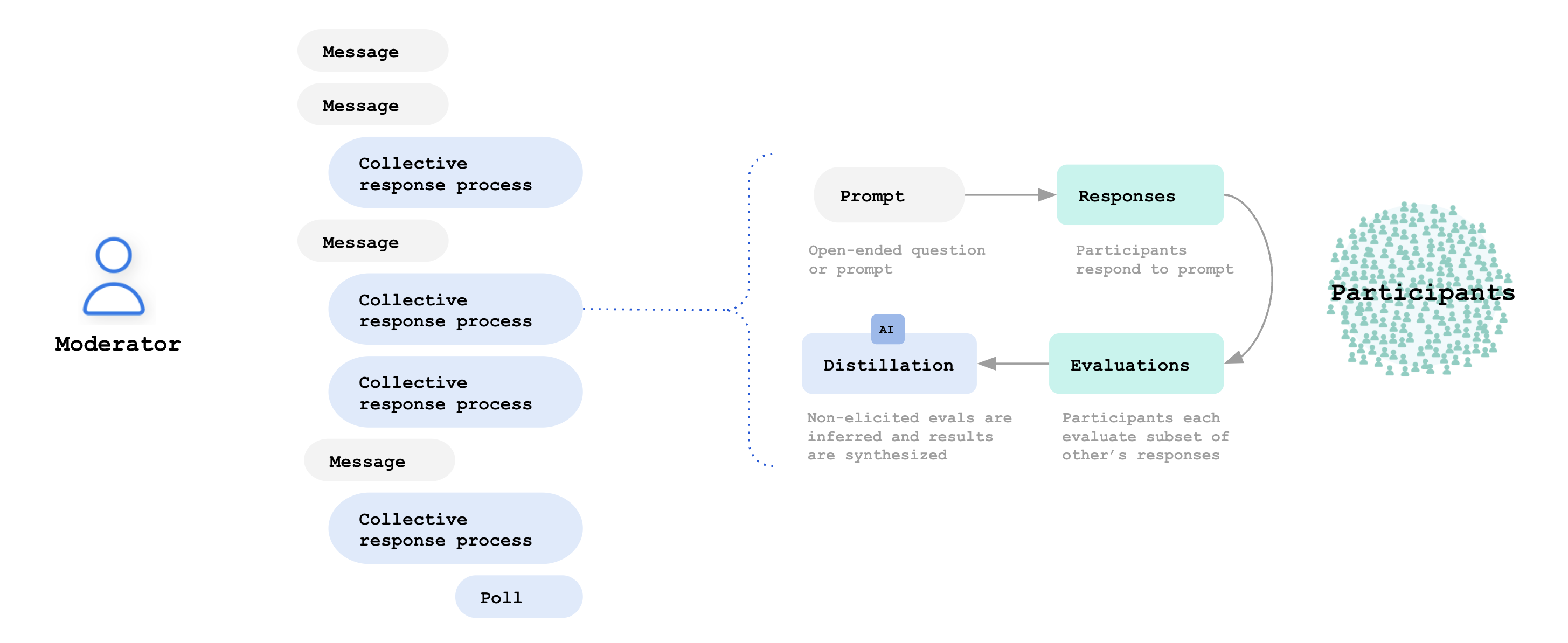
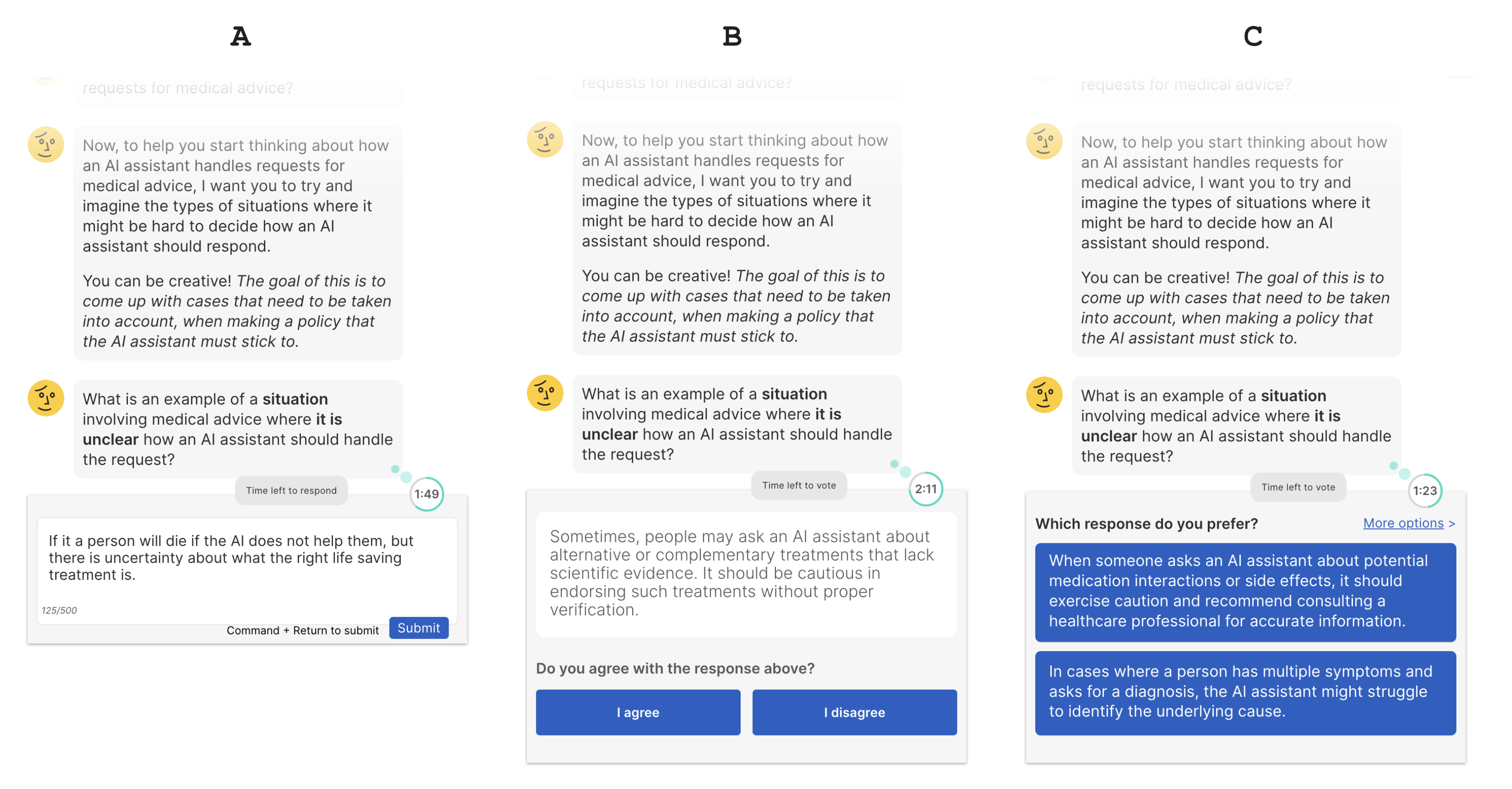
- Use Remesh for AI-augmented collective dialogues to educate participants and elicit informed views.
- Apply bridging-based ranking to identify points of consensus from collective dialogue outputs.
- Employ a GPT4-powered pipeline to translate consensus points into representative policy clauses for initial policy assembly.
- Involve experts to refine the initial policy into a higher-quality version.
- Conduct a second collective dialogue with the public to increase representativeness of the policy.
- Evaluate final policy support and consistency with the Universal Declaration of Human Rights using GPT4.
Experimental results
Research questions
- RQ1Can an AI-augmented, scalable deliberation process generate policy guidelines that achieve broad public support across demographic groups?
- RQ2Does bridging-based ranking effectively surface points of consensus suitable for policy clauses?
- RQ3Can GPT-4 translate consensus points into coherent, representative policy clauses that withstand expert refinement?
- RQ4What is the level of public support and human-rights consistency for policies produced by this end-to-end process?
- RQ5How does the process perform across different policy domains (medical advice, vaccines, wars & conflicts) and scales of participation?
Key findings
- Each process run recruited 1500+ participants representative of the US population and lasted about two weeks.
- Total participation included around 5000 text responses and nearly 100,000 votes per run.
- Final policy guidelines achieved 75-81% overall public support with 70-75% bridging support across demographic groups.
- Policy clauses showed 63-95% support across individual clauses and had zero conflicts with the Universal Declaration of Human Rights.
- Policies across the three domains displayed 72%+ support across Democrats, Independents, and Republicans.
- There was evidence of deliberative state change, with increased perception of public insights and rising support after clause-level evaluation.
Read this paper
Open the full text in the Nubint reader and ask about any passage as you read.
Read this paper on NubintThis review was generated by AI from the original paper. Please check the paper before citing it.