
[Paper Review] Demystifying Prompts in Language Models via Perplexity Estimation
This paper proposes SPELL (Selecting Prompts by Estimating LM Likelihood), a method that improves few-shot prompting performance by selecting prompts with the lowest perplexity as a proxy for model familiarity. Using automatic paraphrasing and perplexity estimation, SPELL boosts average accuracy by 1.8–3.6 points over manual prompts without requiring labels, demonstrating that lower-perplexity prompts correlate strongly with better performance across diverse tasks and models.
Language models can be prompted to perform a wide variety of zero- and few-shot learning problems. However, performance varies significantly with the choice of prompt, and we do not yet understand why this happens or how to pick the best prompts. In this work, we analyze the factors that contribute to this variance and establish a new empirical hypothesis: the performance of a prompt is coupled with the extent to which the model is familiar with the language it contains. Over a wide range of tasks, we show that the lower the perplexity of the prompt is, the better the prompt is able to perform the task. As a result, we devise a method for creating prompts: (1) automatically extend a small seed set of manually written prompts by paraphrasing using GPT3 and backtranslation and (2) choose the lowest perplexity prompts to get significant gains in performance.
Motivation & Objective
- To understand why some prompts perform better than others despite similar surface forms in zero- and few-shot prompting.
- To investigate whether model familiarity with a prompt—measured via perplexity—correlates with downstream task performance.
- To develop a label-free, model-agnostic method for generating high-performing prompts for new tasks.
- To validate that lower perplexity prompts yield more stable and higher accuracy results across diverse tasks and model architectures.
Proposed method
- Automatically expand a small set of manually written seed prompts using GPT-3 for paraphrasing and back-translation to generate a diverse, large pool of candidate prompts.
- Estimate the perplexity of each candidate prompt using the target language model to measure how familiar the model is with the prompt.
- Select the k prompts with the lowest perplexity as the final prompt set for inference.
- Use the selected low-perplexity prompts to perform few-shot prompting on downstream tasks without requiring task-specific labels.
- Evaluate performance across multiple tasks and models (e.g., OPT-175B, Bloom) to validate the method’s generalization and robustness.
- Compare the performance of the lowest-perplexity prompts against manually curated prompts to quantify gains and stability.
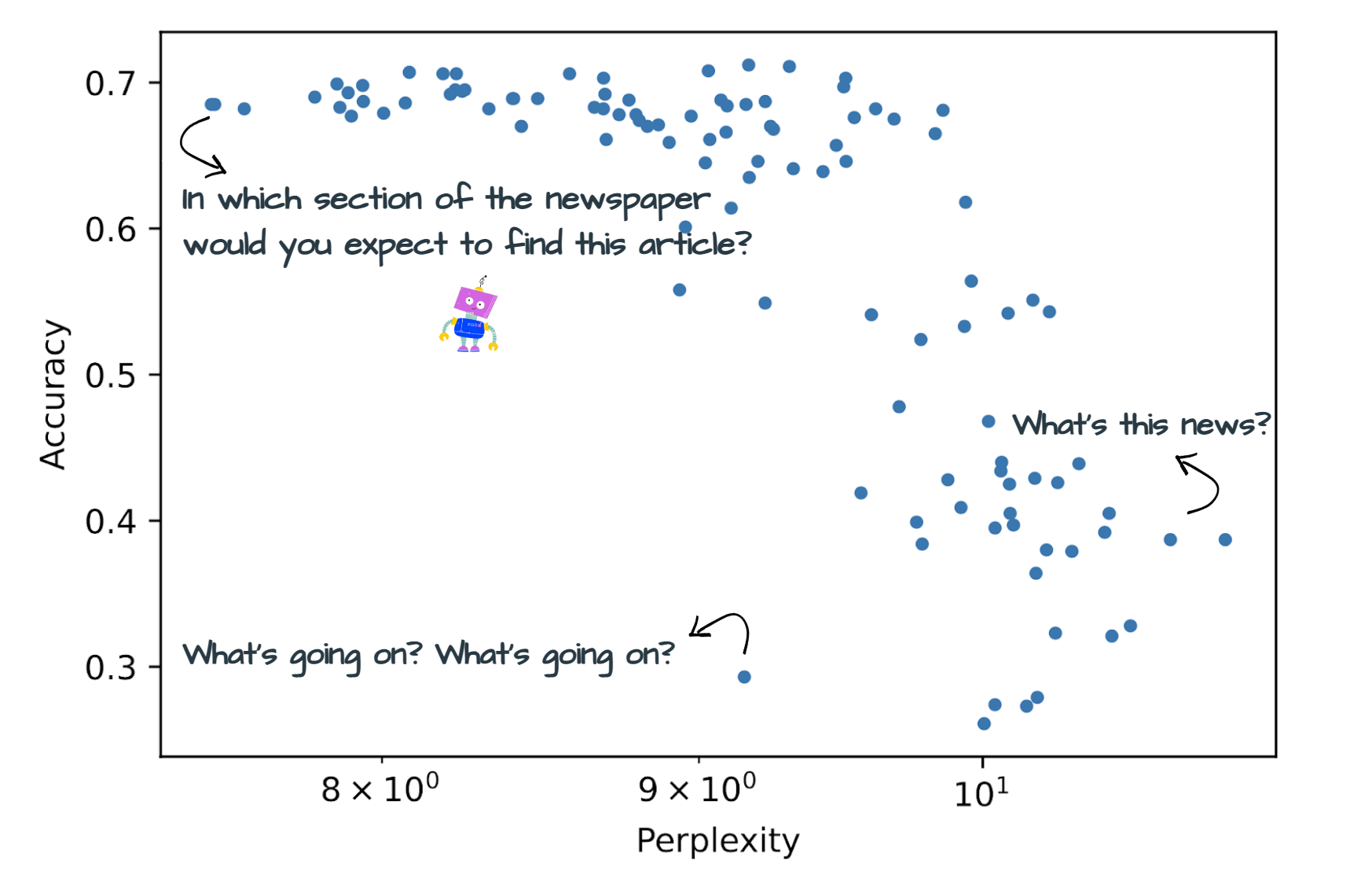
Experimental results
Research questions
- RQ1Does the perplexity of a prompt correlate with its performance on downstream tasks?
- RQ2Can perplexity serve as a reliable proxy for model familiarity with a prompt, even without access to pretraining data?
- RQ3Does selecting prompts based on low perplexity lead to consistent performance gains across diverse tasks and model architectures?
- RQ4How does the performance of low-perplexity prompts compare to that of manually engineered prompts in terms of accuracy and variance?
Key findings
- A strong negative correlation exists between prompt perplexity and task performance, with lower perplexity consistently predicting higher accuracy across diverse tasks and models.
- Using the three lowest-perplexity prompts from the expanded set improved average accuracy by 1.8 points over manual prompts on OPT-175B and 3.6 points on Bloom.
- The performance of low-perplexity prompts was significantly more stable, with lower standard deviation (5.07 vs. 6.86 for OPT-175B and 1.31 vs. 5.15 for Bloom) compared to manually created prompts.
- The method, SPELL, achieves substantial performance gains without requiring any labeled data for the target task, making it practical for non-expert users.
- The optimal prompt set varies by model, indicating that prompt performance is model-specific and cannot be generalized across architectures.
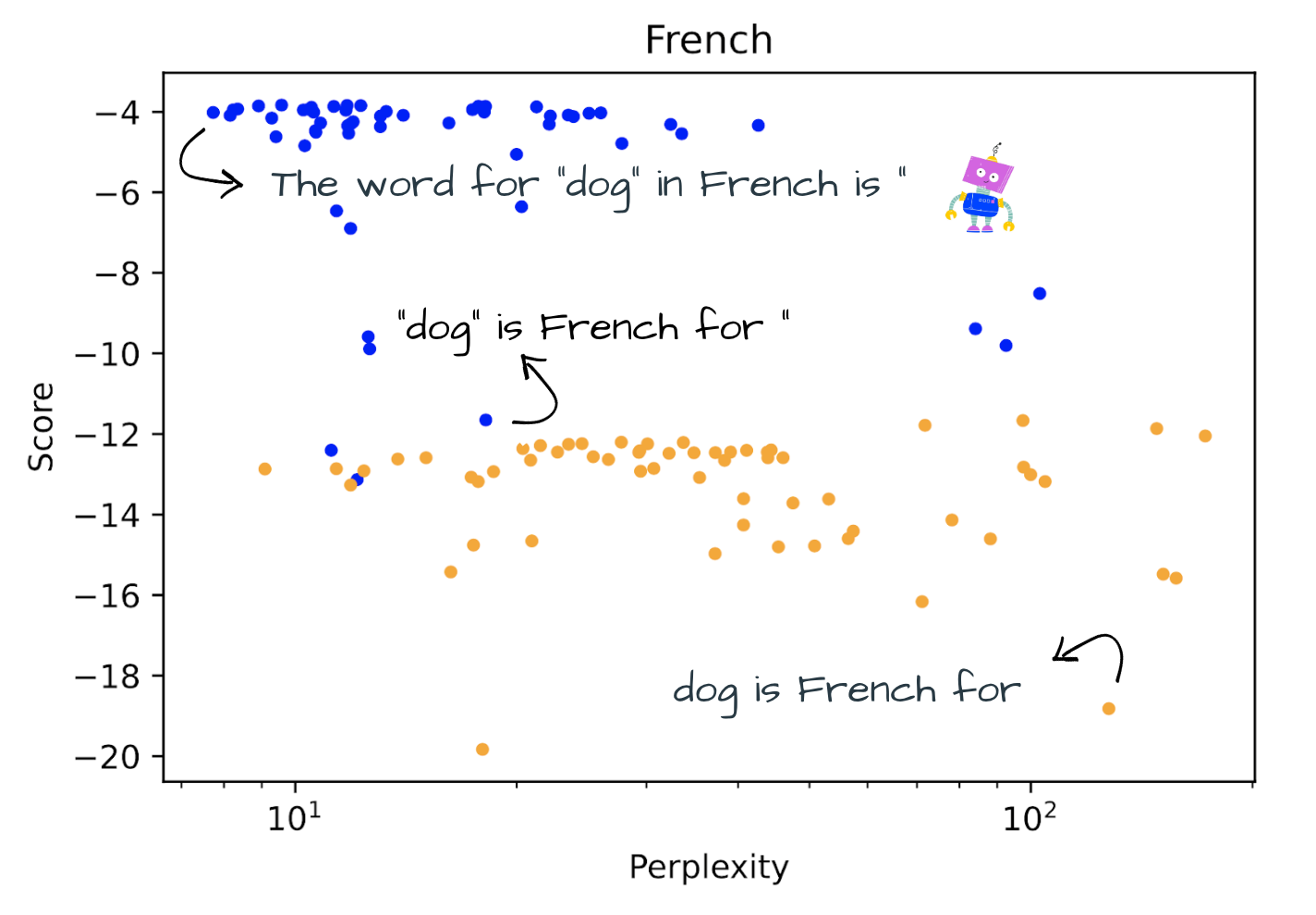
Read this paper
Open the full text in the Nubint reader and ask about any passage as you read.
Read this paper on NubintThis review was generated by AI from the original paper. Please check the paper before citing it.