
[Paper Review] Demystifying Structural Disparity in Graph Neural Networks: Can One Size Fit All?
The paper shows that GNNs perform unevenly across nodes with different structural patterns (homophilic vs heterophilic) within the same graph, and provides a non-i.i.d PAC-Bayesian generalization bound to explain why.
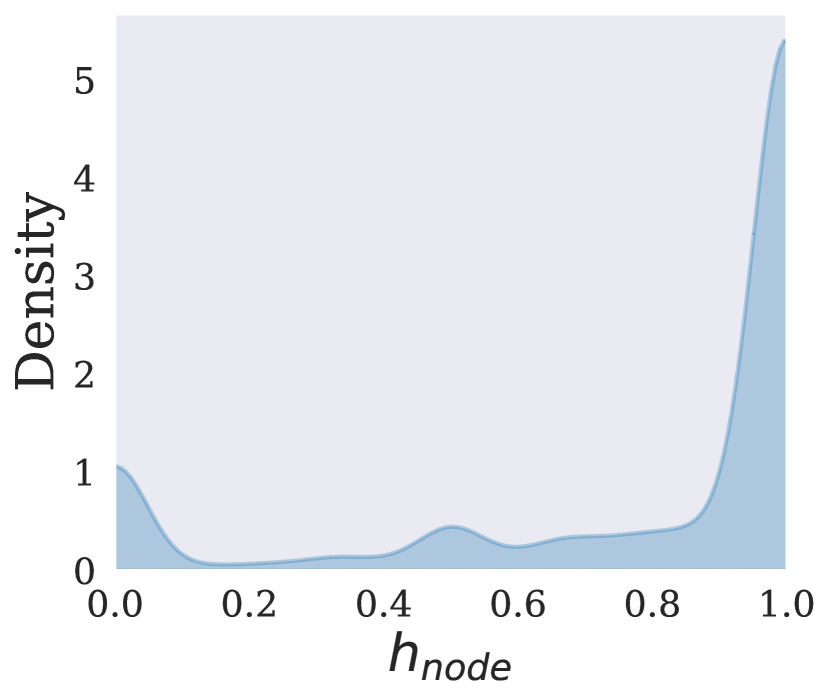
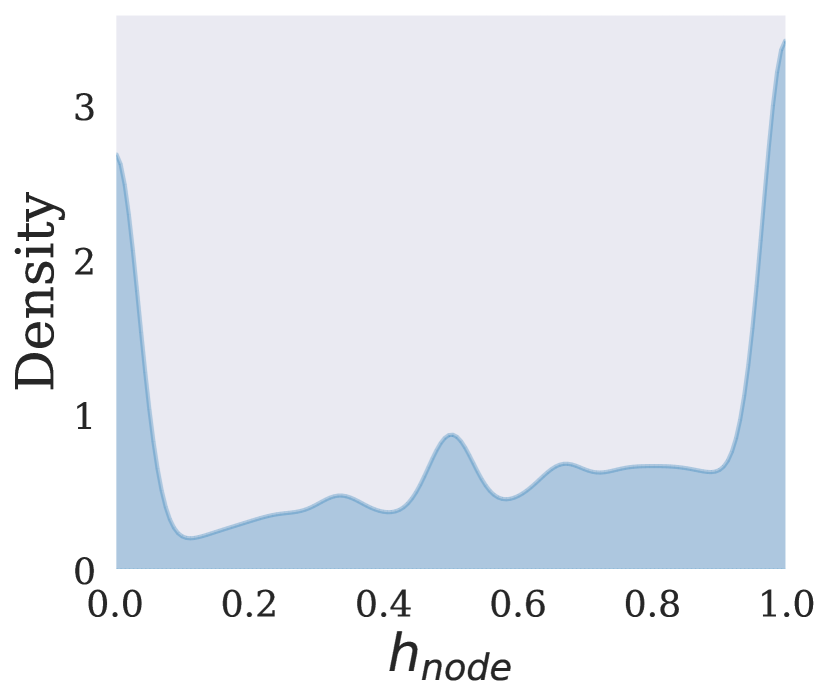
Recent studies on Graph Neural Networks(GNNs) provide both empirical and theoretical evidence supporting their effectiveness in capturing structural patterns on both homophilic and certain heterophilic graphs. Notably, most real-world homophilic and heterophilic graphs are comprised of a mixture of nodes in both homophilic and heterophilic structural patterns, exhibiting a structural disparity. However, the analysis of GNN performance with respect to nodes exhibiting different structural patterns, e.g., homophilic nodes in heterophilic graphs, remains rather limited. In the present study, we provide evidence that Graph Neural Networks(GNNs) on node classification typically perform admirably on homophilic nodes within homophilic graphs and heterophilic nodes within heterophilic graphs while struggling on the opposite node set, exhibiting a performance disparity. We theoretically and empirically identify effects of GNNs on testing nodes exhibiting distinct structural patterns. We then propose a rigorous, non-i.i.d PAC-Bayesian generalization bound for GNNs, revealing reasons for the performance disparity, namely the aggregated feature distance and homophily ratio difference between training and testing nodes. Furthermore, we demonstrate the practical implications of our new findings via (1) elucidating the effectiveness of deeper GNNs; and (2) revealing an over-looked distribution shift factor on graph out-of-distribution problem and proposing a new scenario accordingly.
Motivation & Objective
- Demonstrate that real-world graphs contain a mixture of homophilic and heterophilic nodes leading to structural disparity.
- Empirically and theoretically analyze how GNN aggregation affects nodes with different structural patterns.
- Develop a non-i.i.d PAC-Bayesian generalization bound to explain performance disparity between node subgroups.
- Show implications for deeper GNNs and graph out-of-distribution scenarios.
Proposed method
- Compare GCN against MLP-based models and GLNN to evaluate subgroup performance across node subgroups with varying homophily ratios.
- Propose a CSBM-S model to simulate graphs with mixed homophilic/heterophilic subgroups and analyze aggregated feature distributions.
- Derive a non-i.i.d PAC-Bayesian generalization bound for GNNs focusing on aggregated feature distance and homophily ratio differences between train and test nodes.
- Empirically validate theoretical findings on real datasets (PubMed, Ogbn-arxiv, Chameleon, Squirrel) and synthetic CSBM-S variants.
- Examine the impact of deeper GNNs on minority vs majority node subgroups.
Experimental results
Research questions
- RQ1How does GNN aggregation affect nodes with distinct structural patterns (homophilic vs heterophilic) within the same graph?
- RQ2Why does GNN performance show disparity between majority and minority node subgroups, and can a single model perform well for all nodes?
- RQ3What are the theoretical factors driving subgroup generalization gaps in GNNs, and how do aggregated feature distance and homophily differences contribute?
- RQ4What are the practical implications for deeper GNNs and graph out-of-distribution scenarios given structural disparity?
Key findings
- GNNs often perform well on majority-pattern nodes but poorly on minority-pattern nodes within mixed graphs.
- Aggregation induces a feature distribution shift between homophilic and heterophilic subgroups within the same class, creating a disparity.
- A non-i.i.d PAC-Bayesian bound shows generalization error grows with aggregated feature distance and homophily ratio differences between train and test nodes.
- Deeper GNNs tend to improve minority node performance more than majority nodes, via higher-order information capturing.
- Structural disparity reveals a graph out-of-distribution scenario where homophily pattern shifts can act as an environment-like factor affecting Y|X.
- Empirical results across PubMed, Ogbn-arxiv, Chameleon, and Squirrel substantiate the theoretical claims.
Read this paper
Open the full text in the Nubint reader and ask about any passage as you read.
Read this paper on NubintThis review was generated by AI from the original paper. Please check the paper before citing it.