
[Paper Review] Denoising Diffusion Bridge Models
Denoising Diffusion Bridge Models (DDBMs) propose a unified framework for generative modeling that generalizes diffusion models and optimal transport by learning a score-based diffusion bridge between two arbitrary distributions. The method achieves state-of-the-art performance in image translation and matches SOTA FID scores in unconditional generation, unifying score-based diffusion and flow-matching under a single stochastic differential equation framework.
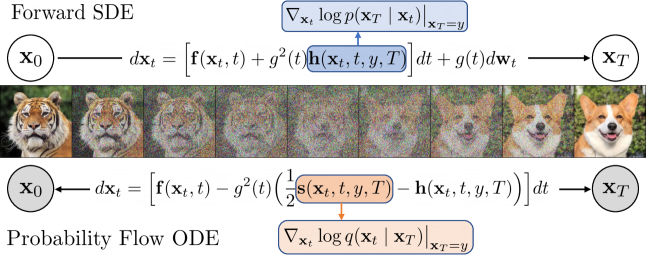
Diffusion models are powerful generative models that map noise to data using stochastic processes. However, for many applications such as image editing, the model input comes from a distribution that is not random noise. As such, diffusion models must rely on cumbersome methods like guidance or projected sampling to incorporate this information in the generative process. In our work, we propose Denoising Diffusion Bridge Models (DDBMs), a natural alternative to this paradigm based on diffusion bridges, a family of processes that interpolate between two paired distributions given as endpoints. Our method learns the score of the diffusion bridge from data and maps from one endpoint distribution to the other by solving a (stochastic) differential equation based on the learned score. Our method naturally unifies several classes of generative models, such as score-based diffusion models and OT-Flow-Matching, allowing us to adapt existing design and architectural choices to our more general problem. Empirically, we apply DDBMs to challenging image datasets in both pixel and latent space. On standard image translation problems, DDBMs achieve significant improvement over baseline methods, and, when we reduce the problem to image generation by setting the source distribution to random noise, DDBMs achieve comparable FID scores to state-of-the-art methods despite being built for a more general task.
Motivation & Objective
- To address the limitation of standard diffusion models, which assume a random noise prior and struggle with non-noise inputs like in image translation.
- To unify score-based diffusion models and optimal transport-based flow matching into a single framework using diffusion bridges.
- To improve performance in image-to-image translation and unconditional generation by leveraging learned score functions on diffusion bridges.
- To reduce reliance on heuristic techniques like guidance or projected sampling in conditional generation.
Proposed method
- The method models a reverse-time diffusion bridge process that interpolates between two given distributions, using a stochastic differential equation (SDE) driven by a learned score function.
- It formulates the problem as learning the score of a diffusion bridge, enabling sampling from one distribution to another via SDE integration.
- The framework generalizes both score-based diffusion models (when prior is noise) and flow-matching (when path is deterministic), subsuming both paradigms.
- The model uses a denoising score matching objective to train the score network, with noise schedules and pre-conditioning adapted for stability and performance.
- It employs an Euler-Maruyama sampler with fixed step count and guidance scaling for inference, ensuring consistency across tasks.
- The approach is applied in both pixel space and latent space using a VAE-based bottleneck, enabling efficient high-resolution translation.
Experimental results
Research questions
- RQ1Can a unified generative modeling framework be developed that naturally handles both unconditional generation and image-to-image translation?
- RQ2How does learning the score of a diffusion bridge compare to standard score-based diffusion or flow-matching in terms of performance and stability?
- RQ3Can the proposed method achieve competitive FID and LPIPS scores in image translation without relying on complex guidance or iterative refinement?
- RQ4Does the framework maintain strong performance when reduced to unconditional generation, matching state-of-the-art diffusion models?
- RQ5Can the method generalize effectively to latent space translation, preserving image quality and structure?
Key findings
- On the Day → Night translation task in latent space, DDBM achieved an FID of 27.63, outperforming Pix2Pix (157.1) and SDEdit (151.1), and ranking second in IS (3.92) and MSE (0.145).
- In pixel-space image translation, DDBM achieved a FID of 12.38 on the DIODE dataset, surpassing Rectified Flow (12.38) and I2SB (15.56), and achieving the best LPIPS (0.366) and MSE (0.129) scores.
- For unconditional generation on CIFAR-10, DDBM achieved an FID of 5.88, comparable to state-of-the-art diffusion models despite being trained for a more general task.
- On FFHQ-64×64, DDBM achieved an FID of 5.21, demonstrating strong performance in unconditional image generation.
- The method showed robustness to input sensitivity and improved training stability through architectural modifications like pre-conditioning and noise schedule adaptation.
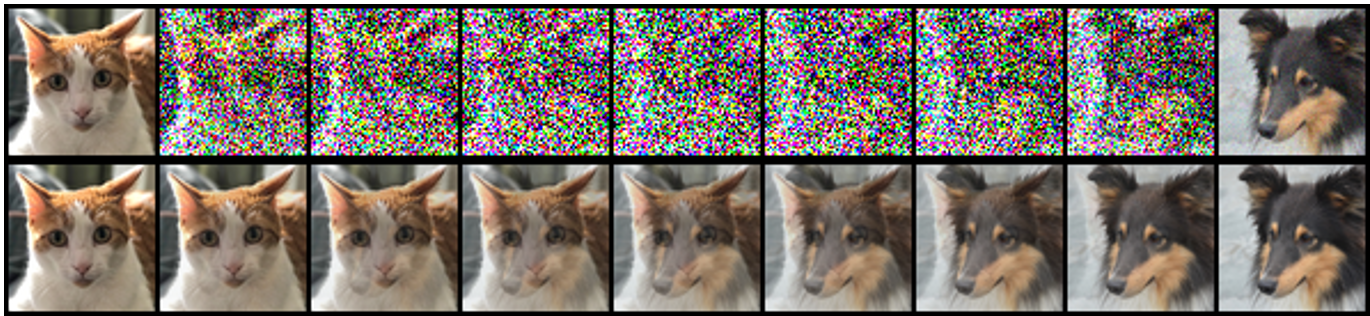
- Qualitative results confirmed high-fidelity translations, with generated images preserving both structure and identity in image-to-image tasks.
Better researchstarts right now
From reading papers to final review, dramatically reduce your research time.
No credit card · Free plan available
This review was created by AI and reviewed by human editors.