
[Paper Review] Denoising Diffusion Probabilistic Models for Robust Image Super-Resolution in the Wild
Introduces SR3+, a diffusion-based model for blind (out-of-distribution) image super-resolution that achieves state-of-the-art results by combining higher-order degradations and noise conditioning augmentation, trained on large datasets and tested zero-shot on RealSR/DRealSR.
Diffusion models have shown promising results on single-image super-resolution and other image- to-image translation tasks. Despite this success, they have not outperformed state-of-the-art GAN models on the more challenging blind super-resolution task, where the input images are out of distribution, with unknown degradations. This paper introduces SR3+, a diffusion-based model for blind super-resolution, establishing a new state-of-the-art. To this end, we advocate self-supervised training with a combination of composite, parameterized degradations for self-supervised training, and noise-conditioing augmentation during training and testing. With these innovations, a large-scale convolutional architecture, and large-scale datasets, SR3+ greatly outperforms SR3. It outperforms Real-ESRGAN when trained on the same data, with a DRealSR FID score of 36.82 vs. 37.22, which further improves to FID of 32.37 with larger models, and further still with larger training sets.
Motivation & Objective
- Motivate robust blind single-image super-resolution in wild settings where degradations are unknown.
- Develop a diffusion-based model that remains effective on out-of-distribution inputs.
- Leverage self-supervised training with composite degradations and noise conditioning augmentation to improve generalization.
- Demonstrate that increasing model size and training data yields significant gains.
Proposed method
- Use a convolutional UNet-based diffusion model (SR3+-style) for conditional super-resolution.
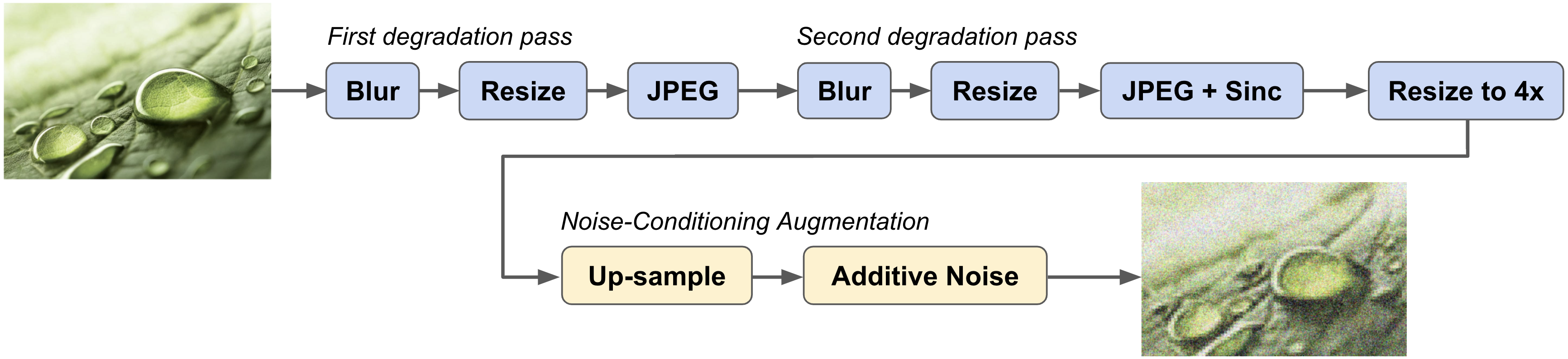
- Apply higher-order, parametric degradation during training to simulate real-world corruptions.
- Incorporate noise conditioning augmentation to improve robustness and enable test-time conditioning.
- Train on large-scale datasets (DF2K+OST and up to 61M images) to scale performance.
- Evaluate using zero-shot testing on RealSR and DRealSR with FID, PSNR, and SSIM metrics.
Experimental results
Research questions
- RQ1Can diffusion-based models achieve state-of-the-art performance in blind super-resolution under Real-World degradations?
- RQ2Do higher-order degradations and noise conditioning augmentation synergistically improve robustness to out-of-distribution inputs?
- RQ3How do model size and training data scale affect SR3+'s performance on RealSR/DRealSR benchmarks?
- RQ4What is the trade-off between perceptual fidelity (FID) and reference-based metrics (PSNR/SSIM) in blind SR?
- RQ5Is SR3+ robust in zero-shot settings across different datasets and image content (e.g., text-heavy images)?
Key findings
- SR3+ with 40M parameters achieves competitive FID(10k) to Real-ESRGAN on RealSR and DRealSR.
- A larger SR3+ model (400M) trained on the same data yields improved FID, surpassing Real-ESRGAN on RealSR and narrowing the gap on DRealSR.
- Training with higher-order degradations plus noise conditioning augmentation substantially improves FID (ablation shows >10 point degradation in FID when removing either component).
- Using a much larger 61M-image dataset further improves FID to 32.37 with 400M parameters, and textures become more realistic and coherent.
- Test-time noise conditioning augmentation (t_eval ≈ 0.1) improves texture quality and maintains reasonable alignment, with higher t_eval risking misalignment and hallucination.
- SR3+ generally yields sharper, more realistic textures than Real-ESRGAN, but may underperform on exact high-frequency texts when evaluated with PSNR/SSIM; these metrics can penalize plausible high-frequency details in multimodal outputs.
Read this paper
Open the full text in the Nubint reader and ask about any passage as you read.
Read this paper on NubintThis review was generated by AI from the original paper. Please check the paper before citing it.