
[Paper Review] Denoising Diffusion Semantic Segmentation with Mask Prior Modeling
The paper introduces DDPS, a two-stage framework that uses a discrete diffusion-based mask prior to refine base segmentation predictions, improving both IoU and boundary accuracy on ADE20K and Cityscapes.
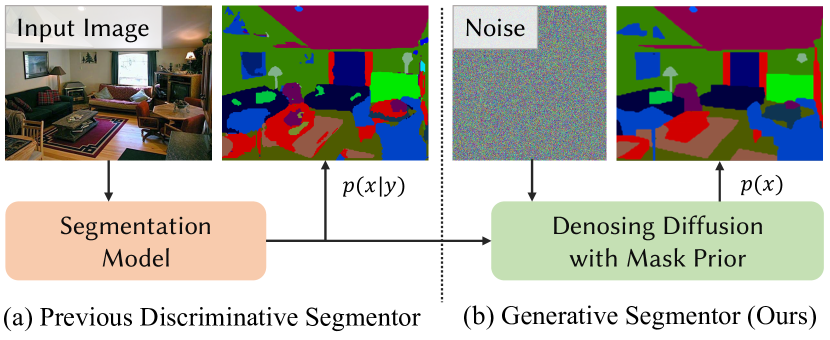
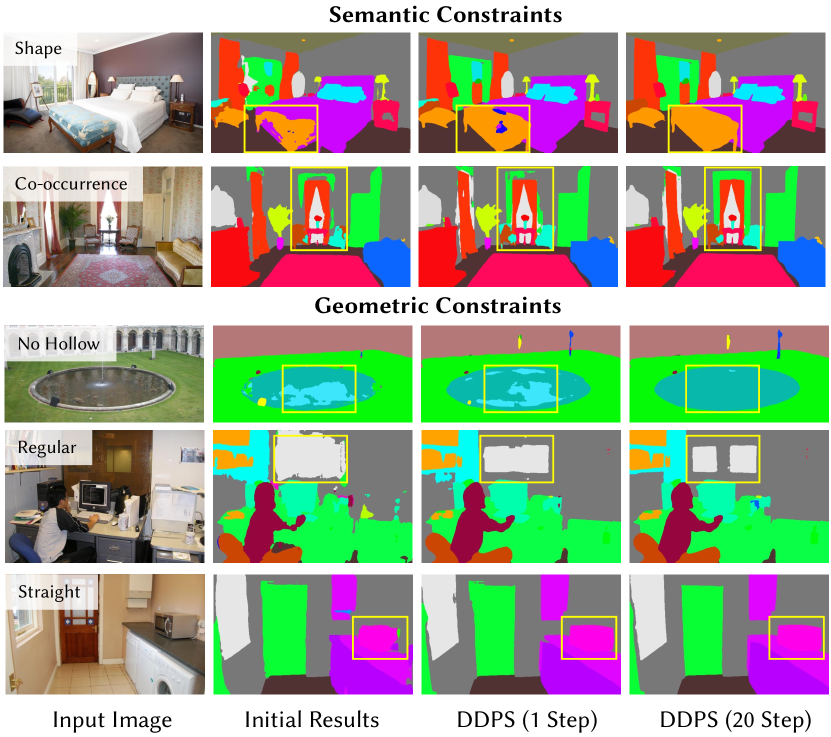
The evolution of semantic segmentation has long been dominated by learning more discriminative image representations for classifying each pixel. Despite the prominent advancements, the priors of segmentation masks themselves, e.g., geometric and semantic constraints, are still under-explored. In this paper, we propose to ameliorate the semantic segmentation quality of existing discriminative approaches with a mask prior modeled by a recently-developed denoising diffusion generative model. Beginning with a unified architecture that adapts diffusion models for mask prior modeling, we focus this work on a specific instantiation with discrete diffusion and identify a variety of key design choices for its successful application. Our exploratory analysis revealed several important findings, including: (1) a simple integration of diffusion models into semantic segmentation is not sufficient, and a poorly-designed diffusion process might lead to degradation in segmentation performance; (2) during the training, the object to which noise is added is more important than the type of noise; (3) during the inference, the strict diffusion denoising scheme may not be essential and can be relaxed to a simpler scheme that even works better. We evaluate the proposed prior modeling with several off-the-shelf segmentors, and our experimental results on ADE20K and Cityscapes demonstrate that our approach could achieve competitively quantitative performance and more appealing visual quality.
Motivation & Objective
- Bridge the gap between discriminative segmentation and segmentation mask priors by modeling p(x) of masks using denoising diffusion.
- Propose a unified DDPS architecture with a mask representation codec, a base segmentor, and a diffusion prior to refine predictions.
- Investigate design choices for discrete diffusion in segmentation and assess training/inference strategies.
- Show that integrating diffusion priors yields competitive quantitative gains and improved visual quality on standard benchmarks.
Proposed method
- Use a two-stage pipeline: a fixed base segmentation model to generate initial predictions and a diffusion-based prior to iteratively refine toward mask priors.
- Adopt a discrete diffusion process operating on a mask representation codec (e.g., simple resize codec with discrete diffusion).
- Employ an x0-parameterization denoiser (UNet) that predicts the clean mask x0 to derive x(t-1) during diffusion, with a Noise-on-First-Prediction training strategy.
- Train with a two-stage approach: first single-step diffusion with maximum noise, then fine-tune with multiple diffusion steps.
- Use replace-only diffusion transitions (uniform replacement) and a Noise-on-First-Prediction target to align training with inference.
- Apply classifier-free guidance (CFG) to enhance conditioning on the base segmentor during inference.
Experimental results
Research questions
- RQ1Can a diffusion-based prior modeling of segmentation masks improve the outcomes of existing discriminative segmentors?
- RQ2What are the key design choices (transition type, target for diffusion, training/inference strategies) that enable effective discrete diffusion for segmentation?
- RQ3How does DDPS affect standard benchmarks (ADE20K, Cityscapes) in terms of mIoU and boundary IoU compared to baselines?
- RQ4Is the inference strategy of a strict diffusion process essential, or can simpler re-noising strategies suffice?
- RQ5What is the impact of iterative refinement and stride sampling on performance and efficiency?
Key findings
- DDPS consistently refines base segmentation predictions across both CNN- and transformer-based models.
- On ADE20K, DDPS with Segformer-SF and MiT-B2/B0 yields notable mIoU gains and improved boundary IoU, with up to around 3-5 point increases reported in various configurations.
- On Cityscapes, DDPS improves several baselines, with substantial gains when paired with stronger backbones and high-capacity decoders.
- Ablations show that diffusion transition type has a modest effect, diffusion targets matter (noise-on-GT causes larger drops), and the free re-noising strategy during inference can outperform strict posterior-based denoising.
- Training with first-prediction-driven noise and multi-stage training significantly benefits the first-step performance, while iterative refinement provides additional gains (e.g., after 20 steps).
- CFG further improves performance by leveraging conditional information from the base segmentor during inference.
Read this paper
Open the full text in the Nubint reader and ask about any passage as you read.
Read this paper on NubintThis review was generated by AI from the original paper. Please check the paper before citing it.