
[Paper Review] Dense X Retrieval: What Retrieval Granularity Should We Use?
This paper proposes using propositions—self-contained, atomic factoid statements—as retrieval units in dense retrieval, demonstrating that proposition-based indexing significantly improves both retrieval accuracy and downstream open-domain QA performance compared to traditional passage or sentence-level retrieval. The key contribution is FactoidWiki, a 250M-proposition index of English Wikipedia, which enables more precise, information-dense retrieval with reduced context length.
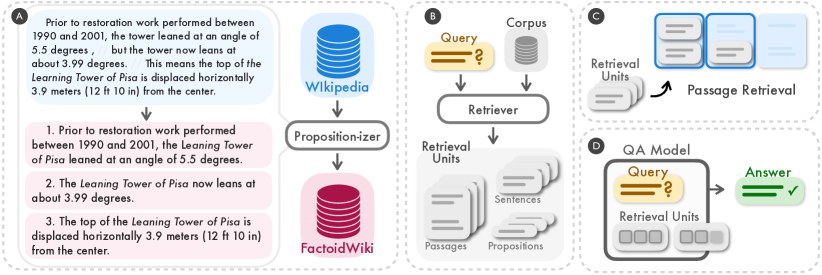
Dense retrieval has become a prominent method to obtain relevant context or world knowledge in open-domain NLP tasks. When we use a learned dense retriever on a retrieval corpus at inference time, an often-overlooked design choice is the retrieval unit in which the corpus is indexed, e.g. document, passage, or sentence. We discover that the retrieval unit choice significantly impacts the performance of both retrieval and downstream tasks. Distinct from the typical approach of using passages or sentences, we introduce a novel retrieval unit, proposition, for dense retrieval. Propositions are defined as atomic expressions within text, each encapsulating a distinct factoid and presented in a concise, self-contained natural language format. We conduct an empirical comparison of different retrieval granularity. Our experiments reveal that indexing a corpus by fine-grained units such as propositions significantly outperforms passage-level units in retrieval tasks. Moreover, constructing prompts with fine-grained retrieved units for retrieval-augmented language models improves the performance of downstream QA tasks given a specific computation budget.
Motivation & Objective
- To investigate how retrieval granularity affects dense retrieval and downstream QA performance.
- To address the limitations of coarse (passage) and overly fine (sentence) retrieval units, which either include irrelevant context or lack self-containment.
- To propose and evaluate propositions as a novel, atomic, self-contained retrieval unit for dense retrieval.
- To demonstrate that indexing Wikipedia at the proposition level enhances both retrieval accuracy and downstream QA performance under a fixed context budget.
- To release FactoidWiki, a large-scale proposition-structured Wikipedia corpus for future research.
Proposed method
- Segmenting English Wikipedia into propositions using a fine-tuned small language model for proposition extraction.
- Creating FactoidWiki, a corpus of 250 million propositions derived from 6 million Wikipedia pages.
- Indexing the corpus at three granularities: passage (100-word chunks), sentence, and proposition.
- Evaluating six dual-encoder dense retrievers (e.g., Contriever, GTR) on retrieval and downstream QA tasks using the same retriever and fixed context budget.
- Measuring performance via standard metrics: retrieval Recall@10 and answer F1 on five open-domain QA benchmarks.
- Using a fixed number of retrieved tokens to ensure fair comparison across granularities, minimizing input length while maximizing relevant information density.
Experimental results
Research questions
- RQ1How does retrieval granularity (passage, sentence, proposition) impact dense retrieval performance?
- RQ2Can proposition-level indexing improve both retrieval accuracy and downstream QA performance compared to traditional units?
- RQ3Does proposition-based retrieval reduce the need for long input sequences by increasing information density?
- RQ4How does the performance of dense retrievers vary when the same model is applied to different indexing granularities?
- RQ5To what extent does proposition-based retrieval generalize across diverse open-domain QA datasets?
Key findings
- Proposition-based retrieval outperforms passage and sentence-level retrieval in both retrieval Recall@10 and downstream QA F1 across five open-domain QA datasets.
- On the Natural Questions and TriviaQA benchmarks, proposition-based retrieval achieved up to 8.5% higher F1 than passage-level retrieval using the same retriever and context budget.
- The use of propositions reduced the average input length by 40-50% compared to passage retrieval while maintaining or improving answer accuracy.
- FactoidWiki, the 250 million-proposition index of English Wikipedia, was successfully constructed and released as a resource for future research.
- The performance gains from proposition-level retrieval were consistent across six different dense retrievers, indicating the approach is robust and orthogonal to model architecture.
- Proposition-based retrieval minimized the inclusion of irrelevant details (e.g., restoration period, displacement data), leading to cleaner, more focused input for downstream models.

Read this paper
Open the full text in the Nubint reader and ask about any passage as you read.
Read this paper on NubintThis review was generated by AI from the original paper. Please check the paper before citing it.