
[Paper Review] Density of States, Black Holes and the Emergent String Conjecture
The paper argues that the high-energy density of one-particle states in weakly coupled gravity implies either a KK tower or a string-like exponentially growing tower, providing evidence for the Emergent String Conjecture without relying on string theory. It also links the species scale to the smallest black hole and derives bounds on brane tensions.
We study universal features of the density of one-particle states $ρ(E)$ in weakly coupled theories of gravity at energies above the quantum gravity cutoff $Λ$, defined as the scale suppressing higher-derivative corrections to the Einstein--Hilbert action. Using thermodynamic properties of black holes, we show that in asymptotically flat spacetimes, certain features of $ρ(E)$ above the black hole threshold $M_{ m min}$ are an indicator for the existence of large extra dimensions, and cannot be reproduced by any lower-dimensional field theory with finitely many fields satisfying the weak energy condition. Based on the properties of gravitational scattering amplitudes, we argue that there needs to exist a (possibly higher-dimensional) effective description of gravity valid up to the cutoff $Λ$. Combining this with thermodynamic arguments we demonstrate that $ρ(E)$ has to grow exponentially for energies $Λ\ll E \ll M_{ m min}$. Furthermore we show that the tension of any weakly coupled $p$-brane with $p\geq 1$ is bounded from below by $Λ^{p+1}$. We use this to argue that any tower of weakly coupled states with mass below $Λ$ has to be a Kaluza--Klein (KK) tower. Altogether these results indicate that in gravitational weak-coupling limits the lightest tower of states is either a KK tower, or has an exponentially growing degeneracy thereby resembling a string tower. This provides evidence for the Emergent String Conjecture without explicitly relying on string theory or supersymmetry.
Motivation & Objective
- Motivate universal properties of the density of one-particle states in quantum gravity beyond specific UV completions.
- Relate high-energy density of states to black hole thermodynamics and gravitational scattering amplitudes.
- Demonstrate that weakly coupled gravity implies either KK towers or exponentially growing degeneracy akin to a string tower.
- Connect the species scale to the smallest describable black hole and higher-derivative corrections.
- Provide evidence for the Emergent String Conjecture in a gravity-only, non-supersymmetric setting.
Proposed method
- Estimate the density of one-particle states ρ(E) at energies above the quantum gravity cutoff Λ using 2→2 scattering amplitudes at fixed small impact parameter.
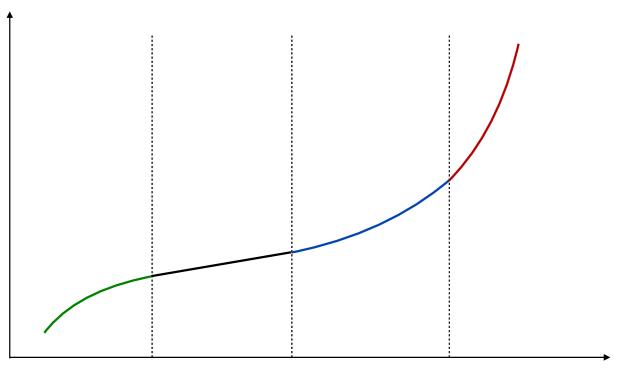
- Parametrize ρ(E) as ρ(E) ~ exp[(E/Λ)^α] with α piecewise constant to extract information about the nature of states.
- Use black hole thermodynamics to identify energy regions where α>1 signals black hole microstates.
- Derive bounds on the tension of weakly coupled p-branes from matching higher-derivative corrections to gravitational amplitudes.
- Argue that below the species scale the tower of states must be a KK tower, while above it can exhibit Hagedorn-like growth.
- Relate the smallest describable black hole to the EFT cutoff and discuss implications for the Emergent String Conjecture.
Experimental results
Research questions
- RQ1What universal features does the high-energy density of one-particle states ρ(E) exhibit in weakly coupled theories of gravity?
- RQ2How does ρ(E) inform the nature of the lightest tower of states below the black hole threshold (KK tower vs. string-like tower)?
- RQ3What is the relationship between the quantum gravity cutoff (species scale) and the size of the smallest black hole describable in an EFT?
- RQ4Can gravitational scattering amplitudes constrain the tension of weakly coupled strings and branes?
- RQ5What evidence do ρ(E) and black hole thermodynamics provide for the Emergent String Conjecture in a non-string-theory context?
Key findings
- ρ(E) is proposed to grow exponentially with energy in the regime Λ ≪ E ≪ M_min, signaling a tower of states with degeneracy increasing rapidly.
- The transition energy M_min marks the black hole threshold for the EFT, with α crossing from ≤1 to >1 indicating black hole microstates.
- The analysis yields a lower bound on the tension of any weakly coupled p-brane: T ≥ Λ^2, implying KK towers below Λ in gravitational weak-coupling limits.
- In gravitational weak-coupling limits, any tower below the species scale Λ must be a KK tower; above Λ, towers can exhibit exponential growth akin to string excitations (Hagedorn behavior).
- The lightest tower in such limits is either a KK tower or a string-like tower, providing evidence for the Emergent String Conjecture without relying on supersymmetry or string theory.
Read this paper
Open the full text in the Nubint reader and ask about any passage as you read.
Read this paper on NubintThis review was generated by AI from the original paper. Please check the paper before citing it.