
[Paper Review] DeOccNet: Learning to See Through Foreground Occlusions in Light Fields
DeOccNet is the first deep learning-based method for light field de-occlusion, using an encoder-decoder network with residual atrous spatial pyramid pooling to reconstruct occlusion-free center-view sub-aperture images by leveraging multi-view complementary information. It achieves state-of-the-art performance on synthetic and real-world light field datasets, outperforming prior methods in PSNR and SSIM by significant margins.
Background objects occluded in some views of a light field (LF) camera can be seen by other views. Consequently, occluded surfaces are possible to be reconstructed from LF images. In this paper, we handle the LF de-occlusion (LF-DeOcc) problem using a deep encoder-decoder network (namely, DeOccNet). In our method, sub-aperture images (SAIs) are first given to the encoder to incorporate both spatial and angular information. The encoded representations are then used by the decoder to render an occlusionfree center-view SAI. To the best of our knowledge, DeOccNet is the first deep learning-based LF-DeOcc method. To handle the insufficiency of training data, we propose an LF synthesis approach to embed selected occlusion masks into existing LF images. Besides, several synthetic and realworld LFs are developed for performance evaluation. Experimental results show that, after training on the generated data, our DeOccNet can effectively remove foreground occlusions and achieves superior performance as compared to other state-of-the-art methods. Source codes are available at: https://github.com/YingqianWang/DeOccNet.
Motivation & Objective
- To address the challenge of reconstructing occluded surfaces in light fields using deep learning, where traditional methods fail due to complex scene structures.
- To overcome the lack of large-scale annotated light field datasets with removable foreground occlusions.
- To develop a method that effectively utilizes both spatial and angular information across sub-aperture images to infer missing regions behind occlusions.
- To enable end-to-end training by using the occlusion-free center-view as ground truth, allowing the network to learn disparity-based occlusion detection and removal.
Proposed method
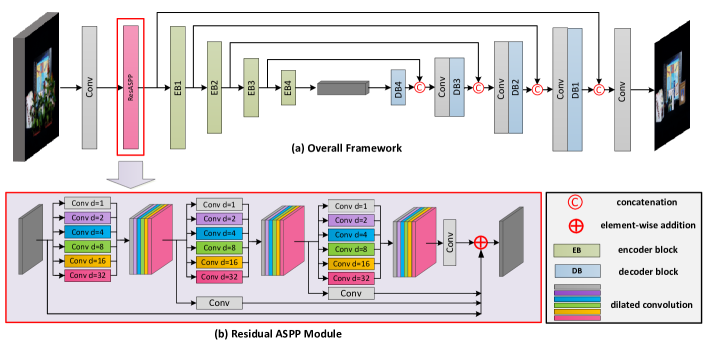
- The network employs an encoder-decoder architecture that concatenates all sub-aperture images (SAIs) along the channel dimension to preserve spatial and angular information.
- A residual atrous spatial pyramid pooling (ASPP) module is integrated into the encoder to extract multi-scale features and expand the receptive field for handling occlusions of various shapes and scales.
- Skip connections are used between encoder and decoder blocks to preserve high-frequency and low-level details lost during downsampling.
- A novel data synthesis method embeds real occlusion masks into existing light field images to generate over 1,000 synthetic LFs for training, overcoming data scarcity.
- The network is trained end-to-end with the occlusion-free center-view SAI as ground truth, enabling the model to learn to detect and remove foreground occlusions using disparity discrepancies.
- The method generalizes well to unseen scenes, including slanted and pierced occlusions, by relying on inter-view disparity differences rather than single-view priors.
Experimental results
Research questions
- RQ1Can a deep learning model effectively reconstruct occluded surfaces in light fields by exploiting complementary information from multiple viewpoints?
- RQ2How can a deep network be trained effectively when large-scale real-world light field datasets with removable occlusions are unavailable?
- RQ3To what extent does multi-scale feature extraction and skip connections improve the quality of de-occluded light field reconstructions?
- RQ4Can a network trained on synthetic, fence-like occlusions generalize to real-world scenes with complex, slanted, or irregular occlusions?
- RQ5How does the use of disparity discrepancy enable accurate detection and removal of foreground occlusions in light fields?
Key findings
- DeOccNet achieves a mean PSNR of 22.45 dB and SSIM of 0.727 on the real-world Bike01 scene, significantly outperforming prior methods.
- The ablation study shows that removing the residual ASPP module reduces average PSNR by over 3 dB and SSIM by nearly 0.1, demonstrating its critical role in receptive field expansion.
- The outermost skip connection contributes 3.34 dB to average PSNR and 0.14 to average SSIM, proving its importance in preserving high-frequency details.
- Even with identical center-view inputs, DeOccNet fails to reconstruct, confirming it relies on multi-view disparity differences rather than single-image inpainting mechanisms.
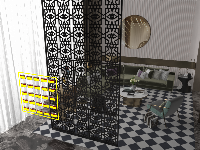
- The model generalizes well to scenes with slanted and pierced occlusions (e.g., basket in Bike01), despite training on only front-parallel, fence-like masks.
- The network performs poorly on solid block occlusions (e.g., right-bottom corner in Bike02), indicating limitations when background is occluded in all views, highlighting the need for combined perspective and neighborhood priors.
Read this paper
Open the full text in the Nubint reader and ask about any passage as you read.
Read this paper on NubintThis review was generated by AI from the original paper. Please check the paper before citing it.