
[Paper Review] Depression detection in social media posts using affective and social norm features
This paper proposes a deep learning model for depression detection in social media that integrates BERT-based text representations with affective features from a pretrained emotion classifier and social norm features (profanity and morality) via late fusion. The model achieves state-of-the-art performance, improving F1 scores by 6.73% and 2.65% on user-level and post-level depression detection tasks, respectively.
We propose a deep architecture for depression detection from social media posts. The proposed architecture builds upon BERT to extract language representations from social media posts and combines these representations using an attentive bidirectional GRU network. We incorporate affective information, by augmenting the text representations with features extracted from a pretrained emotion classifier. Motivated by psychological literature we propose to incorporate profanity and morality features of posts and words in our architecture using a late fusion scheme. Our analysis indicates that morality and profanity can be important features for depression detection. We apply our model for depression detection on Reddit posts on the Pirina dataset, and further consider the setting of detecting depressed users, given multiple posts per user, proposed in the Reddit RSDD dataset. The inclusion of the proposed features yields state-of-the-art results in both settings, namely 2.65% and 6.73% absolute improvement in F1 score respectively. Index Terms: Depression detection, BERT, Feature fusion, Emotion recognition, profanity, morality
Motivation & Objective
- To improve depression detection in social media by incorporating psychological insights on language use in depression.
- To investigate the contribution of affective (emotion) and social norm (profanity, morality) features to depression detection models.
- To develop a hierarchical deep learning architecture that fuses BERT, emotion, and social norm features for both post-level and user-level classification.
- To evaluate the model's performance on diverse datasets, including small (Pirina) and large-scale (RSDD) collections of social media posts.
- To demonstrate that social norm features enhance detection performance regardless of dataset size, especially in low-resource settings.
Proposed method
- The model uses BERT (bert-base-uncased) to extract contextualized word representations from social media posts.
- A pretrained emotion classifier is used to extract affective features, which are fused with BERT representations using an attentive bidirectional GRU (BiGRU) network.
- Profanity and morality scores are computed per post and user using lexicon-based methods, and incorporated via late fusion with BERT and emotion features.
- The architecture employs a two-level design: first, BERT and emotion features are processed through a BiGRU; second, representations are fused with profanity and morality features at the fusion layer.
- The final classifier uses cross-entropy loss with class weighting (1:7) and is trained for 10 epochs using Adam with a base learning rate of 1e-3.
- For post-level classification, 10-fold cross-validation is used; for user-level classification, multiple posts per user are averaged before feeding into the BiGRU.
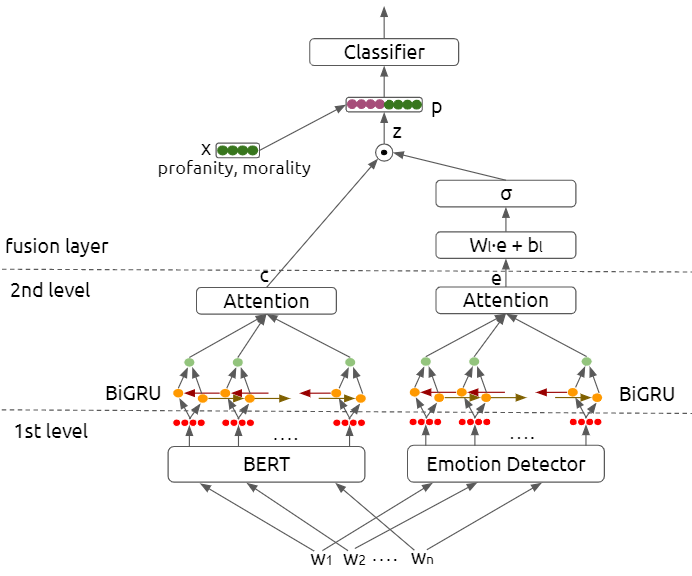
Experimental results
Research questions
- RQ1Can affective features from a pretrained emotion classifier improve depression detection in social media posts?
- RQ2Do social norm features—specifically profanity and morality—contribute meaningfully to depression detection models?
- RQ3How does the integration of affective and social norm features impact performance across different dataset sizes and classification levels (post vs. user)?
- RQ4Is the performance gain from these features consistent across diverse social media datasets, including low-resource settings?
- RQ5Does the late fusion strategy effectively combine BERT, emotion, and social norm features without degrading performance?
Key findings
- The inclusion of emotion features (B+E) improved recall by 24% over BERT-only baseline, indicating better detection of depressed users.
- Adding profanity features (B+E+P) yielded the highest F1 score of 62.73 on the RSDD dataset, a 6.73% absolute improvement over the best prior model.
- On the Pirina dataset, the B+E+P model achieved an F1 score of 95.65, a 2.65% absolute improvement over the BERT-only baseline.
- The combination of all features (B+E+P+M) did not further improve performance, suggesting potential redundancy or suboptimal fusion.
- Social norm features significantly enhanced detection performance even on the small Pirina dataset (under 2,000 posts), indicating robustness in low-resource settings.
- The model achieved state-of-the-art results on both the RSDD (user-level) and Pirina (post-level) datasets, demonstrating generalization across tasks and data scales.

Read this paper
Open the full text in the Nubint reader and ask about any passage as you read.
Read this paper on NubintThis review was generated by AI from the original paper. Please check the paper before citing it.