
[Paper Review] Depth-conditioned Dynamic Message Propagation for Monocular 3D Object Detection
This paper proposes DDMP-3D, a graph-based method that dynamically samples context-aware nodes and uses depth-conditioned, multi-scale filter weights and affinity matrices to propagate features for monocular 3D object detection. It achieves state-of-the-art performance on the KITTI benchmark, ranking 1st in the monocular 3D detection track as of November 16, 2020, by integrating a center-aware depth encoding task to mitigate inaccurate depth priors.
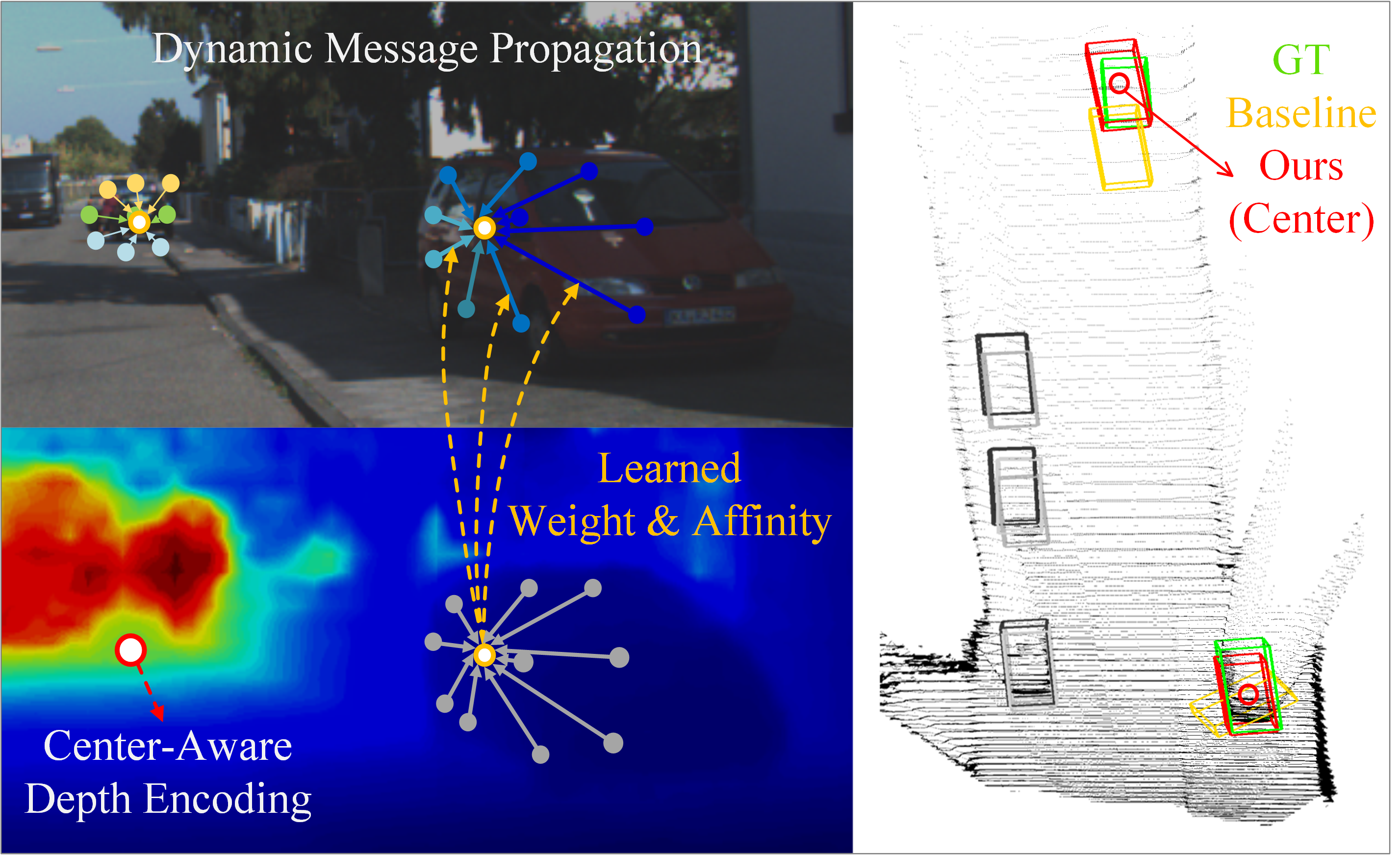
The objective of this paper is to learn context- and depth-aware feature representation to solve the problem of monocular 3D object detection. We make following contributions: (i) rather than appealing to the complicated pseudo-LiDAR based approach, we propose a depth-conditioned dynamic message propagation (DDMP) network to effectively integrate the multi-scale depth information with the image context;(ii) this is achieved by first adaptively sampling context-aware nodes in the image context and then dynamically predicting hybrid depth-dependent filter weights and affinity matrices for propagating information; (iii) by augmenting a center-aware depth encoding (CDE) task, our method successfully alleviates the inaccurate depth prior; (iv) we thoroughly demonstrate the effectiveness of our proposed approach and show state-of-the-art results among the monocular-based approaches on the KITTI benchmark dataset. Particularly, we rank $1^{st}$ in the highly competitive KITTI monocular 3D object detection track on the submission day (November 16th, 2020). Code and models are released at \url{https://github.com/fudan-zvg/DDMP}
Motivation & Objective
- To address the challenge of monocular 3D object detection, which suffers from scale variance and lack of depth cues in single-view RGB images.
- To overcome the limitations of pseudo-LiDAR methods that rely on inaccurate depth maps and discard semantic information from RGB images.
- To improve feature representation by fusing multi-scale depth features with image context in a dynamic, depth-aware manner.
- To reduce the impact of inaccurate depth priors on 3D localization through an auxiliary center-aware depth encoding task.
- To achieve state-of-the-art performance in monocular 3D object detection without relying on expensive LiDAR sensors.
Proposed method
- The method employs a graph-based formulation where each feature map pixel is treated as a node, enabling dynamic sampling of contextually relevant neighboring nodes.
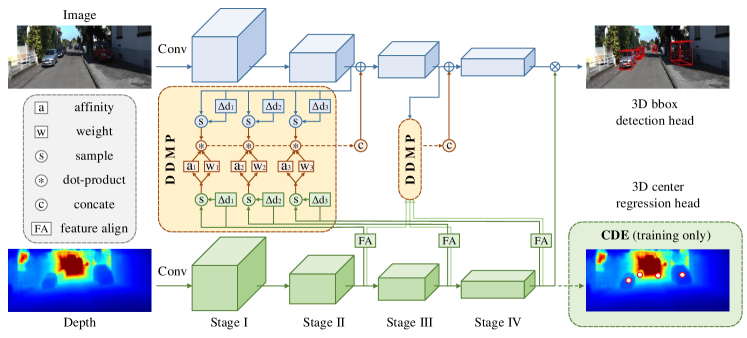
- It introduces depth-conditioned dynamic message propagation that learns hybrid, depth-dependent filter weights and affinity matrices for feature propagation using multi-scale depth features.
- The network uses a dual-branch architecture: one for 3D detection and another for depth feature extraction, with the DDMP module operating on the image branch using depth features from the bottom branch.
- A center-aware depth encoding (CDE) task is introduced as an auxiliary loss to guide depth features to be instance-aware, improving localization accuracy.
- The model is trained end-to-end with joint optimization, and the CDE head is discarded during inference.
- Multi-scale depth features are used to enhance perception across varying object scales, improving robustness to perspective distortion.
Experimental results
Research questions
- RQ1Can dynamic message propagation conditioned on multi-scale depth features improve context-aware feature learning in monocular 3D detection?
- RQ2How does integrating depth-aware graph propagation affect 3D detection performance compared to simple feature fusion or pseudo-LiDAR approaches?
- RQ3To what extent can a center-aware depth encoding task mitigate the negative impact of inaccurate depth priors on 3D localization?
- RQ4Does the proposed method generalize across different depth estimation networks, such as monocular and stereo-based estimators?
- RQ5Can the proposed approach achieve state-of-the-art performance on the KITTI benchmark without relying on LiDAR data?
Key findings
- The proposed DDMP-3D model achieved a 30.83% average precision (AP) on the 'easy' KITTI 3D detection subset, ranking 1st in the official KITTI monocular 3D detection benchmark on November 16, 2020.
- The ablation study showed that dynamic message propagation alone improved AP from 18.82% to 22.36% on the 'moderate' subset, demonstrating the effectiveness of the graph-based mechanism.
- Using multi-scale depth features (Group III) led to a 0.48% performance gain over single-scale depth features, confirming the benefit of scale-aware depth perception.
- The addition of the center-aware depth encoding (CDE) task improved the 'easy' subset AP from 28.12% to 31.14%, indicating significant gains in localization accuracy.
- The method outperformed both the baseline and the D⁴LCN model, with gains of 5.42% and 6.50% on the 'easy' and 'moderate' subsets, respectively.
- The model showed consistent improvements across different depth estimators, including DORN and PSMNet, indicating strong generalization to varying depth quality.
Read this paper
Open the full text in the Nubint reader and ask about any passage as you read.
Read this paper on NubintThis review was generated by AI from the original paper. Please check the paper before citing it.