
[Paper Review] DERA: Enhancing Large Language Model Completions with Dialog-Enabled Resolving Agents
DERA introduces a two-agent dialogue framework (Researcher and Decider) to iteratively refine LLM outputs for clinical tasks, showing improved medical conversation summarization and care plan generation over baseline GPT-4, with mixed gains on open-ended medical QA.
Large language models (LLMs) have emerged as valuable tools for many natural language understanding tasks. In safety-critical applications such as healthcare, the utility of these models is governed by their ability to generate outputs that are factually accurate and complete. In this work, we present dialog-enabled resolving agents (DERA). DERA is a paradigm made possible by the increased conversational abilities of LLMs, namely GPT-4. It provides a simple, interpretable forum for models to communicate feedback and iteratively improve output. We frame our dialog as a discussion between two agent types - a Researcher, who processes information and identifies crucial problem components, and a Decider, who has the autonomy to integrate the Researcher's information and makes judgments on the final output. We test DERA against three clinically-focused tasks. For medical conversation summarization and care plan generation, DERA shows significant improvement over the base GPT-4 performance in both human expert preference evaluations and quantitative metrics. In a new finding, we also show that GPT-4's performance (70%) on an open-ended version of the MedQA question-answering (QA) dataset (Jin et al. 2021, USMLE) is well above the passing level (60%), with DERA showing similar performance. We release the open-ended MEDQA dataset at https://github.com/curai/curai-research/tree/main/DERA.
Motivation & Objective
- Motivate the use of dialog-enabled resolving agents to improve factuality and completeness in clinical NLP outputs.
- Introduce a two-agent (Researcher and Decider) framework that iteratively refines outputs via structured dialogue.
- Evaluate DERA on medical conversation summarization, care plan generation, and open-ended medical question answering.
- Show improved expert-consensus quality for long-form generation tasks and provide open-ended MedQA dataset release.
Proposed method
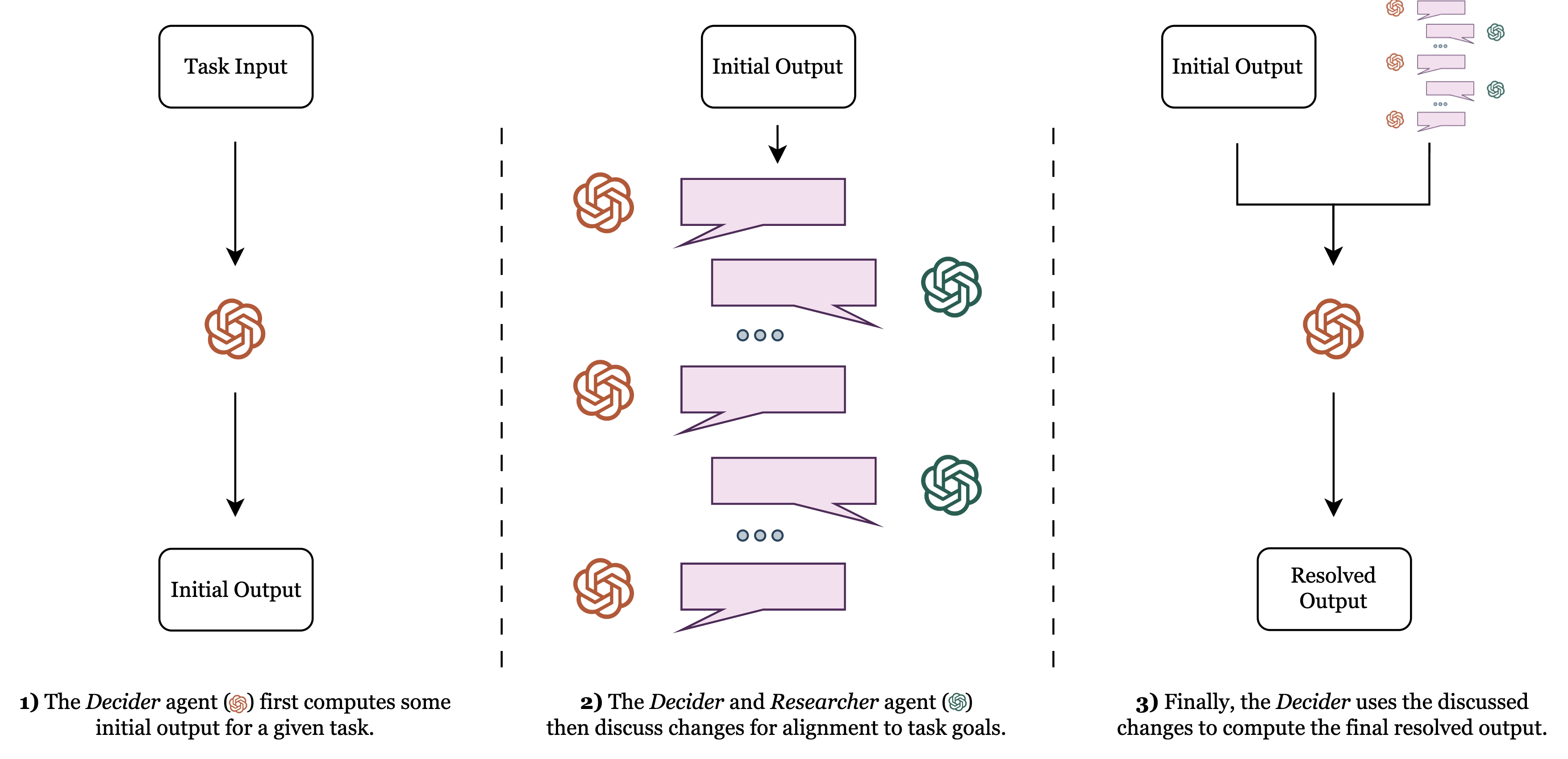
- Propose a two-agent dialog framework where a Researcher identifies crucial problem components and a Decider integrates information to produce the final output.
- Use an initial Decider-generated output followed by iterative dialogue where Researcher highlights discrepancies and the Decider updates a shared scratchpad.
- Allow the Decider to make final judgments while not deferring entirely to the Researcher, enabling role-defined, iterative refinement.
- Apply DERA to three tasks: medical conversation summarization, care plan generation, and open-ended medical question answering.
- Utilize GPT-4 with task-specific prompts and a bounded dialog length to elicit iterative corrections (example prompts and prompts-refinement described).
- Provide human expert evaluations (physician evaluators) and quantitative metrics (GPT-F1) to assess corrections of corrupted summaries and plan completeness.
Experimental results
Research questions
- RQ1Can a two-agent dialogue (Researcher and Decider) improve factual completeness and reduce hallucinations in clinical LLM outputs relative to a baseline GPT-4 prompt?
- RQ2Does DERA consistently enhance long-form outputs (summaries and care plans) more than short-form open-ended QA in clinical settings?
- RQ3To what extent can iterative error correction via dialog correct synthetic corruptions in medical summaries?
- RQ4How does DERA perform on open-ended medical QA datasets when questions are reformulated to be non-multiple-choice?
- RQ5What is the potential for releasing open-ended MedQA data to spur research in model-based medical QA?
Key findings
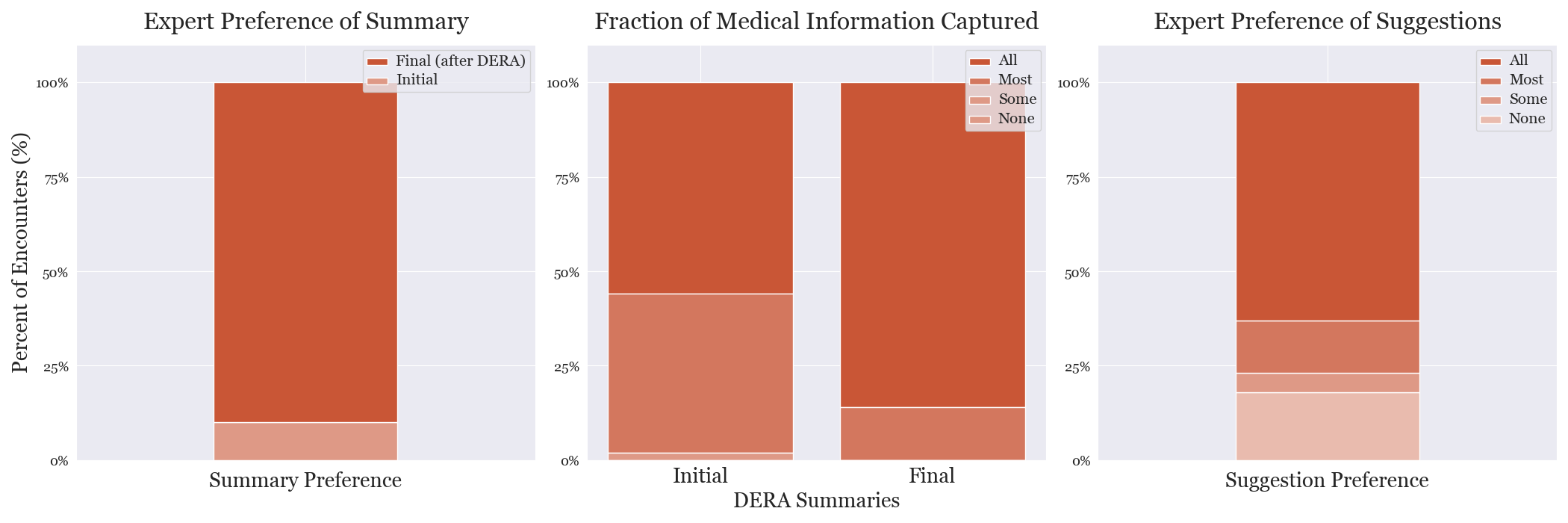
- DERA outperforms base GPT-4 in medical conversation summarization according to physician expert preferences.
- DERA produces summaries that doctors rate as capturing more of the relevant medical information than initial GPT-4 outputs.
- DERA improves care plan generation, with physicians preferring final DERA plans over initial GPT-4 plans and rating higher completeness.
- Quantitative evaluation with corrupted summaries shows DERA significantly improves GPT-F1 scores across low, medium, and high corruption levels.
- DERA achieves near-expert performance on open-ended MedQA-like QA, indicating the dialog-based refinement can extend to knowledge reasoning tasks.
- The authors release an open-ended MEDQA dataset to foster further research in medical QA using DERA.
Read this paper
Open the full text in the Nubint reader and ask about any passage as you read.
Read this paper on NubintThis review was generated by AI from the original paper. Please check the paper before citing it.