
[Paper Review] Describe, Explain, Plan and Select: Interactive Planning with Large Language Models Enables Open-World Multi-Task Agents
DEPS is an interactive planning framework using LLMs for open-world multi-task agents, improving plan reliability via describe, explain, plan, and select cycles and a horizon-predictive selector; it achieves strong zero-shot Minecraft performance and generalizes to ALFWorld and tabletop tasks.
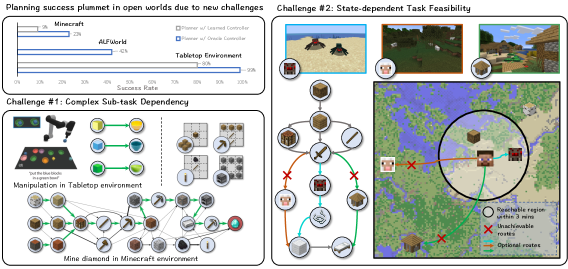
We investigate the challenge of task planning for multi-task embodied agents in open-world environments. Two main difficulties are identified: 1) executing plans in an open-world environment (e.g., Minecraft) necessitates accurate and multi-step reasoning due to the long-term nature of tasks, and 2) as vanilla planners do not consider how easy the current agent can achieve a given sub-task when ordering parallel sub-goals within a complicated plan, the resulting plan could be inefficient or even infeasible. To this end, we propose "$\underline{D}$escribe, $\underline{E}$xplain, $\underline{P}$lan and $\underline{S}$elect" ($ extbf{DEPS}$), an interactive planning approach based on Large Language Models (LLMs). DEPS facilitates better error correction on initial LLM-generated $ extit{plan}$ by integrating $ extit{description}$ of the plan execution process and providing self-$ extit{explanation}$ of feedback when encountering failures during the extended planning phases. Furthermore, it includes a goal $ extit{selector}$, which is a trainable module that ranks parallel candidate sub-goals based on the estimated steps of completion, consequently refining the initial plan. Our experiments mark the milestone of the first zero-shot multi-task agent that can robustly accomplish 70+ Minecraft tasks and nearly double the overall performances. Further testing reveals our method's general effectiveness in popularly adopted non-open-ended domains as well (i.e., ALFWorld and tabletop manipulation). The ablation and exploratory studies detail how our design beats the counterparts and provide a promising update on the $ exttt{ObtainDiamond}$ grand challenge with our approach. The code is released at https://github.com/CraftJarvis/MC-Planner.
Motivation & Objective
- Address the challenge of long-horizon planning in open worlds (e.g., Minecraft) where plans may be infeasible or inefficient.
- Improve plan robustness by enabling error-aware plan correction through descriptor and explainer feedback.
- Enhance plan feasibility by introducing a trainable horizon-based goal selector that chooses near-term, reachable sub-goals.
- Demonstrate zero-shot capability to solve 70+ Minecraft tasks without environment-specific planning training.
- Show generalization to non-open-ended domains like ALFWorld and tabletop manipulation.
Proposed method
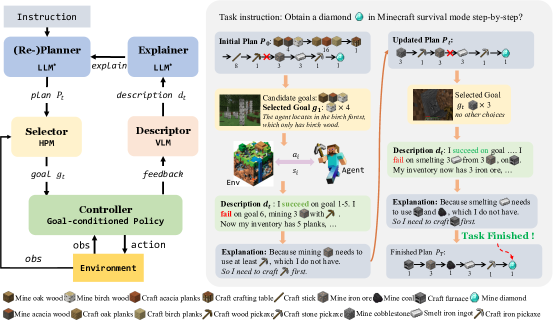
- Propose DEPS: a loop where an LLM acts as descriptor, explainer, and planner to iteratively refine sub-goals.
- Use a descriptor to summarize current state after sub-goal execution failures and feed this to the LLM for self-explanation and replanning.
- Introduce a horizon-predictive selector that estimates remaining steps (horizon) to complete each candidate sub-goal and selects the nearest/most feasible one.
- Train a selector backbone (Impala CNN-based) to predict goal feasibility and horizon, improving plan efficiency.
- Ground the approach with a zero-shot LLM planner and a goal-conditioned controller that executes sub-goals via learned policies.
Experimental results
Research questions
- RQ1How can an LLM-based planner recover from failures in open-world, long-horizon tasks?
- RQ2Can feedback-driven re-planning (describe, explain, plan) improve success rates over one-shot planning in open worlds?
- RQ3Does a horizon-aware selector improve the efficiency and feasibility of sub-goal sequences in open-world tasks?
- RQ4To what extent does DEPS generalize beyond Minecraft to other domains like ALFWorld and tabletop manipulation?
- RQ5What is the impact of multiple re-planning rounds on task success in open-ended environments?
Key findings
- DEPS substantially outperforms all language-planner baselines on 71 Minecraft tasks, nearly doubling overall success rate.
- Ablations show DEPS with description, self-explanation, and re-planning (DEP) beats prior planners, and adding the selector (DEPS) yields further gains.
- The horizon-predictive selector improves efficiency, especially in tasks with many parallel goals, and surpasses vision-language baselines in ranking feasibility.
- More re-planning rounds lead to higher success, with gains growing for harder tasks, up to the horizon-limited token constraints.
- DEPS achieves 0.59% on ObtainDiamond within 10 minutes, matching contemporary zero-shot planning performance without task-specific fine-tuning, and shows strong cross-domain results (ALFWorld, Tabletop).
Read this paper
Open the full text in the Nubint reader and ask about any passage as you read.
Read this paper on NubintThis review was generated by AI from the original paper. Please check the paper before citing it.