
[Paper Review] Detecting Unknown Encrypted Malicious Traffic in Real Time via Flow Interaction Graph Analysis
HyperVision is a real-time, unsupervised machine learning system that detects unknown encrypted malicious traffic by analyzing flow interaction patterns through a compact in-memory graph. It achieves high detection accuracy (AUC ≥ 0.92, F1 ≥ 0.86) and throughput (>80.6 Gb/s) without requiring labeled datasets or prior knowledge of attack patterns.
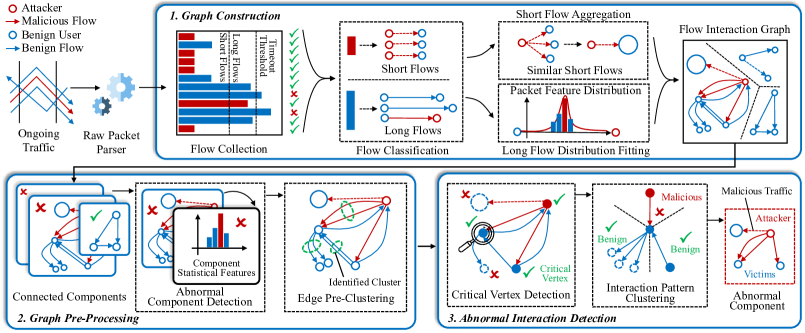
In this paper, we propose HyperVision, a realtime unsupervised machine learning (ML) based malicious traffic detection system. Particularly, HyperVision is able to detect unknown patterns of encrypted malicious traffic by utilizing a compact inmemory graph built upon the traffic patterns. The graph captures flow interaction patterns represented by the graph structural features, instead of the features of specific known attacks. We develop an unsupervised graph learning method to detect abnormal interaction patterns by analyzing the connectivity, sparsity, and statistical features of the graph, which allows HyperVision to detect various encrypted attack traffic without requiring any labeled datasets of known attacks. Moreover, we establish an information theory model to demonstrate that the information preserved by the graph approaches the ideal theoretical bound. We show the performance of HyperVision by real-world experiments with 92 datasets including 48 attacks with encrypted malicious traffic. The experimental results illustrate that HyperVision achieves at least 0.92 AUC and 0.86 F1, which significantly outperform the state-of-the-art methods. In particular, more than 50% attacks in our experiments can evade all these methods. Moreover, HyperVision achieves at least 80.6 Gb/s detection throughput with the average detection latency of 0.83s.
Motivation & Objective
- To address the challenge of detecting unknown encrypted malicious traffic that evades traditional signature- and supervised ML-based methods.
- To enable real-time detection of encrypted attacks without prior knowledge of attack patterns or labeled datasets.
- To model complex attack behaviors through interaction patterns among multiple network flows rather than single-flow features.
- To develop a task-agnostic detection system that works across diverse encrypted attack types.
Proposed method
- Constructs a compact in-memory flow interaction graph that captures connectivity, sparsity, and statistical features of network flows.
- Uses two strategies to represent interaction patterns from short and long flows, enabling unified analysis of diverse traffic behaviors.
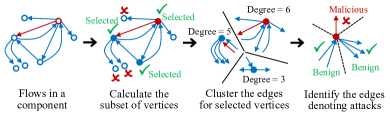
- Applies an unsupervised graph learning method to detect anomalies based on structural and statistical deviations in the graph.
- Employs an information theory model to prove that the graph preserves near-optimal information for detection.
- Leverages discrete-time Markov chains (DTMC) to quantify the information retention efficiency of the graph representation.
- Integrates real-time processing pipelines to achieve low-latency detection (0.83s average) and high throughput (>80.6 Gb/s).
Experimental results
Research questions
- RQ1Can flow interaction patterns in encrypted traffic be effectively modeled to detect unknown attacks without labeled data?
- RQ2How well does a compact in-memory graph preserve essential information for detecting malicious behavior in encrypted traffic?
- RQ3Can unsupervised graph learning detect anomalies in encrypted traffic that are invisible to single-flow analysis?
- RQ4What is the theoretical information-theoretic bound of graph-based representation in malicious traffic detection?
- RQ5How does HyperVision perform against state-of-the-art methods in detecting real-world encrypted attacks?
Key findings
- HyperVision achieves at least 0.92 AUC and 0.86 F1 on 92 real-world attack datasets, significantly outperforming state-of-the-art methods.
- More than 50% of the 48 attacks tested (24 attacks) evaded all five existing state-of-the-art detection systems.
- The system sustains a detection throughput of over 80.6 Gb/s with an average latency of 0.83 seconds.
- The information preserved by the flow interaction graph approaches the theoretical information-theoretic upper bound.
- HyperVision successfully detects complex, multi-stage attacks that rely on encrypted traffic and are invisible to single-flow analysis.
- The method is effective across diverse attack types, including C2 exfiltration, malware campaigns, and data exfiltration, without requiring prior knowledge of attack signatures.
Read this paper
Open the full text in the Nubint reader and ask about any passage as you read.
Read this paper on NubintThis review was generated by AI from the original paper. Please check the paper before citing it.