
[Paper Review] DETRs with Collaborative Hybrid Assignments Training
The paper introduces Co-DETR, a training scheme that adds multiple auxiliary heads with one-to-many label assignments to DETR-like detectors, enriching encoder supervision and decoding attention without extra inference cost, and achieves state-of-the-art results on COCO and LVIS.
In this paper, we provide the observation that too few queries assigned as positive samples in DETR with one-to-one set matching leads to sparse supervision on the encoder's output which considerably hurt the discriminative feature learning of the encoder and vice visa for attention learning in the decoder. To alleviate this, we present a novel collaborative hybrid assignments training scheme, namely $\mathcal{C}$o-DETR, to learn more efficient and effective DETR-based detectors from versatile label assignment manners. This new training scheme can easily enhance the encoder's learning ability in end-to-end detectors by training the multiple parallel auxiliary heads supervised by one-to-many label assignments such as ATSS and Faster RCNN. In addition, we conduct extra customized positive queries by extracting the positive coordinates from these auxiliary heads to improve the training efficiency of positive samples in the decoder. In inference, these auxiliary heads are discarded and thus our method introduces no additional parameters and computational cost to the original detector while requiring no hand-crafted non-maximum suppression (NMS). We conduct extensive experiments to evaluate the effectiveness of the proposed approach on DETR variants, including DAB-DETR, Deformable-DETR, and DINO-Deformable-DETR. The state-of-the-art DINO-Deformable-DETR with Swin-L can be improved from 58.5% to 59.5% AP on COCO val. Surprisingly, incorporated with ViT-L backbone, we achieve 66.0% AP on COCO test-dev and 67.9% AP on LVIS val, outperforming previous methods by clear margins with much fewer model sizes. Codes are available at \url{https://github.com/Sense-X/Co-DETR}.
Motivation & Objective
- Motivate and analyze the limitations of one-to-one DETR set matching, notably sparse encoder supervision and weak decoder attention.
- Propose a collaborative hybrid assignments training (Co-DETR) scheme to enrich encoder supervision using one-to-many label assignments via auxiliary heads.
- Enhance decoder training by generating customized positive queries and sharing parameters across auxiliary branches.
- Demonstrate that Co-DETR improves convergence and accuracy across DETR variants without adding inference overhead.
Proposed method
- Introduce K auxiliary heads supervised by versatile one-to-many label assignments (e.g., ATSS, Faster R-CNN, RetinaNet, FCOS).
- Construct a feature pyramid from the encoder outputs to feed auxiliary heads at multiple scales.
- Compute enc loss as the sum of losses over all auxiliary heads, using their assigned positives/negatives.
- Generate customized positive queries from auxiliary head positive coordinates to enrich decoder training without changing the original decoder architecture.
- Train with a global objective combining the main one-to-one DETR loss and the auxiliary head losses with balancing coefficients.
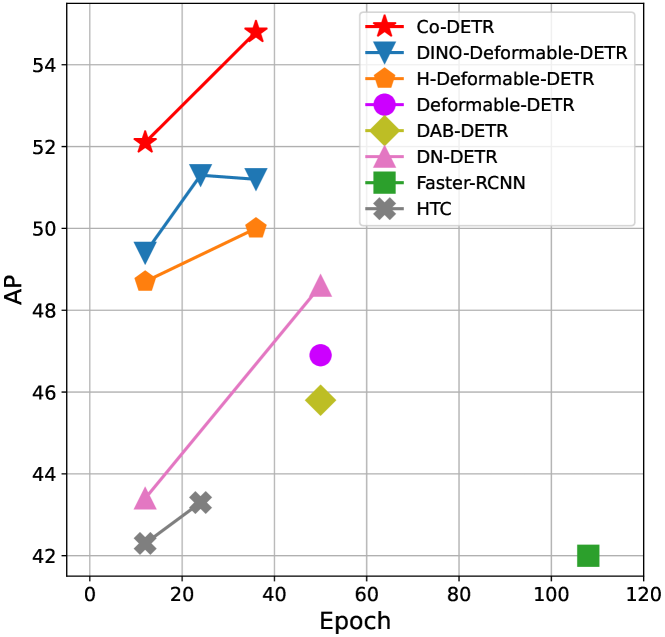
Experimental results
Research questions
- RQ1How does introducing auxiliary heads with one-to-many assignments affect encoder discriminability and feature learning in DETR variants?
- RQ2Can customized positive queries from auxiliary heads improve cross-attention learning in the decoder without increasing inference cost?
- RQ3What are the performance gains when applying Co-DETR to various DETR backbones (e.g., Deformable-DETR, DINO-Deformable-DETR, Swin-L backbones) on COCO and LVIS?
- RQ4How do auxiliary heads interact and what are the limits (e.g., optimal number of heads) for stable training?
Key findings
- Co-DETR yields substantial AP gains across DETR variants, e.g., Deformable-DETR improves by 5.8 AP (12-epoch) and 3.2 AP (36-epoch).
- DINO-Deformable-DETR with Swin-L improves from 58.5 to 59.5 AP on COCO val when using Co-DETR.
- With ViT-L backbone, Co-DETR achieves 66.0 AP on COCO test-dev and 67.9 AP on LVIS val, surpassing prior methods with smaller models.
- On COCO val, Co-DETR with ViT-L achieves 65.9 AP (val) / 66.0 AP (test-dev); LVIS results include 56.9 AP (val) / 62.3 AP (minival).
- Co-DETR enables faster convergence and maintains no extra inference cost, as auxiliary heads are discarded during testing.
- In large-scale backbones (ViT-L pre-trained on Objects365), Co-DETR sets a new record on COCO test-dev with 66.0 AP and LVIS with 71.9 AP minival (without heavy test-time augmentation).

Read this paper
Open the full text in the Nubint reader and ask about any passage as you read.
Read this paper on NubintThis review was generated by AI from the original paper. Please check the paper before citing it.