
[Paper Review] DevBench: A multimodal developmental benchmark for language learning
DevBench introduces a multimodal benchmark with seven language tasks assessing lexical, syntactic, and semantic abilities in children and adults, enabling direct comparison of vision-language models to human developmental trajectories. It reveals that model performance and human-likeness are strongly correlated, with larger models and longer training showing closer alignment to human response patterns, especially in developmental progression.
How (dis)similar are the learning trajectories of vision-language models and children? Recent modeling work has attempted to understand the gap between models' and humans' data efficiency by constructing models trained on less data, especially multimodal naturalistic data. However, such models are often evaluated on adult-level benchmarks, with limited breadth in language abilities tested, and without direct comparison to behavioral data. We introduce DevBench, a multimodal benchmark comprising seven language evaluation tasks spanning the domains of lexical, syntactic, and semantic ability, with behavioral data from both children and adults. We evaluate a set of vision-language models on these tasks, comparing models and humans not only on accuracy but on their response patterns. Across tasks, models exhibit variation in their closeness to human response patterns, and models that perform better on a task also more closely resemble human behavioral responses. We also examine the developmental trajectory of OpenCLIP over training, finding that greater training results in closer approximations to adult response patterns. DevBench thus provides a benchmark for comparing models to human language development. These comparisons highlight ways in which model and human language learning processes diverge, providing insight into entry points for improving language models.
Motivation & Objective
- To address the lack of developmental benchmarks that evaluate language models using child-level data and human-like evaluation methods.
- To create a benchmark that captures the dynamic range of language development across lexical, syntactic, and semantic domains.
- To enable direct comparison between model and human response patterns rather than relying on absolute accuracy metrics.
- To evaluate how vision-language models trained on developmental data approximate human language learning trajectories.
- To identify gaps in model behavior—especially regarding ambiguity resolution—relative to children’s language acquisition.
Proposed method
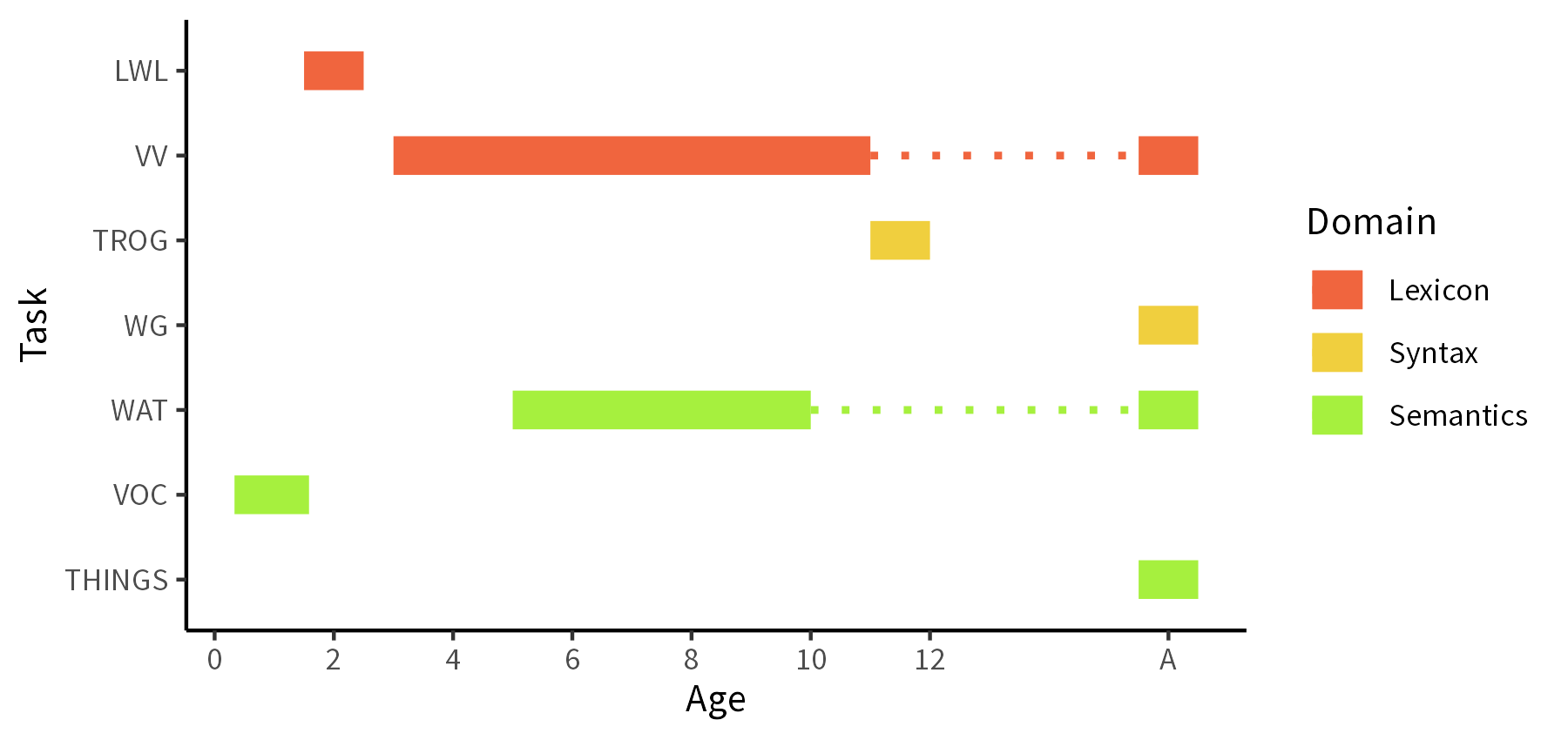
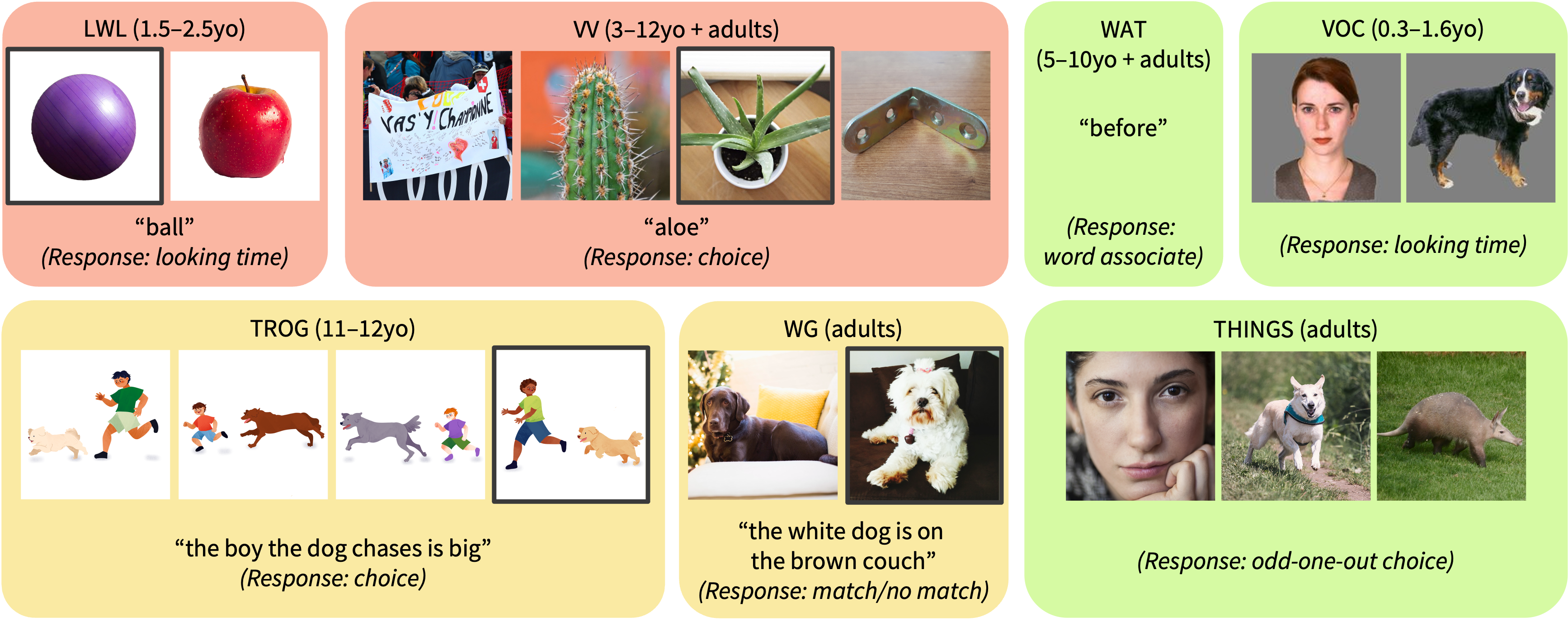
- DevBench comprises seven multimodal language evaluation tasks designed to reflect developmental progression in language acquisition.
- Each task collects behavioral data from both children (ages 2–5) and adults, using nonverbal response methods like looking or pointing to reduce cognitive load.
- Model performance is evaluated not only by accuracy but by similarity to human response patterns using optimized KL divergence between model logits and human response distributions.
- A diverse set of vision-language models—including state-of-the-art, smaller, and developmentally trained models—are evaluated on DevBench.
- Intermediate training checkpoints of OpenCLIP are analyzed to track changes in model–human similarity over time, revealing developmental trends.
- The benchmark is designed to be extensible, with a standardized format to encourage future contributions of new tasks and multilingual data.
Experimental results
Research questions
- RQ1How do vision-language models compare to children and adults in their response patterns across different language abilities?
- RQ2To what extent does model size or training duration influence its similarity to human developmental response patterns?
- RQ3Can models trained on developmentally realistic data better approximate human language learning than standard models?
- RQ4In what ways do models diverge from children in handling ambiguous or contextually complex language inputs?
- RQ5How do response pattern similarities between models and humans evolve during training, and do they reflect known developmental trajectories?
Key findings
- Model–human similarity in response patterns is strongly correlated with model accuracy, indicating that higher-performing models also more closely resemble human behavior.
- Larger models and those with longer training durations show greater alignment with adult response patterns, particularly in syntactic and semantic tasks.
- OpenCLIP models exhibit developmental trends over training, with intermediate checkpoints showing increasing similarity to adult response patterns, though not consistently across all tasks.
- Models are less effective than humans at resolving ambiguous inputs, suggesting a key divergence in pragmatic reasoning and uncertainty handling.
- The benchmark reveals that current models vary significantly in their human-likeness, highlighting ambiguity resolution and developmental trajectory modeling as critical areas for future improvement.
- DevBench enables methodologically rigorous, direct comparisons between models and children, offering a framework to evaluate models not just on accuracy but on developmental plausibility.
Better researchstarts right now
From reading papers to final review, dramatically reduce your research time.
No credit card · Free plan available
This review was created by AI and reviewed by human editors.