
[Paper Review] DexPilot: Vision Based Teleoperation of Dexterous Robotic Hand-Arm System
DexPilot presents a low-cost, markerless, vision-based teleoperation system that enables full 23-degree-of-freedom control of a dexterous robotic hand-arm system using only bare-hand observation. By combining deep learning-based hand tracking, nonlinear kinematic retargeting, and GPU-accelerated optimization, it achieves high task success rates in complex manipulation tasks despite the absence of tactile feedback.
Teleoperation offers the possibility of imparting robotic systems with sophisticated reasoning skills, intuition, and creativity to perform tasks. However, current teleoperation solutions for high degree-of-actuation (DoA), multi-fingered robots are generally cost-prohibitive, while low-cost offerings usually provide reduced degrees of control. Herein, a low-cost, vision based teleoperation system, DexPilot, was developed that allows for complete control over the full 23 DoA robotic system by merely observing the bare human hand. DexPilot enables operators to carry out a variety of complex manipulation tasks that go beyond simple pick-and-place operations. This allows for collection of high dimensional, multi-modality, state-action data that can be leveraged in the future to learn sensorimotor policies for challenging manipulation tasks. The system performance was measured through speed and reliability metrics across two human demonstrators on a variety of tasks. The videos of the experiments can be found at https://sites.google.com/view/dex-pilot.
Motivation & Objective
- To develop a low-cost, markerless, and glove-free teleoperation system for high-degree-of-freedom robotic hand-arm systems.
- To enable precise, dexterous manipulation of complex tasks through vision-only human hand observation.
- To collect high-dimensional, multi-modal state-action data for future learning of sensorimotor policies.
- To overcome the limitations of expensive or restrictive teleoperation systems while maintaining high control fidelity.
Proposed method
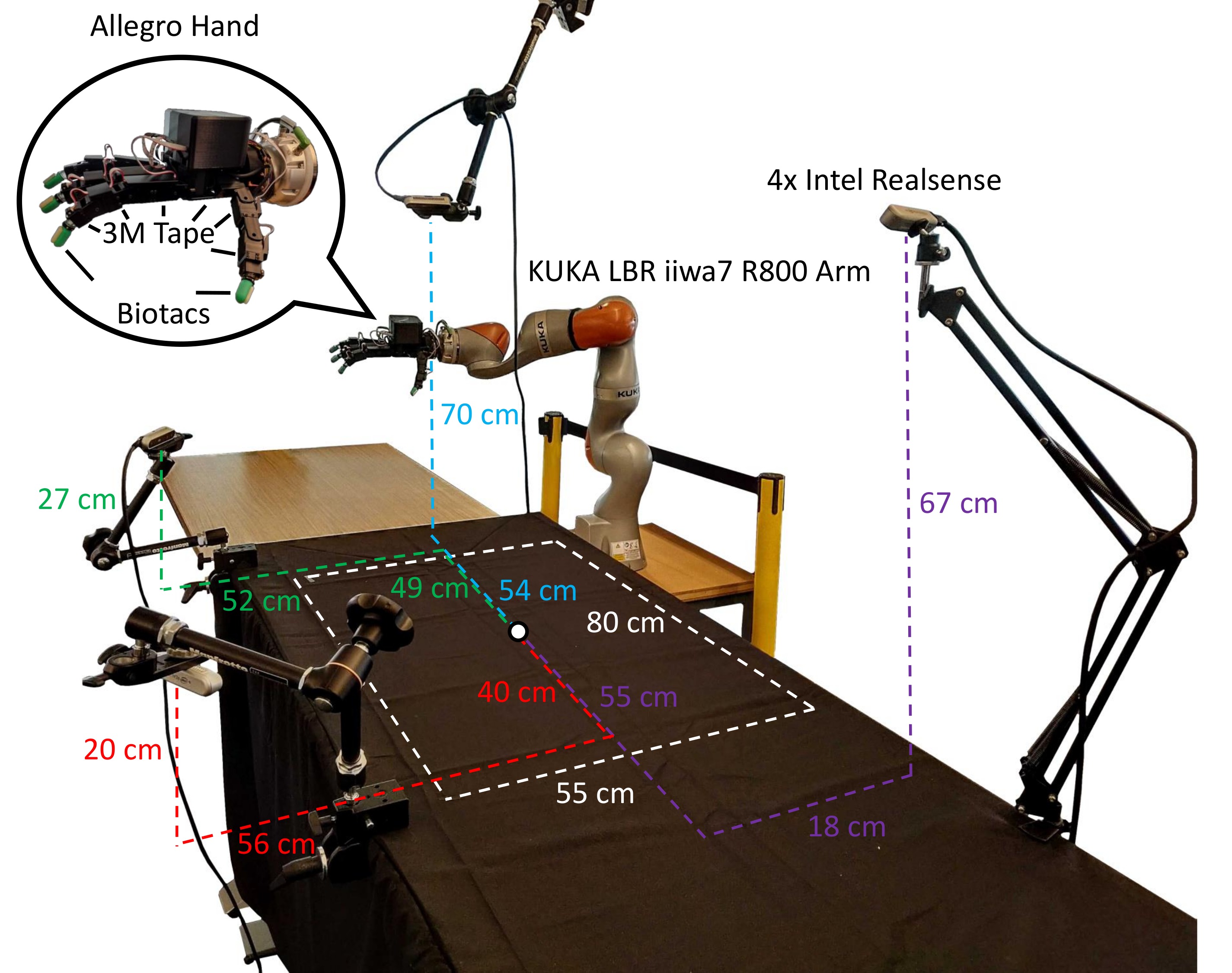
- Uses four Intel RealSense depth cameras to capture real-time RGB-D data of the human hand.
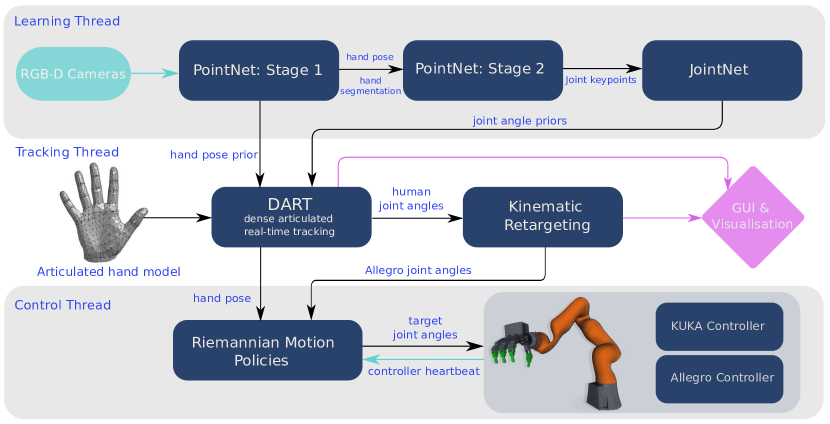
- Employs deep learning-based bare-hand 3D pose estimation to track joint positions without markers or gloves.
- Applies a novel cost function and projection scheme to kinematically retarget human hand poses to the Allegro robotic hand’s joint space.
- Utilizes nonlinear optimization on two NVIDIA GPUs to resolve kinematic inconsistencies and preserve grasp feasibility.
- Implements a Riemannian Motion Policy (RMP) motion generator for smooth, responsive robot motion control.
- Integrates real-time feedback loops to synchronize human motion with robotic execution, minimizing latency.
Experimental results
Research questions
- RQ1Can a low-cost, vision-based system achieve reliable and precise teleoperation of a 23-DoF robotic hand-arm system without gloves or markers?
- RQ2How effective is vision-only human hand tracking in enabling fine dexterous manipulation tasks?
- RQ3To what extent can kinematic retargeting preserve grasp feasibility and dexterity under tracking errors?
- RQ4Can high task success rates be achieved in complex manipulation tasks without tactile feedback?
- RQ5What is the performance of the system across different human operators in diverse manipulation scenarios?
Key findings
- The system achieved high task success rates across a variety of complex manipulation tasks, including pulling out paper currency from a wallet and grasping two cubes with four fingers.
- Despite the absence of tactile feedback, two trained human demonstrators successfully completed tasks requiring fine dexterity, indicating strong reliance on visual perception and cognitive planning.
- Kinematic retargeting with the novel cost function preserved grasp feasibility and enabled precise control even with moderate hand tracking errors.
- The system demonstrated the ability to collect rich, high-dimensional state-action data, including 92 tactile signals, 23 joint positions and velocities, and torque commands, enabling future learning-based policy development.
- Peg-in-hole insertions were attempted with a 0.1 mm clearance, achieving success in about 10% of attempts under optimal initial placement conditions, highlighting the challenge of high-precision tasks.
- The system's performance was limited by hand tracking inaccuracies during fingertip contact and interference in finger gaiting, which could be mitigated with improved tracking and control algorithms.
Read this paper
Open the full text in the Nubint reader and ask about any passage as you read.
Read this paper on NubintThis review was generated by AI from the original paper. Please check the paper before citing it.