
[Paper Review] DFME: A New Benchmark for Dynamic Facial Micro-expression Recognition
This paper introduces DFME, a new large-scale dynamic facial micro-expression dataset with 7,526 high-frame-rate videos from 671 participants, annotated by over 20 annotators. It evaluates four spatiotemporal models on DFME, demonstrating its utility for automatic micro-expression recognition and providing benchmarks for class imbalance and key-frame sampling strategies, with I3D achieving 55.24% accuracy using adaptive sampling.
One of the most important subconscious reactions, micro-expression (ME), is a spontaneous, subtle, and transient facial expression that reveals human beings' genuine emotion. Therefore, automatically recognizing ME (MER) is becoming increasingly crucial in the field of affective computing, providing essential technical support for lie detection, clinical psychological diagnosis, and public safety. However, the ME data scarcity has severely hindered the development of advanced data-driven MER models. Despite the recent efforts by several spontaneous ME databases to alleviate this problem, there is still a lack of sufficient data. Hence, in this paper, we overcome the ME data scarcity problem by collecting and annotating a dynamic spontaneous ME database with the largest current ME data scale called DFME (Dynamic Facial Micro-expressions). Specifically, the DFME database contains 7,526 well-labeled ME videos spanning multiple high frame rates, elicited by 671 participants and annotated by more than 20 professional annotators over three years. Furthermore, we comprehensively verify the created DFME, including using influential spatiotemporal video feature learning models and MER models as baselines, and conduct emotion classification and ME action unit classification experiments. The experimental results demonstrate that the DFME database can facilitate research in automatic MER, and provide a new benchmark for this field. DFME will be published via https://mea-lab-421.github.io.
Motivation & Objective
- To address the critical lack of large-scale, high-quality spontaneous micro-expression datasets for data-driven MER models.
- To construct a dynamic, high-frame-rate micro-expression dataset with extensive labeling and long-term annotation to support robust model training.
- To validate the feasibility and reliability of the DFME dataset through comprehensive experiments using state-of-the-art spatiotemporal models.
- To investigate and provide solutions for key challenges in dynamic MER, including class imbalance and non-uniform key-frame sequence sampling.
- To establish DFME as a new benchmark for future research in automatic micro-expression recognition.
Proposed method
- The DFME dataset was collected using high-speed cameras to capture spontaneous micro-expressions induced via emotional elicitation tasks, ensuring high temporal resolution.
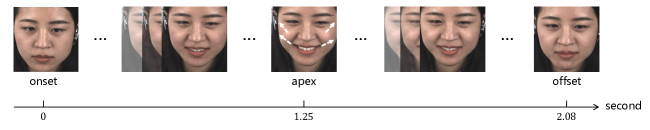
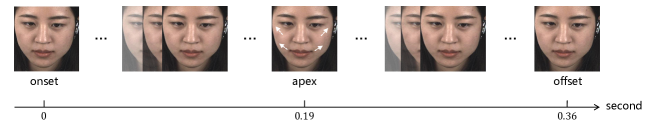
- Videos were annotated by over 20 expert annotators across three years, with precise labeling of onset, apex, and offset frames for each micro-expression.
- Four classical 3D CNN-based spatiotemporal feature learning models—R3D, P3D, D3D, and I3D—were trained and evaluated on DFME to assess dataset quality and model performance.
- Class-Balanced Loss (CBLoss) was applied to mitigate class imbalance, with hyperparameter $β$ tuned to balance effective and actual sample counts.
- Two key-frame sampling strategies—uniform sampling and temporal adaptive sampling based on onset, apex, and offset moments—were compared to evaluate their impact on recognition accuracy.
- The adaptive sampling method used frame selection based on critical temporal landmarks to preserve dynamic micro-expression features more effectively than uniform sampling.
Experimental results
Research questions
- RQ1Can a large-scale, high-frame-rate spontaneous micro-expression dataset significantly improve the performance of data-driven MER models?
- RQ2How does class imbalance affect MER performance on micro-expression datasets, and what loss function effectively mitigates this issue?
- RQ3Does temporal adaptive key-frame sampling outperform uniform sampling in capturing dynamic micro-expression features for recognition?
- RQ4How do different spatiotemporal models perform on the DFME dataset, and which model achieves the highest recognition accuracy?
- RQ5What are the optimal configurations for loss functions and sampling strategies when training MER models on DFME?
Key findings
- The I3D model achieved the highest accuracy of 55.24% on DFME using cross-entropy loss, with a macro F1-score of 0.4576, demonstrating the dataset's suitability for advanced models.
- Class-Balanced Loss improved the F1-score by up to 0.0256 compared to cross-entropy loss on the I3D model, indicating effective mitigation of class imbalance.
- Temporal adaptive key-frame sampling outperformed uniform sampling on R3D and P3D, achieving 0.3817 and 0.3830 F1-scores respectively, compared to 0.3710 and 0.3671.
- On D3D and I3D, uniform sampling slightly outperformed adaptive sampling, suggesting model-dependent optimal sampling strategies.
- The DFME dataset achieved a recognition accuracy of 55.24% on I3D with adaptive sampling, confirming its value as a new benchmark for MER research.
- The comprehensive evaluation across four models and two sampling strategies confirms the robustness and reliability of DFME for future MER studies.
Read this paper
Open the full text in the Nubint reader and ask about any passage as you read.
Read this paper on NubintThis review was generated by AI from the original paper. Please check the paper before citing it.