
[Paper Review] Dialogue Relation Extraction with Document-level Heterogeneous Graph Attention Networks
This paper proposes a heterogeneous graph attention network (HGAT) for dialogue relation extraction that models speaker, entity, utterance, and type information in a unified graph structure. By leveraging multi-hop message passing across heterogeneous nodes, the model captures long-range dependencies and inter-speaker relations, achieving state-of-the-art performance on the DialogRE benchmark with a 56.1% macro-F1 on the test set.
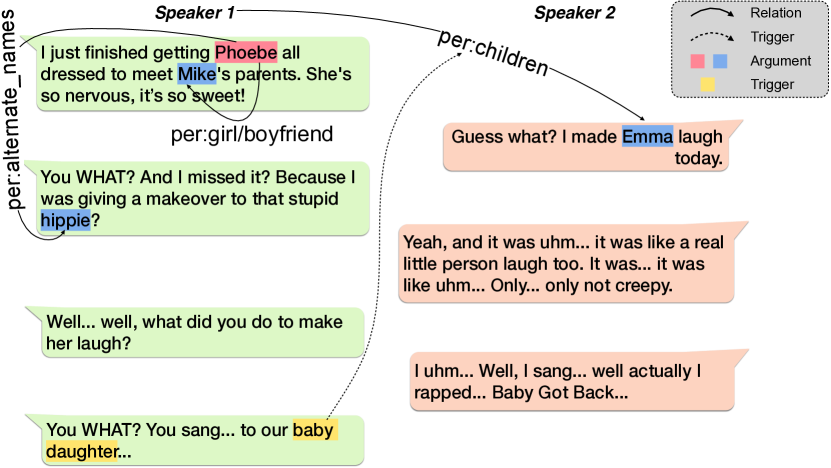
Dialogue relation extraction (DRE) aims to detect the relation between two entities mentioned in a multi-party dialogue. It plays an important role in constructing knowledge graphs from conversational data increasingly abundant on the internet and facilitating intelligent dialogue system development. The prior methods of DRE do not meaningfully leverage speaker information-they just prepend the utterances with the respective speaker names. Thus, they fail to model the crucial inter-speaker relations that may give additional context to relevant argument entities through pronouns and triggers. We, however, present a graph attention network-based method for DRE where a graph, that contains meaningfully connected speaker, entity, entity-type, and utterance nodes, is constructed. This graph is fed to a graph attention network for context propagation among relevant nodes, which effectively captures the dialogue context. We empirically show that this graph-based approach quite effectively captures the relations between different entity pairs in a dialogue as it outperforms the state-of-the-art approaches by a significant margin on the benchmark dataset DialogRE. Our code is released at: https://github.com/declare-lab/dialog-HGAT
Motivation & Objective
- To address the limitation of prior dialogue relation extraction methods that underutilize speaker information and fail to model inter-speaker relations.
- To improve long-distance dependency learning in conversational text, which is more entangled and less information-dense than formal documents.
- To develop an inductive, lightweight graph neural network that generalizes well to unseen dialogue graphs without costly matrix operations.
- To incorporate speaker identity and trigger words as key signals for relation inference in multi-party dialogues.
Proposed method
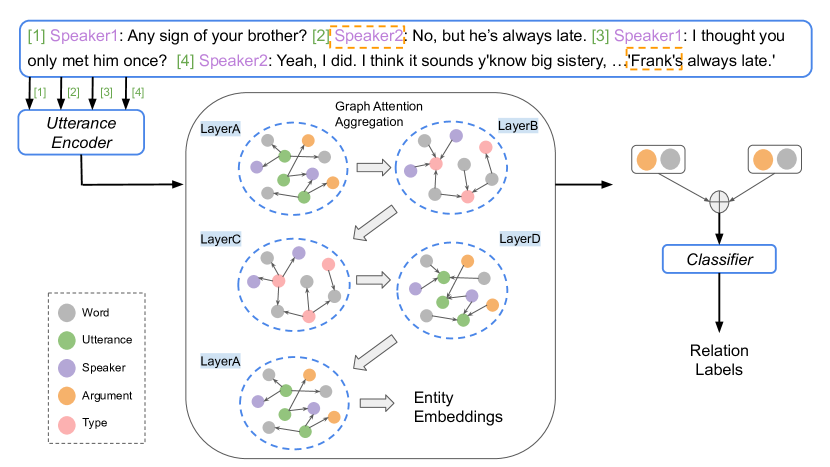
- Construct a heterogeneous graph with nodes representing speakers, entities, entity types, and utterances, connected by semantic and syntactic relations.
- Apply a multi-layer graph attention mechanism that propagates context across different node types in a specific meta-path order: utterance → type → entity → utterance.
- Use a five-layer message-passing strategy (A-B-C-D-A) to update node representations iteratively, enhancing long-range context learning.
- Leverage attention mechanisms to dynamically weight the importance of neighboring nodes during message passing, improving representation learning.
- Design a heterogeneous graph module that is inductive and avoids expensive matrix operations, enabling generalization to unseen graphs.
Experimental results
Research questions
- RQ1How can speaker information be effectively modeled in dialogue relation extraction to improve relation inference?
- RQ2Can a heterogeneous graph neural network with multi-type node propagation outperform existing methods on dialogue relation extraction?
- RQ3What is the optimal depth and structure of the message-passing mechanism for capturing long-range dependencies in dialogues?
- RQ4How do entity type biases affect model predictions, and can they be mitigated through multi-source context aggregation?
Key findings
- The proposed HGAT model achieves a macro-F1 score of 56.1% on the test set of the DialogRE benchmark, significantly outperforming state-of-the-art methods.
- Ablation studies show that a one-layer graph module performs poorly (48.4% F1), indicating that deeper message passing is essential for capturing complex dependencies.
- A seven-layer module (Strategy2) reduces performance by 1.7% on the test set compared to the five-layer model, suggesting that increased depth can lead to over-smoothing.
- A nine-layer module (Strategy3) shows the largest performance drop (52.2% F1), confirming that overly complex structures degrade model performance.
- Error analysis reveals that entity type bias leads to incorrect predictions—especially for rare relations like 'per:alumni'—when other contextual signals are weak.
Read this paper
Open the full text in the Nubint reader and ask about any passage as you read.
Read this paper on NubintThis review was generated by AI from the original paper. Please check the paper before citing it.