
[Paper Review] DialogueLLM: Context and Emotion Knowledge-Tuned Large Language Models for Emotion Recognition in Conversations
DialogueLLM fine-tunes open-source LLaMA 2-7B with emotion and context knowledge using multi-modal (text+video) instruction data to achieve state-of-the-art emotion recognition in conversations, including zero-shot and few-shot analyses.
Large language models (LLMs) and their variants have shown extraordinary efficacy across numerous downstream natural language processing (NLP) tasks, which has presented a new vision for the development of NLP. Despite their remarkable performance in natural language generating (NLG), LLMs lack a distinct focus on the emotion understanding domain. As a result, using LLMs for emotion recognition may lead to suboptimal and inadequate precision. Another limitation of LLMs is that they are typical trained without leveraging multi-modal information. To overcome these limitations, we propose DialogueLLM, a context and emotion knowledge tuned LLM that is obtained by fine-tuning LLaMA models with 13,638 multi-modal (i.e., texts and videos) emotional dialogues. The visual information is considered as the supplementary knowledge to construct high-quality instructions. We offer a comprehensive evaluation of our proposed model on three benchmarking emotion recognition in conversations (ERC) datasets and compare the results against the SOTA baselines and other SOTA LLMs. Additionally, DialogueLLM-7B can be easily trained using LoRA on a 40GB A100 GPU in 5 hours, facilitating reproducibility for other researchers.
Motivation & Objective
- Motivate emotion understanding in conversations (ERC) beyond general LLMs.
- Propose an emotion and context knowledge-tuned LLM to improve ERC accuracy.
- Leverage multi-modal (text and video) information to construct high-quality instructions.
- Create and utilize an instruction-tuning dataset from multiple ERC benchmarks to guide training.
- Demonstrate reproducibility with LoRA-based fine-tuning on accessible hardware.
Proposed method
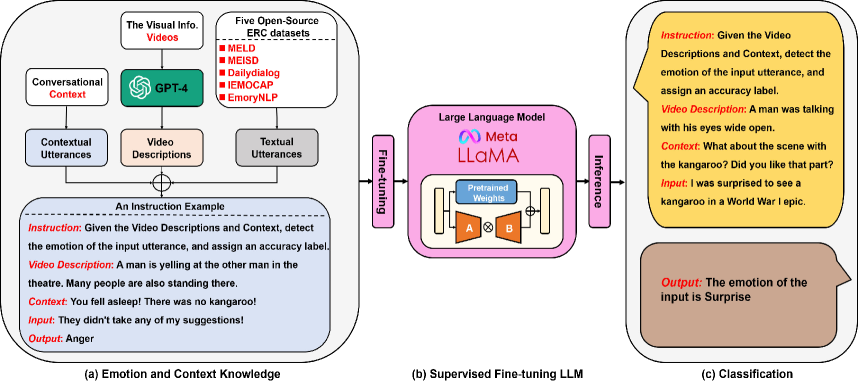
- Use LLaMA 2-7B as the base model and fine-tune with LoRA on emotion knowledge instructions.
- Construct an instruction dataset from MELD, IEMOCAP, and EmoryNLP with video-derived descriptions as supplementary knowledge.
- Treat ERC as a conditional generation task where the model outputs an emotion label given prompts.
- Incorporate contextual utterances and video descriptions into the prompt to guide emotion classification.
- Apply supervised instruction tuning on 24,304 utterances across 2,411 dialogues to align model with emotion-specific tasks.

Experimental results
Research questions
- RQ1Is an emotion-tailored LLM (DialogueLLM) effective for ERC tasks?
- RQ2Does incorporating conversational context and multi-modal information improve ERC performance?
- RQ3Can DialogueLLM demonstrate strong in-context learning capabilities for ERC in zero-shot and few-shot settings?
Key findings
- DialogueLLM achieves state-of-the-art performance across three ERC datasets, outperforming 15 baselines.
- On MELD, DialogueLLM attains an accuracy of 71.96% and a weighted F1 score of 71.81%.
- On IEMOCAP, DialogueLLM achieves an accuracy of 70.62% and a weighted F1 score of 69.93%.
- On EmoryNLP, DialogueLLM achieves an accuracy of 41.88% and a weighted F1 score of 40.05%.
- DialogueLLM shows margins of improvement of 5.36%, 1.03%, and 1.5% over respective baselines on three ERC tasks.
- Ablation studies confirm that context, LoRA, and video-derived descriptions each contribute to performance, with notable drops when any component is removed.
- Zero-shot and one-shot prompts yield competitive results, with limited gains as shots increase, suggesting stable but sensitive few-shot behavior.
Read this paper
Open the full text in the Nubint reader and ask about any passage as you read.
Read this paper on NubintThis review was generated by AI from the original paper. Please check the paper before citing it.