
[Paper Review] Diff-TTS: A Denoising Diffusion Model for Text-to-Speech
Diff-TTS proposes a non-autoregressive text-to-speech model based on denoising diffusion probabilistic models (DDPM) that generates high-fidelity, natural-sounding speech by learning mel-spectrogram distributions conditioned on text via likelihood-based optimization. It achieves 28× faster inference than real-time on a single GPU using accelerated sampling, while maintaining high perceptual quality and requiring 53% fewer parameters than Tacotron2 and Glow-TTS.
Although neural text-to-speech (TTS) models have attracted a lot of attention and succeeded in generating human-like speech, there is still room for improvements to its naturalness and architectural efficiency. In this work, we propose a novel non-autoregressive TTS model, namely Diff-TTS, which achieves highly natural and efficient speech synthesis. Given the text, Diff-TTS exploits a denoising diffusion framework to transform the noise signal into a mel-spectrogram via diffusion time steps. In order to learn the mel-spectrogram distribution conditioned on the text, we present a likelihood-based optimization method for TTS. Furthermore, to boost up the inference speed, we leverage the accelerated sampling method that allows Diff-TTS to generate raw waveforms much faster without significantly degrading perceptual quality. Through experiments, we verified that Diff-TTS generates 28 times faster than the real-time with a single NVIDIA 2080Ti GPU.
Motivation & Objective
- To develop a non-autoregressive TTS model that achieves high naturalness and architectural efficiency.
- To apply denoising diffusion models—previously successful in image and audio generation—to text-to-speech synthesis for improved sample quality and training stability.
- To enable controllable prosody variation through latent space variance and noise scaling without retraining.
- To accelerate inference speed via accelerated sampling while preserving perceptual quality.
- To reduce model size compared to autoregressive and flow-based TTS models without sacrificing audio fidelity.
Proposed method
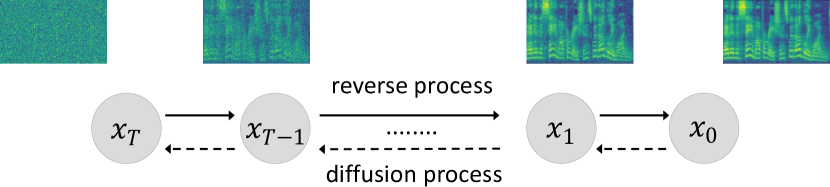
- Uses a denoising diffusion framework to transform a noise signal into a mel-spectrogram over T time steps, conditioned on text input.
- Employs a likelihood-based optimization objective derived from the DDPM framework to train the model without auxiliary losses.
- Applies a Markovian reverse diffusion process to generate mel-spectrograms from noise, starting from a Gaussian prior.
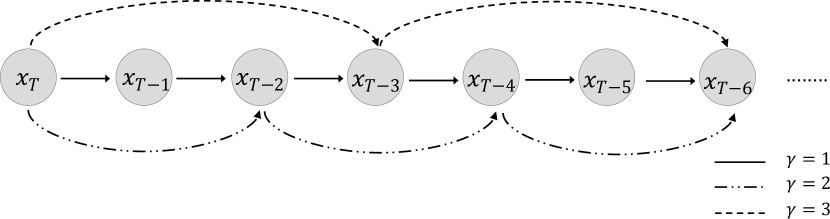
- Introduces accelerated sampling using a distillation-based method with a temperature scaling factor γ to reduce inference steps.
- Controls prosodic variability by modulating the variance of the latent space and additive noise using a temperature hyperparameter η.
- Uses a U-Net-based architecture for the denoising network, with cross-attention mechanisms to attend to text embeddings.
Experimental results
Research questions
- RQ1Can a denoising diffusion model be effectively applied to non-autoregressive text-to-speech synthesis with high perceptual quality?
- RQ2How does the proposed likelihood-based training objective compare to regression or flow-based objectives in terms of audio quality and model efficiency?
- RQ3To what extent can accelerated sampling reduce inference time without degrading speech quality?
- RQ4Can prosodic variability in synthesized speech be effectively controlled through latent space variance and noise scaling?
- RQ5How does the model size of Diff-TTS compare to state-of-the-art TTS models like Tacotron2 and Glow-TTS while maintaining high-fidelity output?
Key findings
- Diff-TTS achieves a Mean Opinion Score (MOS) of 4.337 with 95% confidence interval ±0.064, outperforming Tacotron2 (4.006) and Glow-TTS (4.160) despite using only 13.4M parameters—53% fewer than both.
- With accelerated sampling (γ=57), Diff-TTS achieves an inference speed of 0.035 RTF (28× faster than real-time) on a single NVIDIA 2080Ti GPU, while maintaining MOS comparable to Tacotron2.
- The model's inference speed can be tuned via the sampling parameter γ, allowing a trade-off between speed and quality based on computational constraints.
- Prosodic variability is controllable via a temperature term η: higher values (e.g., η=0.6) increase pitch variation and diversity without degrading quality.
- The model maintains high perceptual quality even at high acceleration levels, with MOS dropping only slightly from 4.337 (γ=1) to 4.091 (γ=57), indicating robustness to speed-up.
- Diff-TTS demonstrates that diffusion models can be effectively applied to TTS with stable training, architectural freedom, and superior parameter efficiency.
Read this paper
Open the full text in the Nubint reader and ask about any passage as you read.
Read this paper on NubintThis review was generated by AI from the original paper. Please check the paper before citing it.