
[Paper Review] Differential voltage analysis for battery manufacturing process control
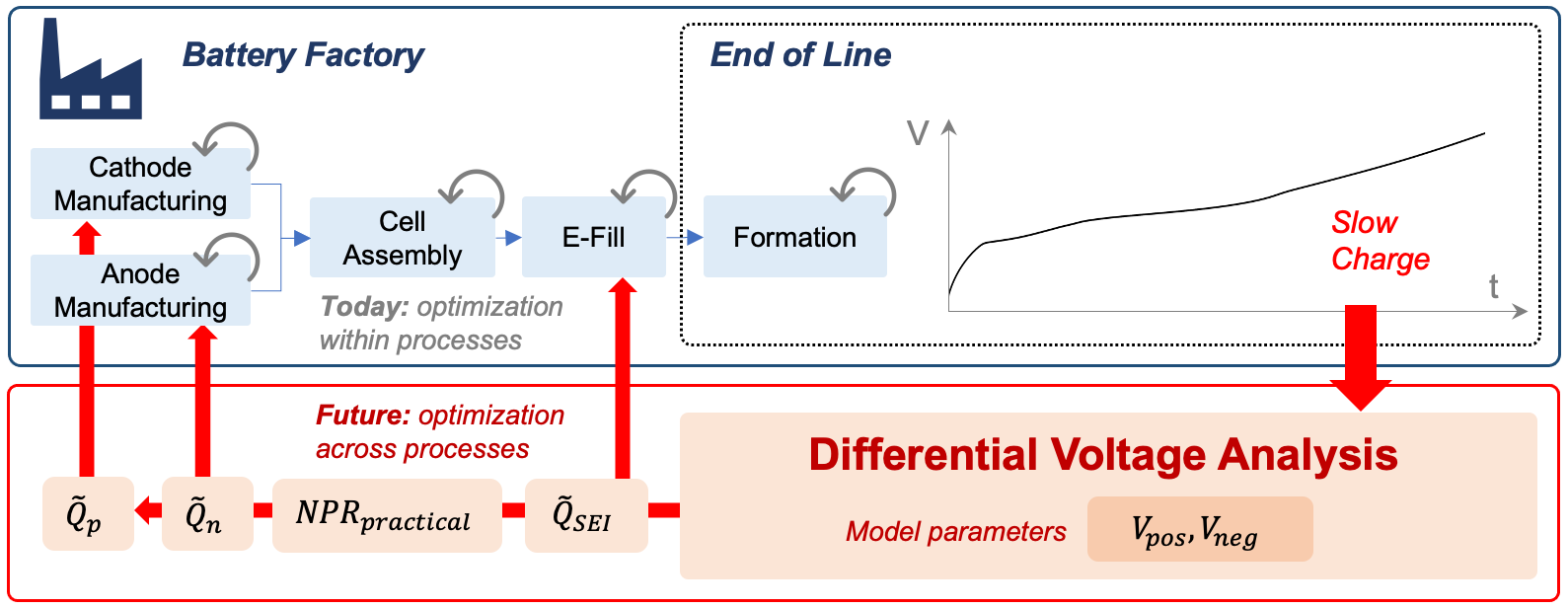
This paper presents an automated, reproducible differential voltage analysis (DVA) framework for end-of-line battery manufacturing process control, using full-cell voltage curves to extract electrochemically interpretable metrics such as lithium consumed during formation and practical negative-to-positive ratio. The method improves on traditional DVA by formalizing model uncertainty due to the 'inaccessible lithium problem' and enabling non-destructive, scalable diagnostics that link manufacturing variability to long-term cell performance.
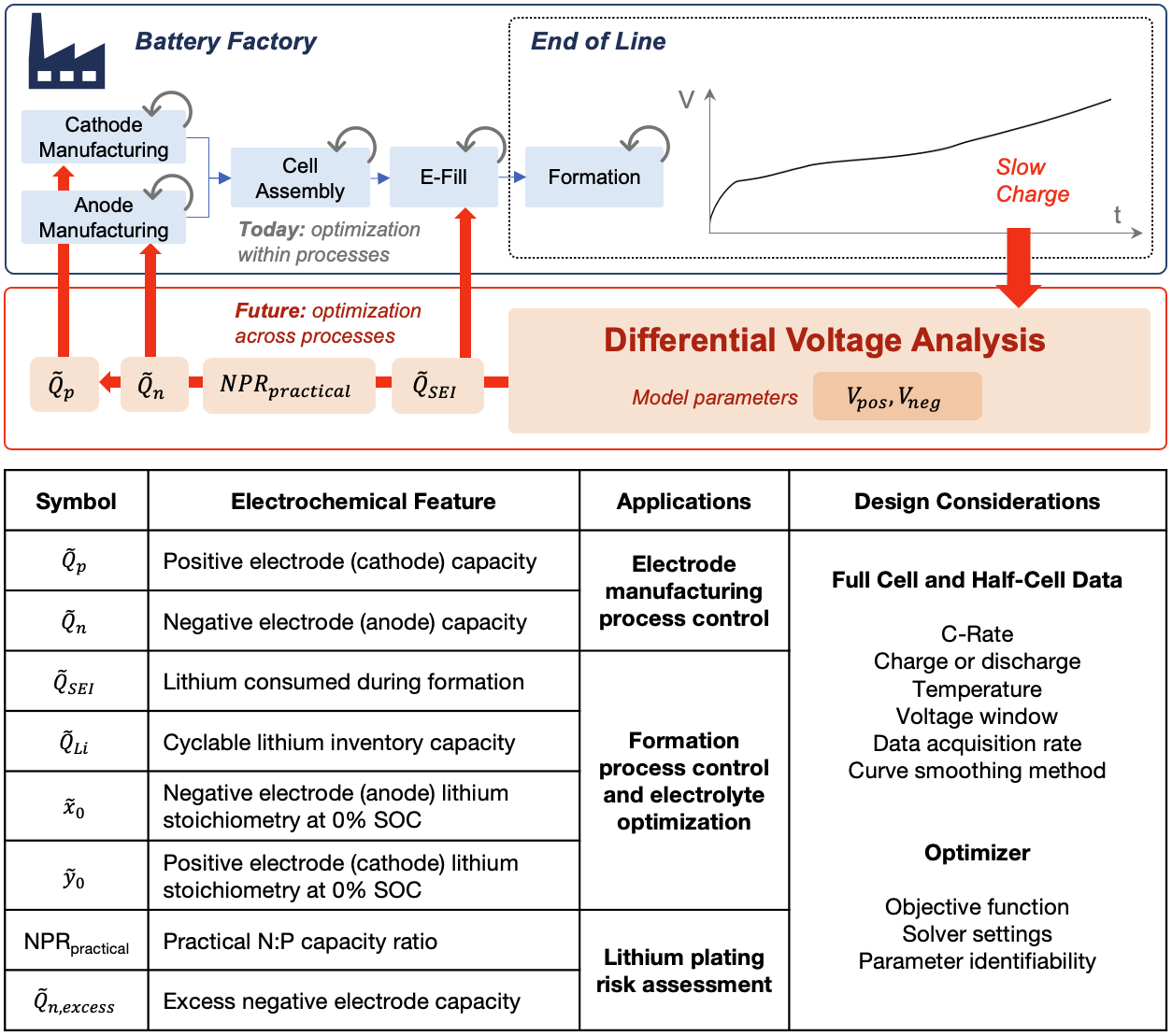
Voltage-based battery metrics are ubiquitous and essential in battery manufacturing diagnostics. They enable electrochemical "fingerprinting" of batteries at the end of the manufacturing line and are naturally scalable, since voltage data is already collected as part of the formation process which is the last step in battery manufacturing. Yet, despite their prevalence, interpretations of voltage-based metrics are often ambiguous and require expert judgment. In this work, we present a method for collecting and analyzing full cell near-equilibrium voltage curves for end-of-line manufacturing process control. The method builds on existing literature on differential voltage analysis (DVA or dV/dQ) by expanding the method formalism through the lens of reproducibility, interpretability, and automation. Our model revisions introduce several new derived metrics relevant to manufacturing process control, including lithium consumed during formation and the practical negative-to-positive ratio, which complement standard metrics such as positive and negative electrode capacities. To facilitate method reproducibility, we reformulate the model to account for the "inaccessible lithium problem" which quantifies the numerical differences between modeled versus true values for electrode capacities and stoichiometries. We finally outline key data collection considerations, including C-rate and charging direction for both full cell and half cell datasets, which may impact method reproducibility. This work highlights the opportunities for leveraging voltage-based electrochemical metrics for online battery manufacturing process control.
Motivation & Objective
- Address the ambiguity and expert-dependency in interpreting voltage-based metrics for battery manufacturing.
- Improve reproducibility and interpretability of differential voltage analysis (DVA) in end-of-line testing by formalizing model uncertainty.
- Develop new electrochemical features—such as lithium consumed during formation and practical negative-to-positive ratio—for direct use in process control.
- Enable automation of DVA for scalable, real-time manufacturing process monitoring using existing formation data.
- Provide clear data collection guidelines (C-rate, current direction, smoothing) to ensure model output reproducibility.
Proposed method
- Reformulate DVA using a physics-based electrochemical model that accounts for the 'inaccessible lithium problem' to correct for discrepancies between modeled and true electrode capacities and stoichiometries.
- Introduce a nonlinear least-squares optimization framework to fit full-cell voltage curves and estimate key parameters: positive/negative electrode capacities, initial stoichiometries, and lithium lost to SEI formation.
- Define new derived metrics including cyclable lithium inventory, practical negative-to-positive ratio (NP ratio), and excess negative electrode capacity from model outputs.
- Use both full-cell and half-cell voltage data to improve parameter identifiability and reduce uncertainty in model predictions.
- Apply data smoothing and careful C-rate selection to minimize noise-induced variability in DVA features.
- Implement the method in MATLAB and Python for end-to-end analysis, with open-source code and datasets publicly available.
Experimental results
Research questions
- RQ1How can differential voltage analysis be formalized to improve reproducibility and reduce expert dependency in battery manufacturing?
- RQ2What new electrochemical features can be derived from DVA that directly inform process control and long-term performance?
- RQ3How do variations in data collection protocols (C-rate, current direction, smoothing) affect the reproducibility of DVA-derived metrics?
- RQ4To what extent does the 'inaccessible lithium problem' introduce bias in DVA-based parameter estimation, and how can it be corrected?
- RQ5Can DVA detect meaningful manufacturing variability—such as differences in SEI formation or electrode loading—without destructive testing?
Key findings
- The reformulated DVA model successfully accounts for the inaccessible lithium problem, reducing systematic errors in estimated electrode capacities and stoichiometries.
- The method detected a three-fold difference in lithium consumed during SEI formation between two cell batches, revealing significant process variability without destructive analysis.
- Full-cell capacity variability in one batch was traced to variations in positive electrode loading, demonstrating the method’s ability to identify root causes of performance differences.
- The practical negative-to-positive ratio and cyclable lithium inventory were successfully estimated and shown to be sensitive to manufacturing deviations.
- Data collection parameters such as C-rate and current direction significantly affect model output reproducibility, with slower C-rates and consistent charging direction improving stability.
- The open-source implementation and publicly available datasets enable replication and integration into industrial process control pipelines.
Read this paper
Open the full text in the Nubint reader and ask about any passage as you read.
Read this paper on NubintThis review was generated by AI from the original paper. Please check the paper before citing it.