
[Paper Review] Differentially Private Diffusion Models Generate Useful Synthetic Images
The paper shows that privately fine-tuned diffusion models trained with pre-training and augmentation strategies can produce high-quality, privacy-preserving synthetic images that enable strong downstream classification performance and effective model selection.
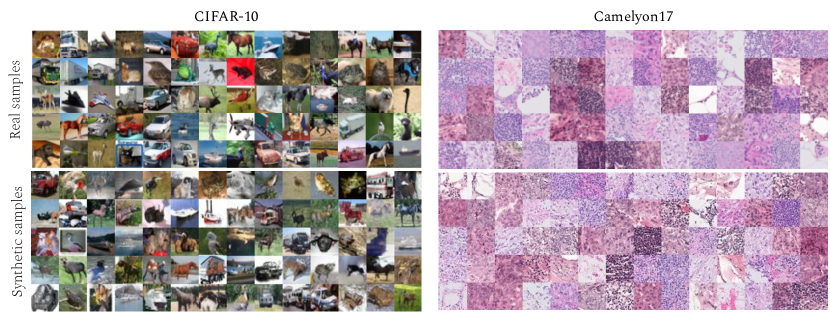
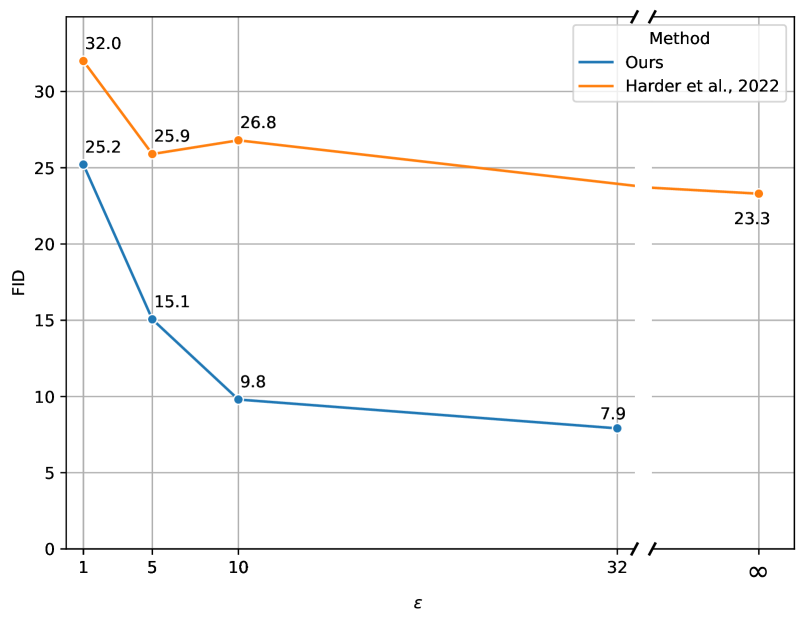
The ability to generate privacy-preserving synthetic versions of sensitive image datasets could unlock numerous ML applications currently constrained by data availability. Due to their astonishing image generation quality, diffusion models are a prime candidate for generating high-quality synthetic data. However, recent studies have found that, by default, the outputs of some diffusion models do not preserve training data privacy. By privately fine-tuning ImageNet pre-trained diffusion models with more than 80M parameters, we obtain SOTA results on CIFAR-10 and Camelyon17 in terms of both FID and the accuracy of downstream classifiers trained on synthetic data. We decrease the SOTA FID on CIFAR-10 from 26.2 to 9.8, and increase the accuracy from 51.0% to 88.0%. On synthetic data from Camelyon17, we achieve a downstream accuracy of 91.1% which is close to the SOTA of 96.5% when training on the real data. We leverage the ability of generative models to create infinite amounts of data to maximise the downstream prediction performance, and further show how to use synthetic data for hyperparameter tuning. Our results demonstrate that diffusion models fine-tuned with differential privacy can produce useful and provably private synthetic data, even in applications with significant distribution shift between the pre-training and fine-tuning distributions.
Motivation & Objective
- Demonstrate that diffusion models can be trained with differential privacy at scale (80M+ parameters) to produce useful synthetic images.
- Show that pre-training on public data (ImageNet) plus DP-SGD with augmentation strategies yields high utility under privacy constraints.
- Evaluate synthetic data utility for downstream classification and model selection across CIFAR-10 and Camelyon17.
- Provide practical guidelines (augmentation multiplicity, timestep sampling bias) to improve DP diffusion model performance.
Proposed method
- Pre-train diffusion models on public ImageNet data (ImageNet32) to bootstrap learning before DP fine-tuning.
- Apply DP-SGD with per-example gradient clipping and Gaussian noise, enabling privacy budgets (ε,δ).
- Use augmentation multiplicity across images and timesteps to amplify useful gradient information under DP.
- Bias diffusion timestep sampling to focus training on harder-to-learn mid-range timesteps, improving content learning.
- Fine-tune a diffusion model with over 80M parameters on CIFAR-10 and Camelyon17, using a privatized optimizer and adjusted hyperparameters.
- Evaluate synthetic data by training downstream classifiers on DP-generated images and comparing to real-data baselines.
Experimental results
Research questions
- RQ1Can large-scale diffusion models be effectively fine-tuned under differential privacy to produce useful synthetic images?
- RQ2Does ImageNet pre-training plus DP-SGD enable high-quality synthetic data for challenging datasets (CIFAR-10, Camelyon17) despite distribution shift?
- RQ3What augmentation and sampling strategies most improve DP diffusion model performance?
- RQ4How can synthetic data be leveraged for downstream tasks and hyperparameter tuning under privacy constraints?
Key findings
- On CIFAR-10, FID improved from 26.8 (SOTA) to 9.8 using DP diffusion models with ImageNet pre-training.
- Downstream classifier accuracy on CIFAR-10 rose from 51.0% to 88.0% when trained on DP-synthetic data.
- On Camelyon17, downstream accuracy achieved 91.1% with synthetic data, approaching the non-private SOTA of 96.5% on real data.
- MNIST experiment achieved 98.6% top-1 accuracy with DP diffusion, surpassing prior DP results on this task.
- Using larger synthetic datasets and ensembling further improved downstream accuracy without increasing privacy cost.
- Pre-training on public data plus DP-SGD enables high-quality synthetic data even under distribution shift (ImageNet32 → CIFAR-10, ImageNet32 → Camelyon17).
Read this paper
Open the full text in the Nubint reader and ask about any passage as you read.
Read this paper on NubintThis review was generated by AI from the original paper. Please check the paper before citing it.